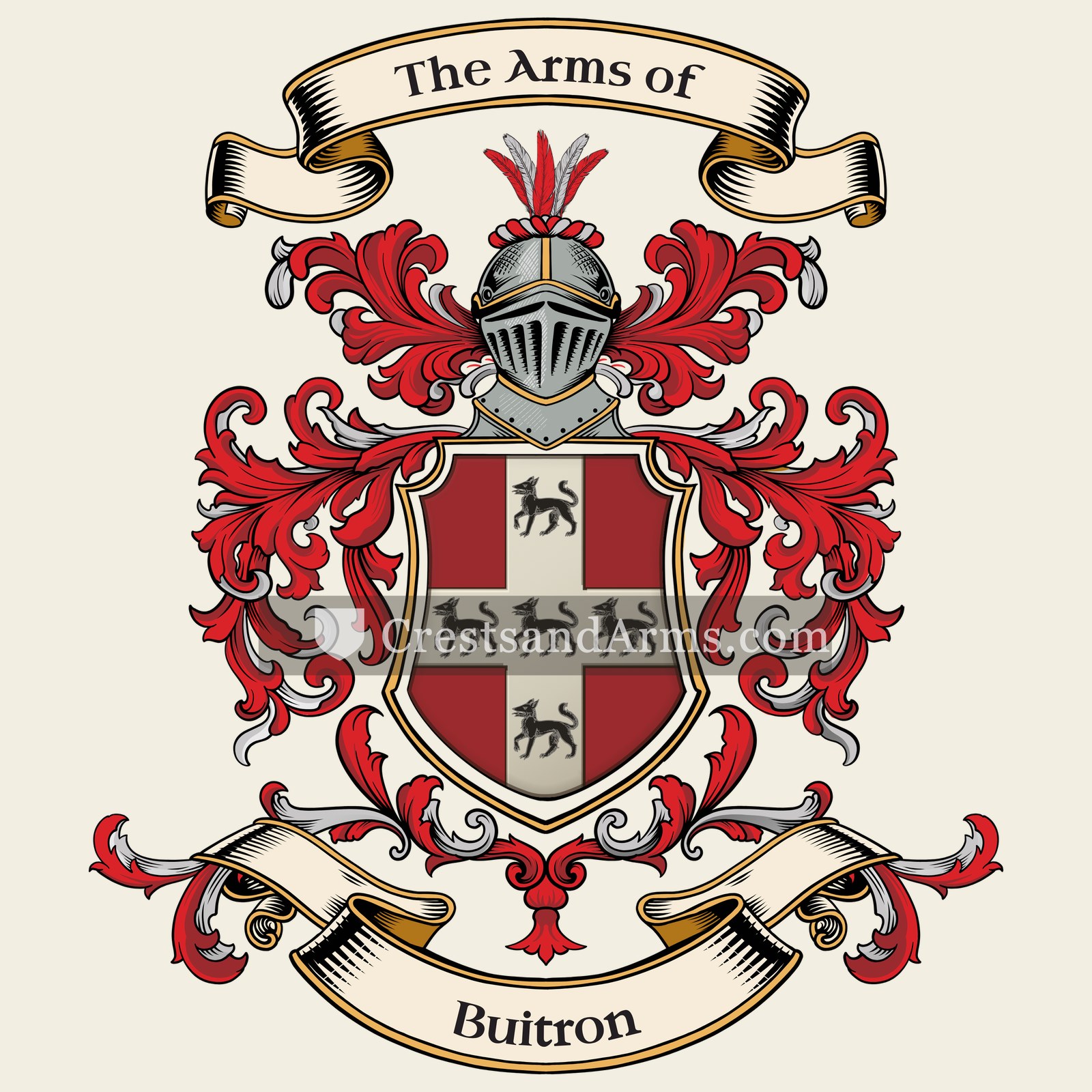
A record of documented arms, meaning and origin, researched for the Buitron family of Spain.
Reg. 4405 · Spanish, A–C
Coat of Arms & Family Crest Details
Symbols on this shield
cross symbolChristian faith and service
wolfReward from long service and hard work
Colours
Red (Gules)Means: Military strength
Silver (Argent)Means: Peace and sincerity
Black (Sable)Means: Constancy
Historical info
Source
J. B. Rietstap, Armorial Général, Gouda: G. B. van Goor Zonen, 1884–87
Blazon (the actual original written record)
“De gu. à la croix d'arg., ch. de cinq loups pass. de sa. et cant. de quatre filets en forme de sacs, posés dans la direction d'un sautoir, les ouvertures vers l'abîme.”
SpainBiscaye, c. 1722
Digital archive packCoat of arms PNG, gold border print PDF, vector SVG and the certificate of authenticity. Sent to your email in minutes.
Map of Spain showing where the Buitron arms are recorded
The Buitron arms were recorded in Biscaye, c. 1722.
This is where the arms were entered in the register. Families often moved to other parts of the country, so the same name can turn up in more than one region.
The body that granted and recorded arms in Spain in this period.
Philip V of Spain
Sovereign of the period
Philip V of Spain
1714–1724
Reigning in Spain when the Buitron arms are first recorded.
How Arms Worked in Spain
In Spain, a coat of arms was considered a form of property that belonged to the entire family line. These arms were passed down from a father to all his children equally. Younger branches of the family usually kept the original design without needing to add any special marks to distinguish their specific line.
Granting authority
The Cronista Rey de Armas was the official body that regulated and granted coats of arms throughout Spain.
How they got arms
Families often obtained their arms through royal grants or by proving their noble status to the official heraldic authority.
Where arms were recorded
Coats of arms were officially recorded in the registers of the Cronista Rey de Armas starting in 1496.
The family's standing
Recorded among the armigerous families of Spain.
Origin & History of the Buitron Family in Spain
The Buitron family name finds its historical roots in the rugged landscape of the Basque Country in northern Spain. By the early eighteenth century, the family was firmly established in the province of Biscay, a region known for its strong maritime traditions and independent spirit. The name itself is linked to the geography of the area, as it likely refers to a specific place or a fortified structure where early ancestors resided. During the 1700s, families in this region were often deeply connected to their local parishes, where their births, marriages, and deaths were carefully recorded in church registers. These records show that the Buitron family was part of the local social fabric, living through a time when the Basque provinces maintained unique legal and economic customs. As the family grew, they contributed to the agricultural and social development of their mountain communities, helping to shape the identity of the region long before the modern era.
Buitron Meaning & Related Branches
Root word
Buitre
A bird of prey belonging to the vulture family.
This name
BuitronA topographic or habitational name referring to a place frequented by vultures.
also spelled
Buytron
Bweetron
Documented Sources
J. B. Rietstap, Armorial Général, Gouda: G. B. van Goor Zonen, 1884–87
Caro Baroja, Julio, Los vascos, 1971
Douglass, William A., Basque Cultural Studies, 1999
Archivo Histórico Eclesiástico de Bizkaia, Registros Sacramentales de la Diócesis de Bilbao
Digital archive packCoat of arms PNG, gold border print PDF, vector SVG and the certificate of authenticity. Sent to your email in minutes.


 cross symbolChristian faith and service
 wolfReward from long service and hard work
 cross symbolChristian faith and service
 wolfReward from long service and hard work