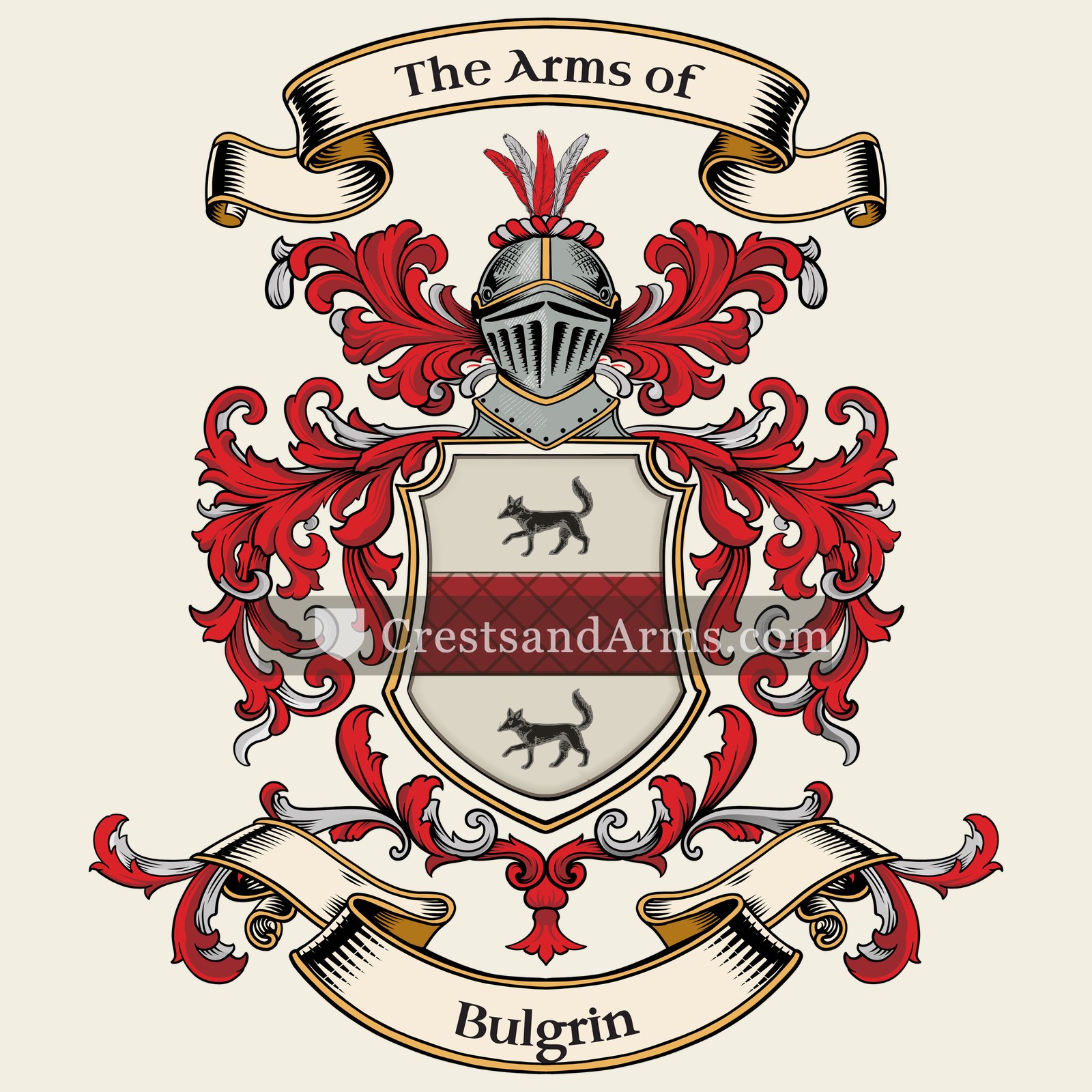
A record of documented arms, meaning and origin, researched for the Bulgrin family of Germany.
Reg. 6435 · German, A–C
Coat of Arms & Family Crest Details
Symbols on this shield
fessThe military belt, and readiness to serve
foxWit and wisdom in defence
Colours
Silver (Argent)Means: Peace and sincerity
Red (Gules)Means: Military strength
Black (Sable)Means: Constancy
Historical info
Source
J. B. Rietstap, Armorial Général, Gouda: G. B. van Goor Zonen, 1884–87
Blazon (the actual original written record)
“D'arg. à la fasce de gu., acc. de deux renards courants de sa., cour. d'or, 1 en chef et 1 en p. C.: trois piques renv. d'arg., soutenues chacune d'une rose de gu.”
PomeraniaPomerania, c. 1730
Digital archive packCoat of arms PNG, gold border print PDF, vector SVG and the certificate of authenticity. Sent to your email in minutes.
Map of Germany showing where the Bulgrin arms are recorded
The Bulgrin arms were recorded in Pomerania, c. 1730.
Pomerania was flat farming country on the Baltic coast, held in large estates by a small number of families. They kept their land for generations, and generations of landholding is what fills the registers.
This is where the arms were entered in the register. Families often moved to other parts of the country, so the same name can turn up in more than one region.
The body that granted and recorded arms in Germany in this period.
Charles VI, Holy Roman Emperor
Sovereign of the period
Charles VI, Holy Roman Emperor
1711–1740
Reigning in Germany when the Bulgrin arms are first recorded.
How Arms Worked in Germany
In the Holy Roman Empire, coats of arms were often granted to individuals by the Emperor or his representatives. These arms were then passed down through the generations to all legitimate descendants of the original holder. Younger branches of a family usually kept the same shield design without needing to change it, as the arms belonged to the entire lineage.
Granting authority
The Holy Roman Emperor held the sole power to grant new coats of arms throughout his vast imperial territories.
How they got arms
Families typically obtained their coats of arms through a formal imperial grant or by proving their noble status to the authorities.
Where arms were recorded
These grants were officially recorded in the Imperial Chancery registers, which began keeping formal records of such honors during the Middle Ages.
The family's standing
Recorded among the armigerous families of Pomerania.
Origin & History of the Bulgrin Family in Germany
The family name Bulgrin is deeply rooted in the historical region of Pomerania, where records confirm the presence of family members as early as 1730. The name likely originated as a descriptive nickname or a locational identifier common among the German-speaking populations of the Baltic coast. During the eighteenth century, the region was characterized by a mix of agricultural life and shifting political borders under the Kingdom of Prussia. Families like the Bulgrins were often part of the rural middle class or farming communities that sustained the local economy. As these families moved through the Pomeranian landscape, they maintained strong ties to their local parishes, which served as the primary centers for documenting births, marriages, and deaths. Over time, the name became a permanent fixture of the region, reflecting the resilience of families who lived through the complex social changes of northern Europe.
Bulgrin Meaning & Related Branches
Root word
Bulger
A person who is a maker or seller of leather bags.
This name
BulgrinA locative or occupational surname derived from Middle High German terms for a bag maker.
also spelled
Bulgryne
Related arms
Kleistsimilar arms
Kleist de Wendisch-Tychowsimilar arms
Kleist de Zützensimilar arms
Meseritzsimilar arms
Documented Sources
J. B. Rietstap, Armorial Général, Gouda: G. B. van Goor Zonen, 1884–87
Behr, Hans-Joachim. Die Geschichte Pommerns. 2004
State Archive in Szczecin (Archiwum Państwowe w Szczecinie), Kirchenbücher der Provinz Pommern
Digital archive packCoat of arms PNG, gold border print PDF, vector SVG and the certificate of authenticity. Sent to your email in minutes.


 fessThe military belt, and readiness to serve
 foxWit and wisdom in defence
 fessThe military belt, and readiness to serve
 foxWit and wisdom in defence