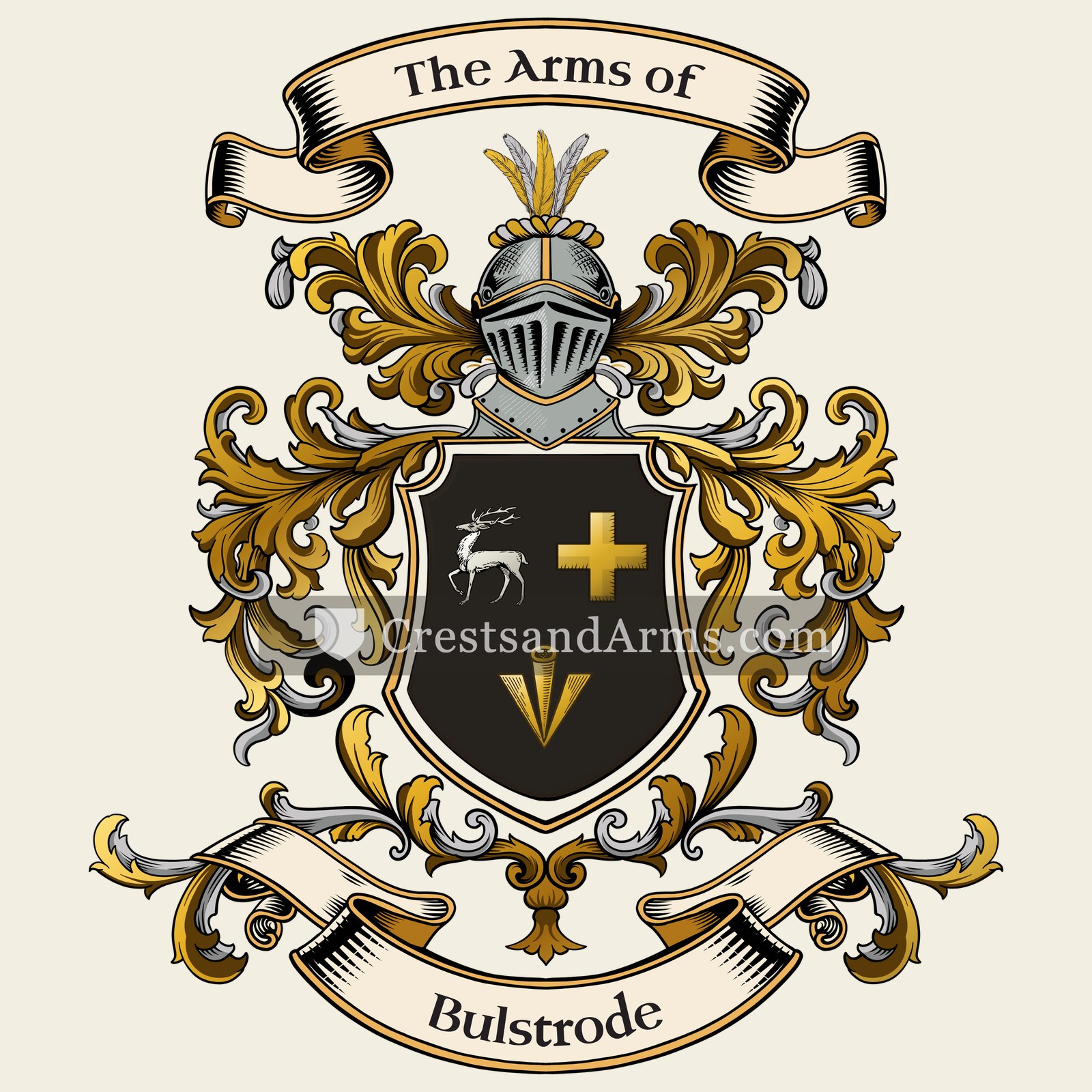
A record of documented arms, meaning and origin, researched for the Bulstrode family lines. Documented in 2 countries.
Reg. 0486 · French, A–C
Coat of Arms & Family Crest Details
Symbols on this shield
stagPeace and harmony, and one who will not fight unprovoked
Colours
Black (Sable)Means: Constancy
Silver (Argent)Means: Peace and sincerity
Historical info
Source
J. B. Rietstap, Armorial Général, Gouda: G. B. van Goor Zonen, 1884–87
Blazon (the actual original written record)
“De sa. au rencontre de cerf d'arg., tenant ses dents une flèche d'arg., en fasce, et ayant entre sa ramure une croix pattée au pied fiché d'or. C.: une tête et col de boeuf de gu., accornée d'arg.; entre un vol de gu. ou d'arg.”
BedfordshireBedfordshire, c. 1725
Digital archive packCoat of arms PNG, gold border print PDF, vector SVG and the certificate of authenticity. Sent to your email in minutes.
Map of France showing where the Bulstrode arms are recorded
The Bulstrode arms were recorded in Bedfordshire, c. 1725.
This is where the arms were entered in the register. Families often moved to other parts of the country, so the same name can turn up in more than one region.
The body that granted and recorded arms in France in this period.
Louis XV of France
Sovereign of the period
Louis XV of France
1715–1774
Reigning in France when the Bulstrode arms are first recorded.
How Arms Worked in France
In France, a coat of arms was a mark of honor that passed down through the male line to all legitimate descendants. Families often used the same shield without changes to show their shared heritage. If a branch wanted to stand out, they could add a small mark to their shield to show their specific place in the family tree.
Granting authority
The Juge d'armes de France acted as the official authority that regulated and verified coats of arms across the country.
How they got arms
Families typically inherited their arms from ancestors, though they could also receive them through royal grants or by proving their noble status.
Where arms were recorded
Coats of arms were officially recorded in the Armorial Général de France, which began its main collection in the year 1696.
The family's standing
Recorded among the armigerous families of Bedfordshire.
Origin & History of the Bulstrode Family in France
The name Bulstrode is traditionally linked to the ancient landscape of Buckinghamshire and Bedfordshire, where the family established deep roots long before the eighteenth century. While the name sounds distinctly English, some historians suggest the lineage may have originated from the French word *boule*, meaning a round hill or a swelling, combined with a term for a marshy crossing. This points to a time when families often took their names from the specific geography of their land. By the time the family was well-documented in Bedfordshire in 1725, they had already spent generations integrating into the local gentry. Their early history reflects the movement of people across the English Channel during the medieval period, as families with French linguistic influences settled into the rural English countryside to manage estates and participate in local governance.
Coat of Arms & Family Crest Details
Symbols on this shield
cross symbolChristian faith and service
stagPeace and harmony, and one who will not fight unprovoked
arrowReadiness for battle, and affliction endured
Colours
Black (Sable)Means: Constancy
Silver (Argent)Means: Peace and sincerity
Gold (Or)Means: Generosity
Historical info
Source
Sir Bernard Burke, The General Armory of England, Scotland, Ireland and Wales, London: Harrison & Sons, 1884
Blazon (the actual original written record)
“Sa. a stag's head cabossed ar. attired or, betw. the attires a cross pattée fitchée of the third, through the nostrils an arrow of the last feathered of the second”
WorcesterCollege · Worcester, c. 1620
Digital archive packCoat of arms PNG, gold border print PDF, vector SVG and the certificate of authenticity. Sent to your email in minutes.
Map of England showing where the Bulstrode arms are recorded
The Bulstrode arms were recorded in Worcester, c. 1620.
Worcestershire was orchard and farming country with a scattering of old manors. Its gentry were middling rather than great, but a manor was a manor, and holding one was what brought arms.
This is where the arms were entered in the register. Families often moved to other parts of the country, so the same name can turn up in more than one region.
The body that granted and recorded arms in England in this period.
James VI and I
Sovereign of the period
James VI and I
1603–1625
Reigning in France when the Bulstrode arms are first recorded.
How Arms Worked in England
English heraldry allowed arms to be shared by all legitimate descendants of the original owner. These symbols were treated as personal property that moved through the generations to all children. While the eldest son kept the original design, other family members could use the same shield without needing to change it or register their own unique versions.
Granting authority
The College of Arms in London has regulated the use of coats of arms throughout England and Wales since 1484.
How they got arms
Families typically obtained their coats of arms through a formal grant from the Crown or by proving their ancient right to them.
Where arms were recorded
All official coats of arms are recorded in the registers kept at the College of Arms, which date back to the fifteenth century.
The family's standing
Recorded among the armigerous families of Worcester.
Origin & History of the Bulstrode Family in England
The family name Bulstrode originates from the landscape of medieval England, specifically drawing its roots from a place name in Buckinghamshire. The name is derived from the Old English words for a bull and a marsh, suggesting that the earliest ancestors lived near a swampy area frequented by cattle. By the early seventeenth century, the family had established a notable presence in Worcester, where they were integrated into the local community by 1620. During this period, the family members were often involved in the professional and civic life of the region, reflecting the broader movement of gentry and merchant families who helped shape the social structure of English provincial towns. Their transition from a rural, land-based identity to active participants in urban life highlights the shifting nature of family influence during the early modern era.
Bulstrode Meaning & Related Branches
Root word
Bull and Strod
A male bovine animal and a marshy or overgrown piece of land.
This name
BulstrodeRefers to a person living near a marshy area frequented by bulls.
also spelled
Bulstrod
Bolstrode
Bulstred
Bulstrood
Bulstroad
Related arms
Bolstrodevariant spelling
Documented Sources
J. B. Rietstap, Armorial Général, Gouda: G. B. van Goor Zonen, 1884–87
Bardsley, Charles Wareing, A Dictionary of English and Welsh Surnames, 1901
Lipscomb, George, The History and Antiquities of the County of Buckingham, 1847


 stagPeace and harmony, and one who will not fight unprovoked
 stagPeace and harmony, and one who will not fight unprovoked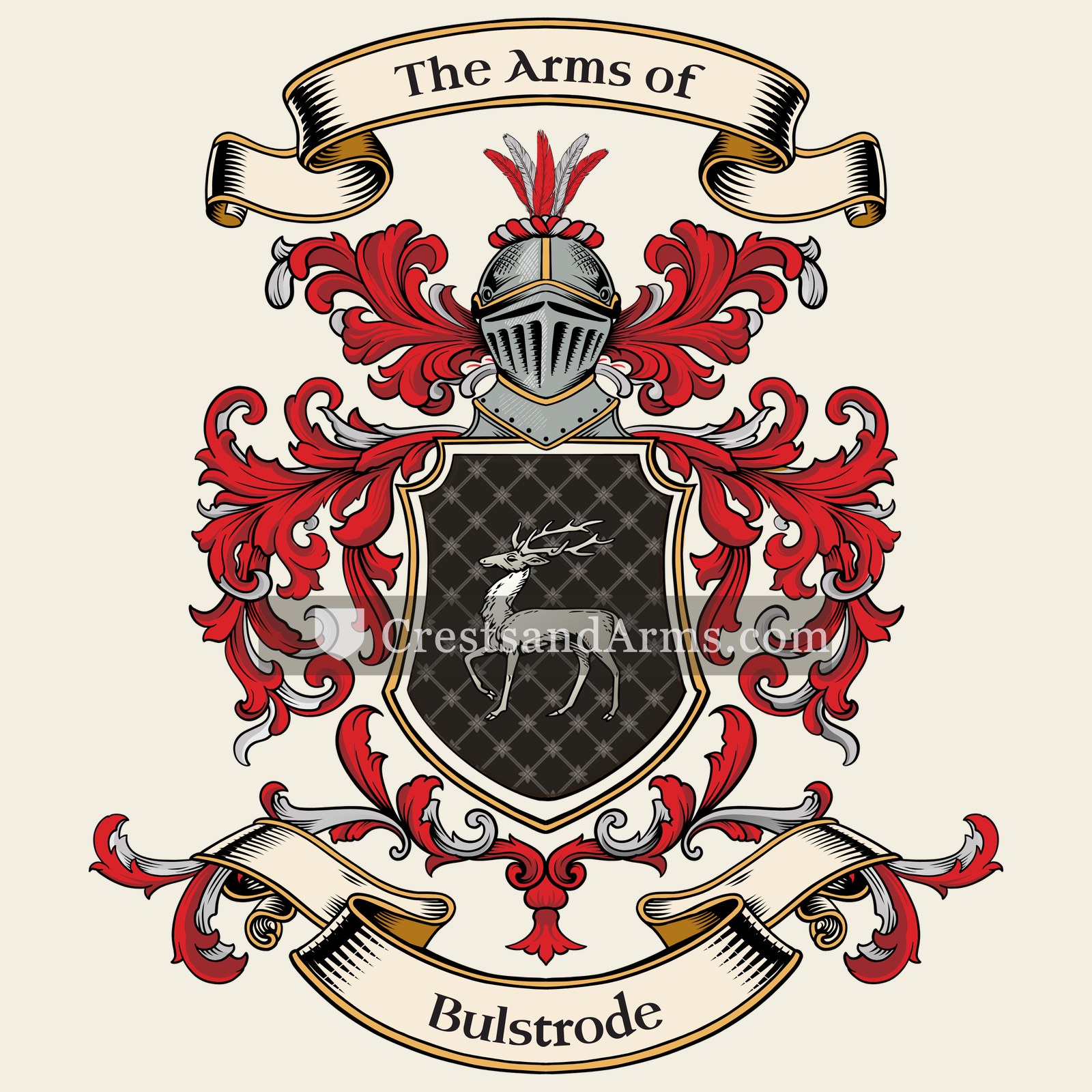


 cross symbolChristian faith and service
 arrowReadiness for battle, and affliction endured