Map of Germany showing where the Bumbaca arms are recorded
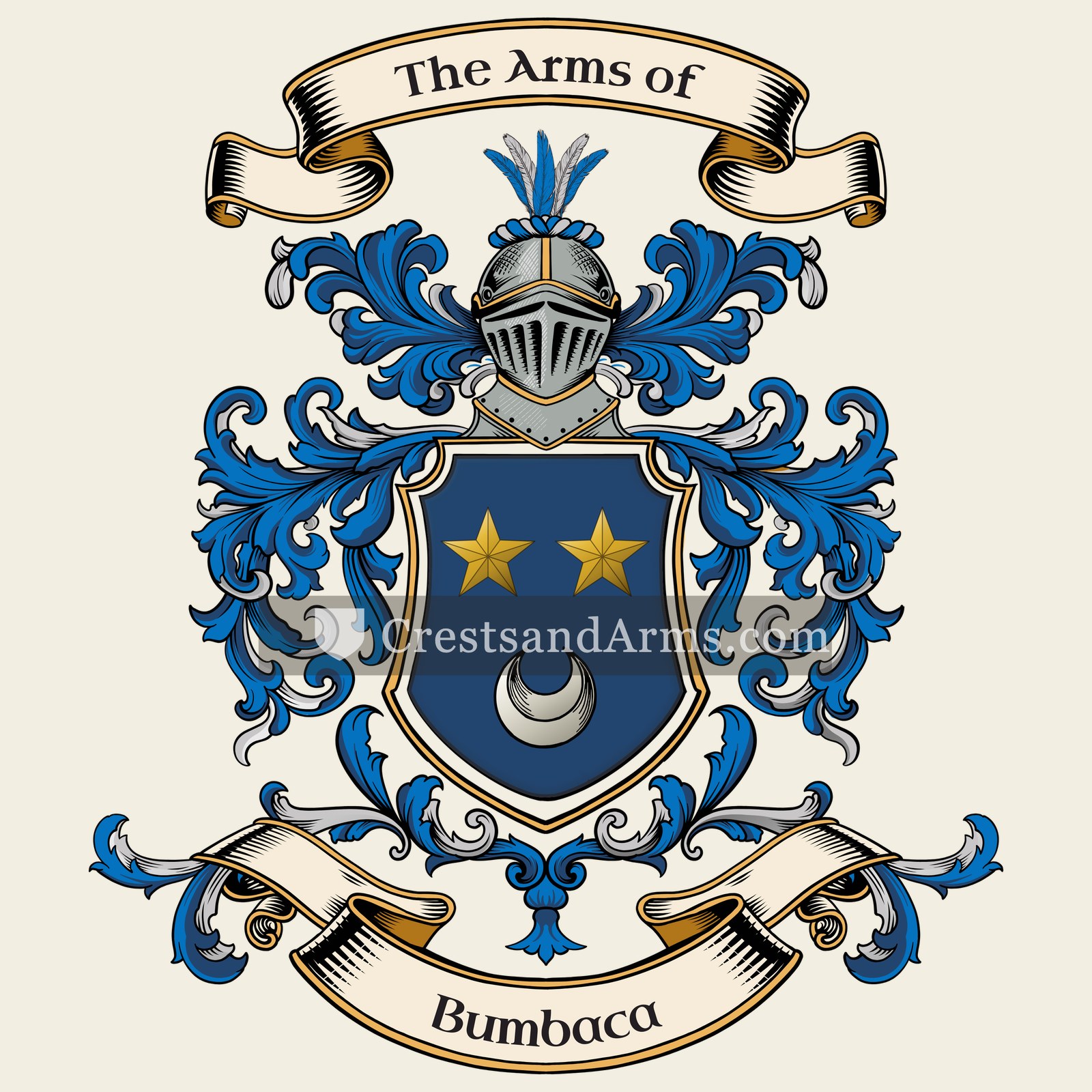
The Bumbaca arms were recorded in Hesse, c. 1858.
Hesse was central German country, divided among a large number of small landowners and prosperous towns. So many separate households held ground there that the region produced an unusual number of coats of arms.
This is where the arms were entered in the register. Families often moved to other parts of the country, so the same name can turn up in more than one region.
The body that granted and recorded arms in Germany in this period.
Frederick William IV of Prussia
Sovereign of the period
Frederick William IV of Prussia
1840–1861
Reigning in Germany when the Bumbaca arms are first recorded.
How Arms Worked in Germany
Prussian heraldry was strictly tied to social rank and noble status rather than being a free choice for every citizen. These symbols were treated as permanent family property that moved through the generations to all legitimate heirs. If a family branch wanted to change their design to stand out, they had to apply for official permission to alter their specific version of the shield.
Granting authority
The Prussian Heroldsamt acted as the central state office that managed and strictly controlled all noble titles and coats of arms.
How they got arms
Families usually obtained their arms through formal royal grants or by proving their long-standing noble status to the state authorities.
Where arms were recorded
All official coats of arms were kept in the rolls of the Prussian Heroldsamt, which functioned from 1706 until 1918.
The family's standing
Recorded among the armigerous families of Hesse.
Origin & History of the Bumbaca Family in Germany
The family name Bumbaca carries a history rooted in the cultural crossroads of Central Europe. While the name is often associated with Mediterranean linguistic patterns, official records confirm that members of the family were established in the German state of Hesse by 1858. During this period, Hesse was a region defined by rapid industrial growth and shifting social structures, which likely influenced the family's movement and daily life. Families living in this area during the mid-nineteenth century were often involved in skilled trades or agricultural management as the local economy transitioned toward modernization. By maintaining a presence in Hesse, the early Bumbaca family members became part of the complex demographic tapestry of the German Confederation, reflecting a legacy of migration and integration into the heart of Europe.
Related Branches & Arms
Root word
Bombax
Latin term for the cotton plant or silk-cotton tree.
This name
BumbacaLikely an occupational or topographic name referring to a merchant or grower of cotton-like fibers.
also spelled
Baumbak
Bowmbak
Documented Sources
J. B. Rietstap, Armorial Général, Gouda: G. B. van Goor Zonen, 1884–87


 crescentHonour by the sovereign, and the second son
 mulletThe third son, and a divine quality from above
 crescentHonour by the sovereign, and the second son
 mulletThe third son, and a divine quality from above