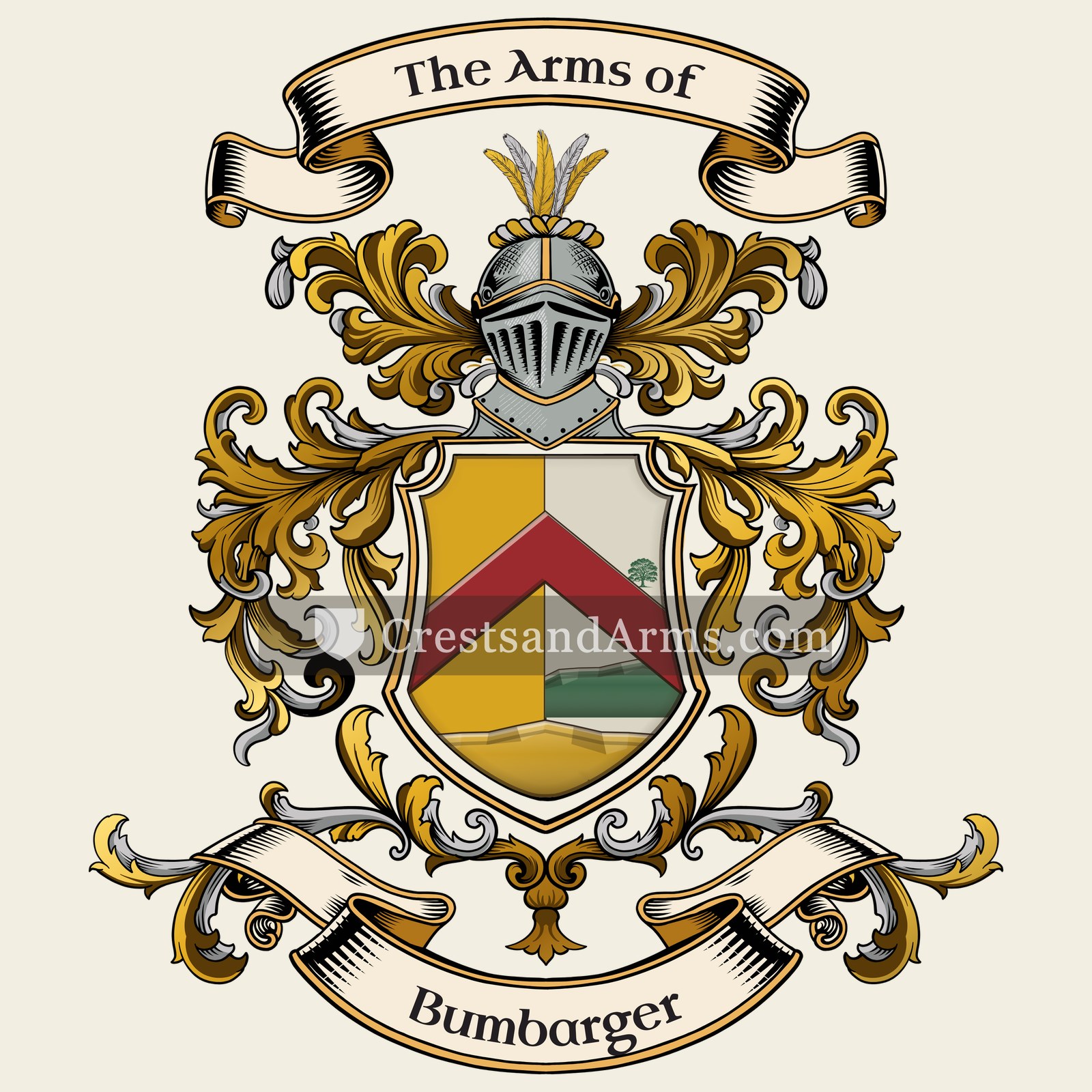
A record of documented arms, meaning and origin, researched for the Bumbarger family lines. Documented in 2 countries.
Reg. 0013 · Swiss, A–C
Coat of Arms & Family Crest Details
Symbols on this shield
chiefAuthority, wisdom and dominion
treeLife, endurance and deep roots
fleur de lisPurity, light, and the sixth son
Colours
Gold (Or)Means: Generosity
Red (Gules)Means: Military strength
Blue (Azure)Means: Loyalty and truth
Green (Vert)Means: Hope
Silver (Argent)Means: Peace and sincerity
Historical info
Source
J. B. Rietstap, Armorial Général, Gouda: G. B. van Goor Zonen, 1884–87
Blazon (the actual original written record)
“D'or à un arbre arr. de sin.; le champ chapé-ployé de gu.; au chef d'azur, ch. de trois fleurs-de-lis d'arg. C.: un More iss., posé de profil, tenant de sa main dextre l'arbre arr. et de sa sen. une massue au nat.”
SwitzerlandBâle, c. 1745
Digital archive packCoat of arms PNG, gold border print PDF, vector SVG and the certificate of authenticity. Sent to your email in minutes.
Map of Switzerland showing where the Bumbarger arms are recorded
The Bumbarger arms were recorded in Bâle, c. 1745.
This is where the arms were entered in the register. Families often moved to other parts of the country, so the same name can turn up in more than one region.
The body that granted and recorded arms in Switzerland in this period.
How Arms Worked in Switzerland
In Switzerland, coats of arms were not restricted to the nobility and were often adopted by common citizens and families. These symbols were passed down through generations to show family identity. When branches of a family grew, they often changed small details of the design to distinguish their own line from the original group.
Granting authority
Cantonal and civic authorities managed the use of coats of arms within their specific regions and local jurisdictions.
How they got arms
Families typically assumed their own coats of arms based on local custom rather than receiving them from a central monarch.
Where arms were recorded
Arms were recorded in various cantonal and civic registers starting from the fourteenth century throughout the Swiss region.
The family's standing
Recorded among the armigerous families of Switzerland.
Origin & History of the Bumbarger Family in Switzerland
The name Bumbarger traces its roots to the German-speaking regions of Switzerland, where it emerged as a descriptive identifier for families living near specific geographic features or working in traditional trades. By the middle of the eighteenth century, the family was well-established in the city of Bâle, a major cultural and economic hub situated along the Rhine River. In 1745, records indicate that members of the family were active participants in the local community, likely navigating the complex guild systems that defined life in Swiss urban centers at the time. As residents of Bâle, these early ancestors lived in a city known for its intellectual vibrancy and its role as a gateway between the Swiss Confederation and the surrounding European territories. The family name reflects this period of regional stability, serving as a linguistic link to the ancestral landscape and the social structures that supported their daily lives in the mid-1700s.
Coat of Arms & Family Crest Details
Symbols on this shield
chevronProtection, and faithful service completed
mountThe ground held, and steadfastness upon it
treeLife, endurance and deep roots
Colours
Gold (Or)Means: Generosity
Silver (Argent)Means: Peace and sincerity
Red (Gules)Means: Military strength
Green (Vert)Means: Hope
Historical info
Source
J. B. Rietstap, Armorial Général, Gouda: G. B. van Goor Zonen, 1884–87
Blazon (the actual original written record)
“Parti: au 1 d'or au chev. de gu.; au 2 d'arg. à l'arbre de sin., posé sur une colline d'or. Deux cq. cour. C.: 1° une tête et col d'aigle cont. de sa., cour. et bq. d'or, languée de gu.: l. d'or et de gu.; 2° trois plumes d'aut., une d'arg. entre deux de gu.; l. d'arg. et de gu. S.: deux aigles de Prusse, reg.”
Germanyc. 1789
Digital archive packCoat of arms PNG, gold border print PDF, vector SVG and the certificate of authenticity. Sent to your email in minutes.
Map of Germany showing where the Bumbarger arms are recorded
The Bumbarger arms were recorded in Germany, c. 1789.
Arms such as these were typically recorded in Bavaria.
Bavaria was a country of old landed families and walled market towns. Estates passed down the same line for centuries, and both the landowners and the leading townsmen kept arms, which is why so many Bavarian names sit in the registers.
This is where the arms were entered in the register. Families often moved to other parts of the country, so the same name can turn up in more than one region.
The body that granted and recorded arms in Germany in this period.
Joseph II, Holy Roman Emperor
Sovereign of the period
Joseph II, Holy Roman Emperor
1765–1790
Reigning in Switzerland when the Bumbarger arms are first recorded.
How Arms Worked in Germany
In the Holy Roman Empire, coats of arms were often granted to individuals by the Emperor or his representatives. These arms were then passed down through the generations to all legitimate descendants of the original holder. Younger branches of a family usually kept the same shield design without needing to change it, as the arms belonged to the entire lineage.
Granting authority
The Holy Roman Emperor held the sole power to grant new coats of arms throughout his vast imperial territories.
How they got arms
Families typically obtained their coats of arms through a formal imperial grant or by proving their noble status to the authorities.
Where arms were recorded
These grants were officially recorded in the Imperial Chancery registers, which began keeping formal records of such honors during the Middle Ages.
The family's standing
Recorded among the armigerous families of Germany.
Origin & History of the Bumbarger Family in Germany
The family name Bumbarger is rooted in the historical landscape of southern Germany, specifically within the region of Bavaria. During the late 18th century, the name was associated with families living in rural or semi-rural settings, where surnames often reflected a person’s occupation or their specific connection to the land. By 1789, records indicate that members of the Bumbarger family were established in Bavarian communities, likely participating in the agricultural traditions that defined the region at that time. Given the linguistic patterns of the area, the name likely evolved from local dialects used to describe people who lived near specific geographic features or worked in particular trades. These early ancestors were part of a stable social structure where families often remained in the same villages for generations, helping to preserve the name as they navigated the significant political and social changes occurring across the German states during the late 1700s.
Bumbarger Meaning & Related Branches
Root word
Baumberger
A person who originates from a place characterized by trees or woods.
This name
BumbargerAn occupational or habitational name for someone living near a prominent tree or forest area.
also spelled
Baumbergerr
Baumbergere
Bowmberger
Documented Sources
J. B. Rietstap, Armorial Général, Gouda: G. B. van Goor Zonen, 1884–87
Staatsarchiv Basel-Stadt, Kirchenbücher der Stadt Basel (1745)
Frey, Daniel, Die Geschichte der Stadt Basel, 1934
Suter, Andreas, Der schweizerische Bauernkrieg von 1653: Politische Sozialgeschichte – Sozialgeschichte eines politischen Konflikts, 1997
Digital archive packCoat of arms PNG, gold border print PDF, vector SVG and the certificate of authenticity. Sent to your email in minutes.


 chiefAuthority, wisdom and dominion
 treeLife, endurance and deep roots
 fleur de lisPurity, light, and the sixth son
 chiefAuthority, wisdom and dominion
 treeLife, endurance and deep roots
 fleur de lisPurity, light, and the sixth son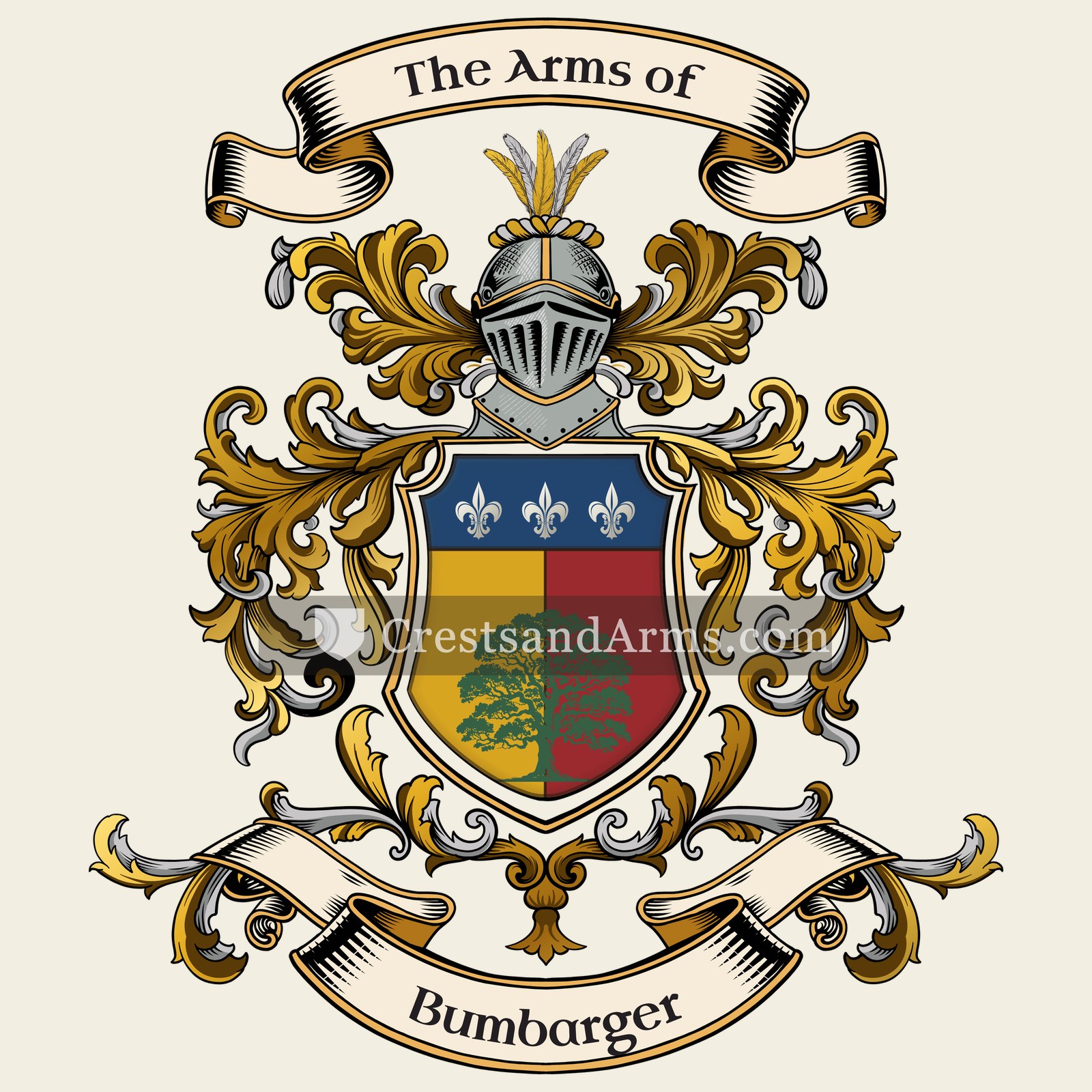

 chevronProtection, and faithful service completed
 mountThe ground held, and steadfastness upon it