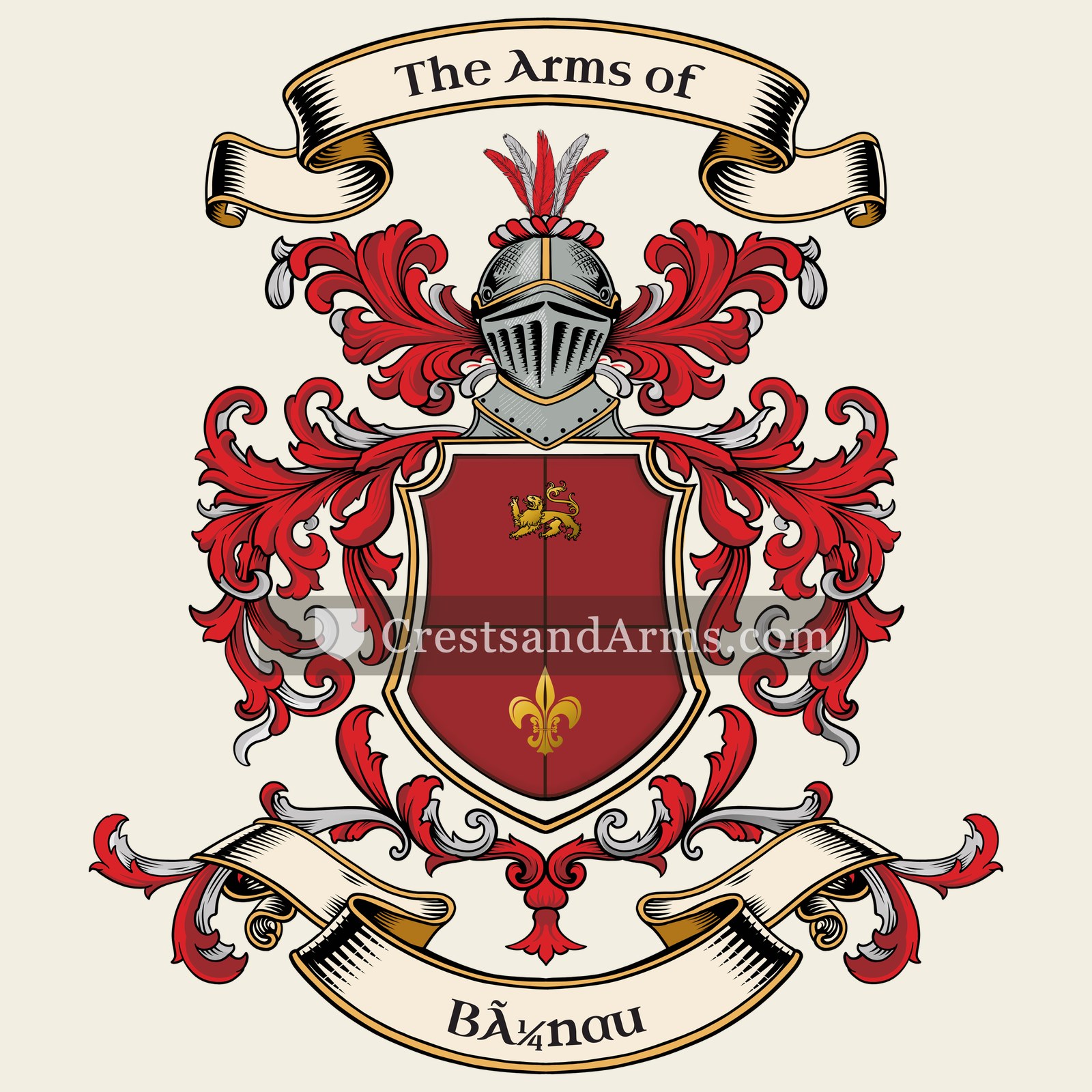
A record of documented arms, meaning and origin, researched for the Bünau family of Germany.
Reg. 9542 · German, A–C
Coat of Arms & Family Crest Details
Symbols on this shield
lionCourage, strength and royalty
fleur de lisPurity, light, and the sixth son
Colours
Red (Gules)Means: Military strength
Gold (Or)Means: Generosity
Historical info
Source
J. B. Rietstap, Armorial Général, Gouda: G. B. van Goor Zonen, 1884–87
Blazon (the actual original written record)
“Ec.: aux 1 et 4 parti de gu. et d'arg.; aux 2 et 3 de gu. à une tête de léopard d'or en chef et une fleur-de-lis du même en p. Deux cq., le 1 cour. C.: 1° un vol, de gu. et d'azur; l. d'arg. et de gu.; 2° un chapeau de gu., retr. d'arg., accoste de deux bâtons d'or, sommés chacun de cinq plumes de paon au nat.; l. d'or et de gu. S.: deux léopards reg., au nat. [Les barons et les gentilshommes du nom portent les mêmes armes sans supports.]”
SaxonySaxony, c. 1741
Digital archive packCoat of arms PNG, gold border print PDF, vector SVG and the certificate of authenticity. Sent to your email in minutes.
Map of Germany showing where the Bünau arms are recorded
The Bünau arms were recorded in Saxony, c. 1741.
Saxony had mines, trade and old landed families all at once. Silver made some fortunes and land held others, and both sorts of family kept arms, which is why Saxon names appear so often in the registers.
This is where the arms were entered in the register. Families often moved to other parts of the country, so the same name can turn up in more than one region.
The body that granted and recorded arms in Germany in this period.
How Arms Worked in Germany
In the Holy Roman Empire, coats of arms were often granted to individuals by the Emperor or his representatives. These arms were then passed down through the generations to all legitimate descendants of the original holder. Younger branches of a family usually kept the same shield design without needing to change it, as the arms belonged to the entire lineage.
Granting authority
The Holy Roman Emperor held the sole power to grant new coats of arms throughout his vast imperial territories.
How they got arms
Families typically obtained their coats of arms through a formal imperial grant or by proving their noble status to the authorities.
Where arms were recorded
These grants were officially recorded in the Imperial Chancery registers, which began keeping formal records of such honors during the Middle Ages.
The family's standing
Recorded among the armigerous families of Saxony.
Origin & History of the Bünau Family in Germany
The Bünau family is a prominent noble house with deep roots in the historical region of Saxony. Their lineage is tied to the town of Bünau, located near the Elbe River, which served as the foundation for their name. By the early 13th century, members of the family had established themselves as influential landowners and loyal servants to the local rulers. They played a significant role in the political and social development of the region over several hundred years. By the time the family was well-documented in the mid-18th century, they had already secured a reputation as respected administrators and military officers. Their long presence in Saxony allowed them to form strong connections with other noble families and participate in the governance of the area for many generations.
Bünau Meaning & Related Branches
Root word
Buna
A Slavic term referring to a riot, rebellion, or uprising.
This name
BünauDerived from a place name in Saxony, likely denoting a settlement associated with a rebellious group.
also spelled
Buenau
Bunow
Buno
Documented Sources
J. B. Rietstap, Armorial Général, Gouda: G. B. van Goor Zonen, 1884–87
Posse, Otto. Die Siegel des Adels der Wettiner Lande. 1903
Hauptstaatsarchiv Dresden. Bestand 10001, Ältere Urkunden
Schöttgen, Christian and Kreysig, Georg Christoph. Diplomataria et Scriptores Historiae Germanicae Medii Aevi. 1753
Digital archive packCoat of arms PNG, gold border print PDF, vector SVG and the certificate of authenticity. Sent to your email in minutes.


 lionCourage, strength and royalty
 fleur de lisPurity, light, and the sixth son
 lionCourage, strength and royalty
 fleur de lisPurity, light, and the sixth son