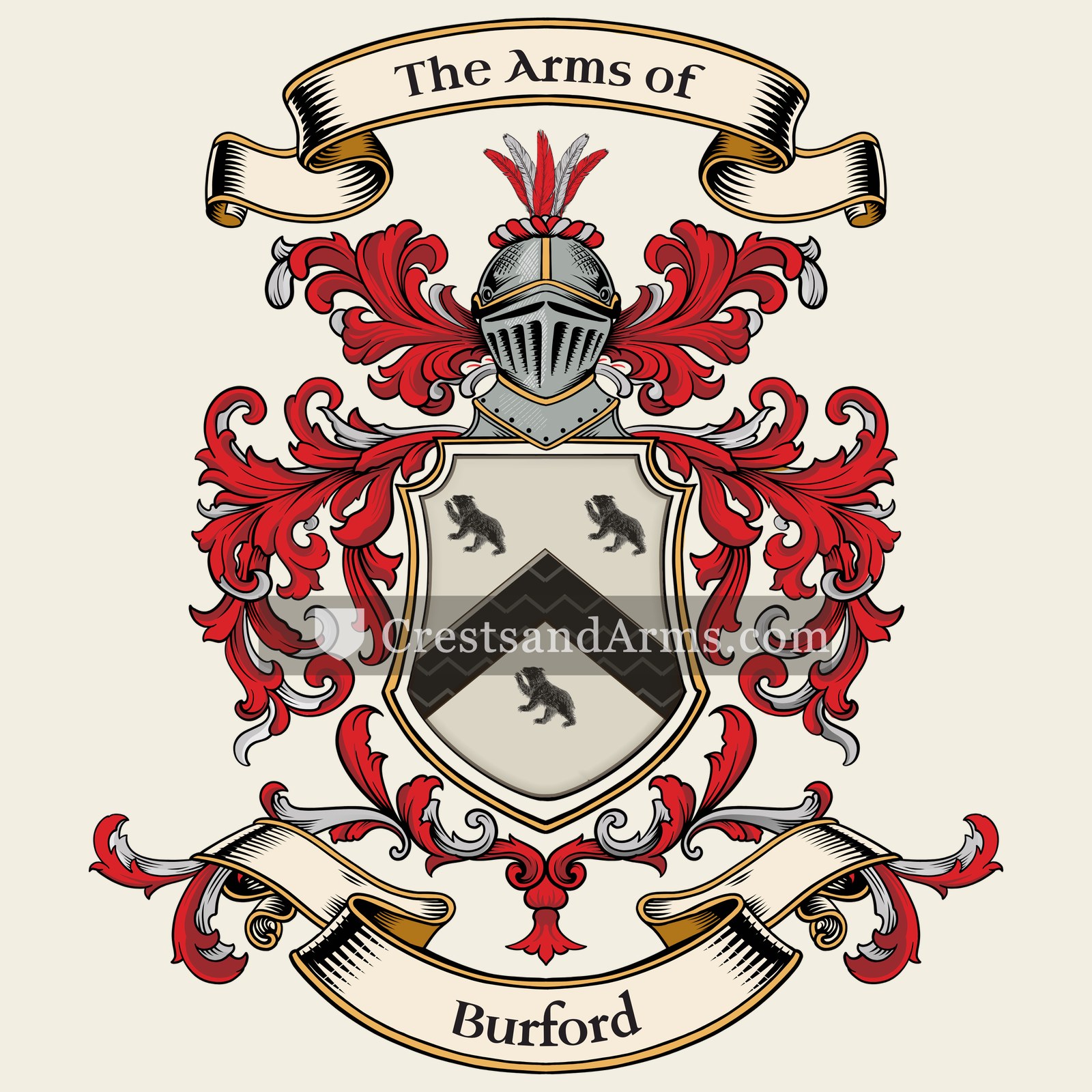
A record of documented arms, meaning and origin, researched for the Burford family of Ireland.
Reg. 8841 · Irish, A–C
Coat of Arms & Family Crest Details
Symbols on this shield
chevronProtection, and faithful service completed
bearStrength, cunning and protection of kin
Colours
Silver (Argent)Means: Peace and sincerity
Black (Sable)Means: Constancy
Historical info
Source
Sir Bernard Burke, The General Armory of England, Scotland, Ireland and Wales, London: Harrison & Sons, 1884
Blazon (the actual original written record)
“Ar. a chev. betw. three bears' heads erased sa. muzzled or”
MeathMeath, c. 1633
Where the Burford Arms Were Recorded
Meath
Map of Ireland showing where the Burford arms are recorded
The Burford arms were recorded in Meath, c. 1633.
Meath was the best farmland in Ireland and the old seat of its high kings. Norman families took it early and held it, and land of that quality kept the same families on it for centuries.
This is where the arms were entered in the register. Families often moved to other parts of the country, so the same name can turn up in more than one region.
The body that granted and recorded arms in Ireland in this period.
Charles I of England
Sovereign of the period
Charles I of England
1625–1649
Reigning in Ireland when the Burford arms are first recorded.
How Arms Worked in Ireland
The Ulster King of Arms granted coats of arms to individuals who proved their social standing and good character. These symbols were typically inherited by all legitimate descendants of the original holder. If a family branch wanted a unique look, they could apply for a specific change to their design through the office to ensure their identity remained distinct.
Granting authority
The Ulster King of Arms acted as the official body that regulated and issued all coats of arms throughout Ireland.
How they got arms
Families obtained their arms through formal grants issued by the office after proving their eligibility and paying the required fees.
Where arms were recorded
All official grants were recorded in the registers held by the Ulster King of Arms starting from the year 1552.
The family's standing
Recorded among the armigerous families of Meath.
Origin & History of the Burford Family in Ireland
The family name Burford originates from England, where it was a locational surname derived from towns named Burford in counties like Oxfordshire and Shropshire. The name itself comes from Old English words meaning a ford near a fortified place or borough. By the early 17th century, members of the family had migrated across the Irish Sea to settle in County Meath. Records from 1633 confirm their presence in this region, likely as part of the broader movement of English settlers during the plantation era. These early Burfords in Ireland were often involved in local administration and land management, establishing a foothold in the area that would persist for generations. Their transition from England to Ireland reflects the complex patterns of migration and land settlement that defined the British Isles during the Stuart period.
Related Branches & Arms
Root word
Burh-ford
A fortified settlement located at a river crossing.
This name
BurfordRefers to a person who lived near a fortified ford or river crossing.
also spelled
Burfurd
Burferd
Burfitt
Related arms
Pennarthsame arms
Pemarthesimilar arms
Borfordvariant spelling
Documented Sources
Sir Bernard Burke, The General Armory of England, Scotland, Ireland and Wales, London: Harrison & Sons, 1884
Reaney, P.H. and Wilson, R.M., A Dictionary of English Surnames, 1991
National Archives of Ireland, Civil Survey of County Meath, 1654–1656
MacLysaght, Edward, The Surnames of Ireland, 1985
Digital archive packCoat of arms PNG, gold border print PDF, vector SVG and the certificate of authenticity. Sent to your email in minutes.


 chevronProtection, and faithful service completed
 bearStrength, cunning and protection of kin
 chevronProtection, and faithful service completed
 bearStrength, cunning and protection of kin