A record of documented arms, meaning and origin, researched for the Bürgin family lines. Documented in 2 countries.
Reg. 2720 · Swiss, A–C
Coat of Arms & Family Crest Details
Symbols on this shield
mountThe ground held, and steadfastness upon it
towerGrandeur and solidity, and a stronghold defended
Colours
Blue (Azure)Means: Loyalty and truth
Green (Vert)Means: Hope
Historical info
Source
J. B. Rietstap, Armorial Général, Gouda: G. B. van Goor Zonen, 1884–87
Blazon (the actual original written record)
“D'azur à un château carré au nat., essoré de gu., portant sur le milieu et sur les angles trois tourelles au nat., couvertes de toits pointus de gu.; le château posé sur une terrasse de sin. C.: le château. L. d'arg. et d'azur.”
SwitzerlandBâle, c. 1745
Digital archive packCoat of arms PNG, gold border print PDF, vector SVG and the certificate of authenticity. Sent to your email in minutes.
Map of Switzerland showing where the Bürgin arms are recorded
The Bürgin arms were recorded in Bâle, c. 1745.
This is where the arms were entered in the register. Families often moved to other parts of the country, so the same name can turn up in more than one region.
The body that granted and recorded arms in Switzerland in this period.
How Arms Worked in Switzerland
In Switzerland, coats of arms were not restricted to the nobility and were often adopted by common citizens and families. These symbols were passed down through generations to show family identity. When branches of a family grew, they often changed small details of the design to distinguish their own line from the original group.
Granting authority
Cantonal and civic authorities managed the use of coats of arms within their specific regions and local jurisdictions.
How they got arms
Families typically assumed their own coats of arms based on local custom rather than receiving them from a central monarch.
Where arms were recorded
Arms were recorded in various cantonal and civic registers starting from the fourteenth century throughout the Swiss region.
The family's standing
Recorded among the armigerous families of Switzerland.
Origin & History of the Bürgin Family in Switzerland
The family name Bürgin is deeply rooted in the history of the Basel region, where records confirm members of the family were established by the year 1745. The name is considered a topographic surname, which means it likely originated from a person’s connection to a specific location or a fortified settlement. In the German language, the root word "Burg" refers to a castle or a protected town, suggesting that early ancestors may have lived near such a structure or served as guards for a local fortification. As the family grew, they integrated into the social and economic life of the Swiss cantons, often working as skilled craftsmen or farmers. These early generations helped shape the local community by participating in the trade guilds that defined the city of Basel during the eighteenth century. By maintaining deep ties to the land and the urban centers of northern Switzerland, the Bürgin family established a lasting presence that has persisted through the centuries.
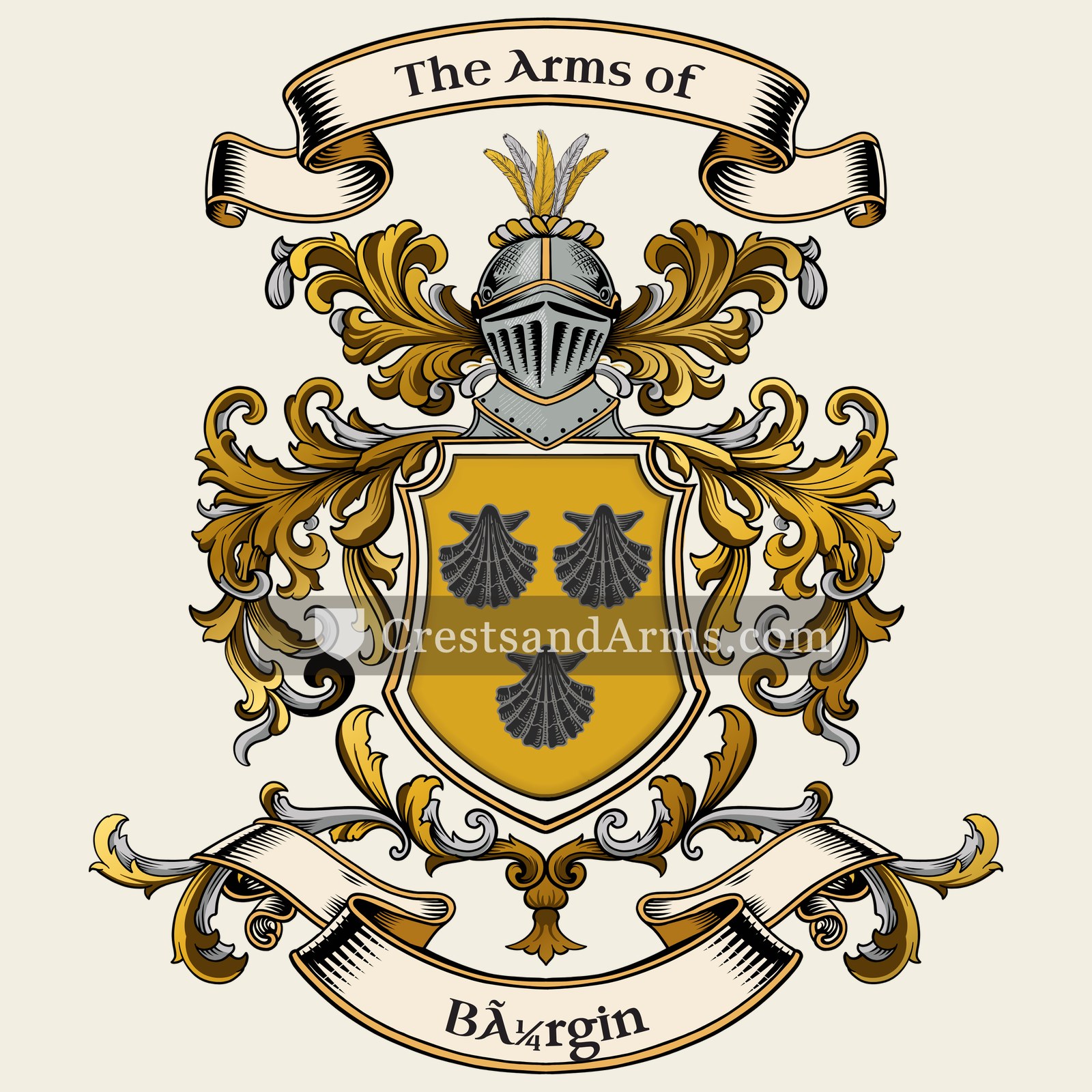
Coat of Arms & Family Crest Details
Symbols on this shield
escallopThe pilgrim's shell, and a long journey made
Colours
Gold (Or)Means: Generosity
Red (Gules)Means: Military strength
Historical info
Source
Sir Bernard Burke, The General Armory of England, Scotland, Ireland and Wales, London: Harrison & Sons, 1884
Blazon (the actual original written record)
“Per fesse indented or and gu. three escallops counterchanged”
Englandc. 1620
Digital archive packCoat of arms PNG, gold border print PDF, vector SVG and the certificate of authenticity. Sent to your email in minutes.
Map of England showing where the Bürgin arms are recorded
The Bürgin arms were recorded in England, c. 1620.
Arms such as these were typically recorded in York.
Yorkshire is the largest of the English counties, and it held more gentry families than any other. Land there was split among a great many households rather than a few, so a great many of them carried arms.
This is where the arms were entered in the register. Families often moved to other parts of the country, so the same name can turn up in more than one region.
The body that granted and recorded arms in England in this period.
James VI and I
Sovereign of the period
James VI and I
1603–1625
Reigning in Switzerland when the Bürgin arms are first recorded.
How Arms Worked in England
English heraldry allowed arms to be shared by all legitimate descendants of the original owner. These symbols were treated as personal property that moved through the generations to all children. While the eldest son kept the original design, other family members could use the same shield without needing to change it or register their own unique versions.
Granting authority
The College of Arms in London has regulated the use of coats of arms throughout England and Wales since 1484.
How they got arms
Families typically obtained their coats of arms through a formal grant from the Crown or by proving their ancient right to them.
Where arms were recorded
All official coats of arms are recorded in the registers kept at the College of Arms, which date back to the fifteenth century.
The family's standing
Recorded among the armigerous families of England.
Origin & History of the Bürgin Family in England
The history of the Bürgin family in England begins with the arrival of early members in the city of York around 1620. During this period, York was a bustling center of trade and religious transition, making it a common destination for continental families seeking new opportunities. The name itself is of Germanic origin, likely derived from the Middle High German word for a citizen or a dweller of a fortified town. When these individuals settled in Northern England, they integrated into the local economy and social structure of the city. Over time, the spelling of the name often shifted to adapt to English phonetic patterns while maintaining its connection to its ancestral roots. These early settlers were part of a broader movement of people who brought unique skills and cultural perspectives to the region, helping to shape the diverse demographic landscape of seventeenth-century Yorkshire.
Bürgin Meaning & Related Branches
Root word
Burg
A fortified place, castle, or protected settlement.
This name
BürginRefers to a person who lived near or worked at a castle or fortified town.
also spelled
Burgyne
Burgyn
Birgin
Bergin
Burgen
Related arms
Burgaynevariant spelling
Burgonvariant spelling
Burgoynevariant spelling
Documented Sources
J. B. Rietstap, Armorial Général, Gouda: G. B. van Goor Zonen, 1884–87
Historisches Lexikon der Schweiz, Historisches Lexikon der Schweiz, 2002
Staatsarchiv Basel-Stadt, Bürgerverzeichnisse und Einwohnerregister, 1745
Schweizerisches Idiotikon, Schweizerisches Idiotikon: Wörterbuch der schweizerdeutschen Sprache, 1881
Digital archive packCoat of arms PNG, gold border print PDF, vector SVG and the certificate of authenticity. Sent to your email in minutes.


 mountThe ground held, and steadfastness upon it
 towerGrandeur and solidity, and a stronghold defended
 mountThe ground held, and steadfastness upon it
 towerGrandeur and solidity, and a stronghold defended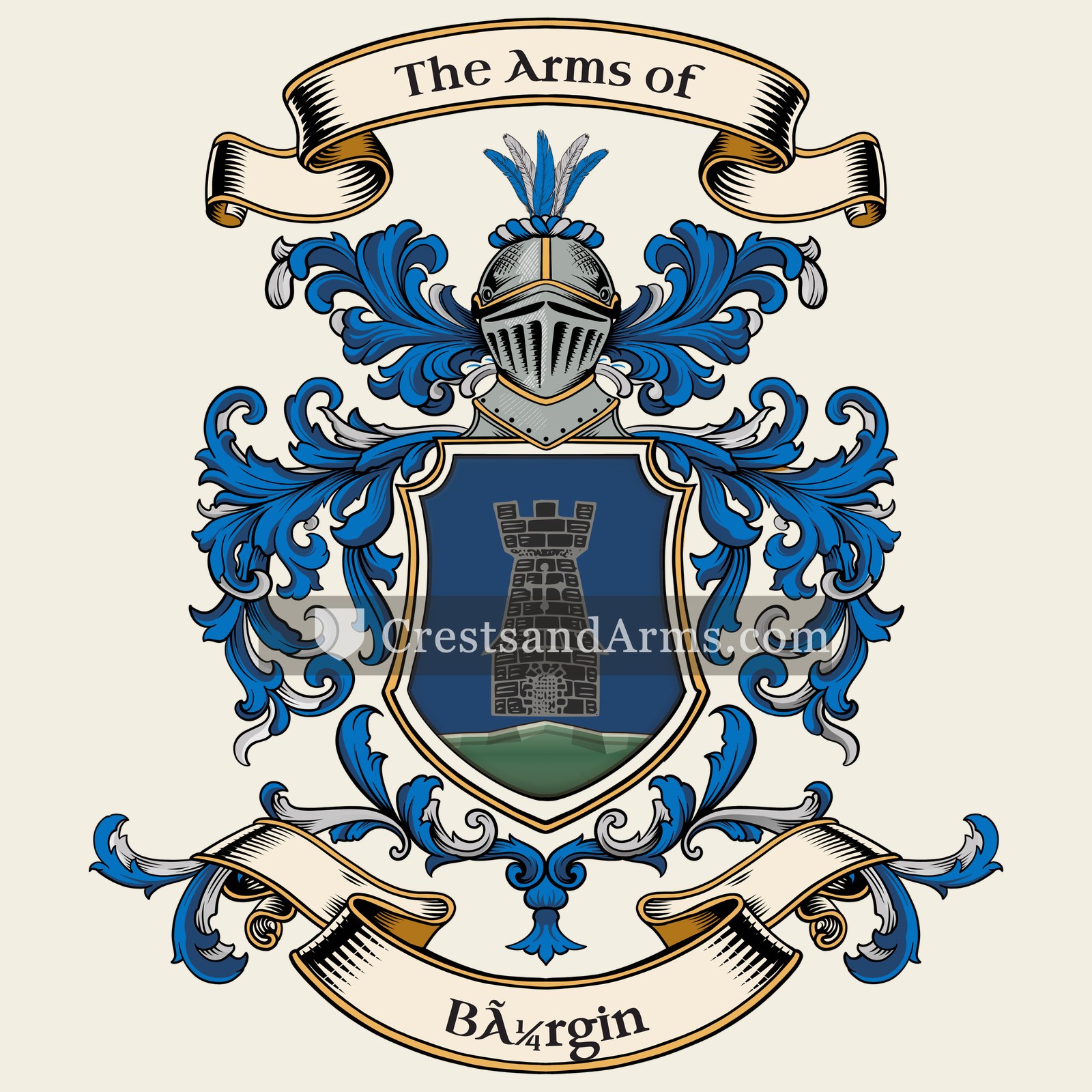

 escallopThe pilgrim's shell, and a long journey made