Map of Italy showing where the Buri arms are recorded
The Buri arms were recorded in Legnago, c. 1775.
This is where the arms were entered in the register. Families often moved to other parts of the country, so the same name can turn up in more than one region.
The body that granted and recorded arms in Italy in this period.
Alvise Giovanni Mocenigo
Sovereign of the period
Alvise Giovanni Mocenigo
1763–1778
Reigning in Italy when the Buri arms are first recorded.
How Arms Worked in Italy
In the Italian states, coats of arms were often used by noble families to show their status and history. These symbols were passed down through the generations to all legitimate male descendants. Younger branches of a family usually kept the original design but sometimes added small changes to distinguish their specific line from the main branch.
Granting authority
Various local rulers and city governments controlled the use of coats of arms across the different Italian states.
How they got arms
Families often assumed their own arms or received them as official grants from local lords, popes, or city councils.
Where arms were recorded
Arms were recorded in local city archives or private family books rather than in one single national register.
The family's standing
Recorded among the armigerous families of Italy.
Origin & History of the Buri Family in Italy
The history of the Buri family in Italy is deeply rooted in the fertile lands of the Veneto region, particularly within the town of Legnago. By the year 1775, the family had established a clear presence in this area, which served as a strategic hub along the Adige River. During this period, families like the Buri were often involved in the management of local agricultural estates or held positions within the civic administration of the town. As Legnago functioned as a vital defensive point between Verona and the surrounding provinces, the family likely navigated the complex social and economic shifts that defined the late eighteenth century. Their documented presence in local records suggests they were integrated into the fabric of the community, contributing to the development of the region during a time of significant political transition in Northern Italy.
Coat of Arms & Family Crest Details
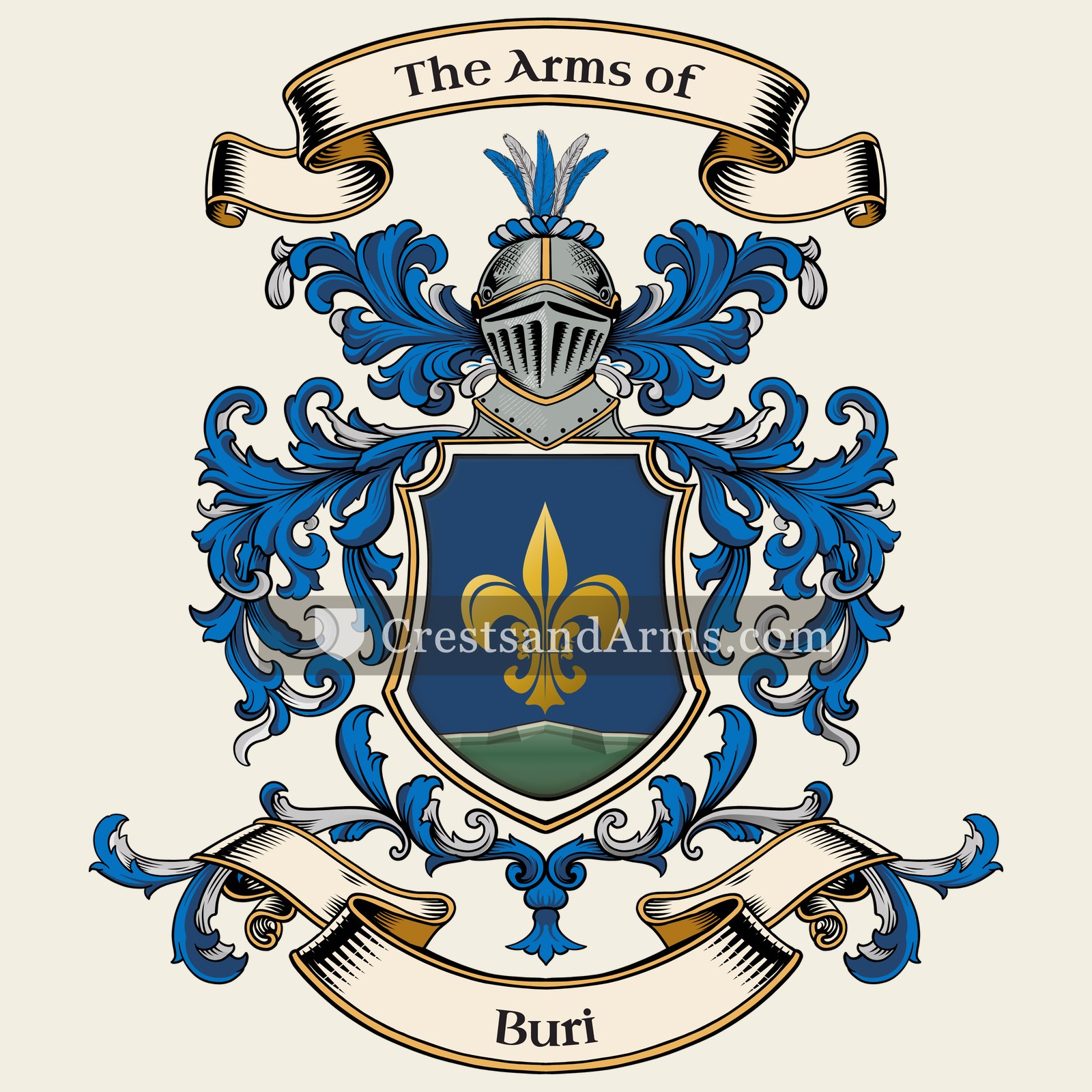
Symbols on this shield
mountThe ground held, and steadfastness upon it
fleur de lisPurity, light, and the sixth son
Colours
Blue (Azure)Means: Loyalty and truth
Green (Vert)Means: Hope
Gold (Or)Means: Generosity
Historical info
Source
J. B. Rietstap, Armorial Général, Gouda: G. B. van Goor Zonen, 1884–87
Blazon (the actual original written record)
“D'azur à un singe au nat., assis sur une terrasse de sin. et supp. de sa patte dextre une fleur-de-lis d'or. C.: une fleur-de-lis d'or. L. d'azur et d'azur.”
SwitzerlandSoleure, c. 1745
Digital archive packCoat of arms PNG, gold border print PDF, vector SVG and the certificate of authenticity. Sent to your email in minutes.
Map of Switzerland showing where the Buri arms are recorded
The Buri arms were recorded in Soleure, c. 1745.
This is where the arms were entered in the register. Families often moved to other parts of the country, so the same name can turn up in more than one region.
The body that granted and recorded arms in Switzerland in this period.
How Arms Worked in Switzerland
In Switzerland, coats of arms were not restricted to the nobility and were often adopted by common citizens and families. These symbols were passed down through generations to show family identity. When branches of a family grew, they often changed small details of the design to distinguish their own line from the original group.
Granting authority
Cantonal and civic authorities managed the use of coats of arms within their specific regions and local jurisdictions.
How they got arms
Families typically assumed their own coats of arms based on local custom rather than receiving them from a central monarch.
Where arms were recorded
Arms were recorded in various cantonal and civic registers starting from the fourteenth century throughout the Swiss region.
The family's standing
Recorded among the armigerous families of Switzerland.
Origin & History of the Buri Family in Switzerland
The Buri family name has deep roots in the Swiss canton of Solothurn, where records confirm their presence as early as 1745. During this period, the family was primarily established in the region surrounding the city of Solothurn, which served as a center for trade and local governance. The name itself is thought to be linked to the Middle High German word for a farmer or a peasant, suggesting that the earliest ancestors were likely involved in the agricultural life that defined the Swiss countryside. As the family grew, they integrated into the local social structure, often participating in the craft guilds and communal organizations that were essential to life in the Swiss cantons. By the mid-18th century, the Buris were well-settled citizens who contributed to the stability and development of their local communities through their work and civic duties. Their history reflects the broader experience of many families in the region who transitioned from rural agricultural roots to becoming established members of the town and village societies that formed the foundation of modern Switzerland.
Buri Meaning & Related Branches
Root word
Buro
Derived from the Germanic word for a small dwelling or hut.
This name
BuriRefers to a person who lived in or originated from a small cottage or farmstead.
also spelled
Bury
Related arms
Buryvariant spelling
Documented Sources
J. B. Rietstap, Armorial Général, Gouda: G. B. van Goor Zonen, 1884–87
Archivio di Stato di Verona, Stato Civile della Restaurazione, Legnago
Buri, Giovanni, Memorie storiche della famiglia Buri, 1892
Comune di Legnago, Archivio Storico Comunale, Registri dei battesimi e dei matrimoni, 1775
Digital archive packCoat of arms PNG, gold border print PDF, vector SVG and the certificate of authenticity. Sent to your email in minutes.


 bearStrength, cunning and protection of kin
 bearStrength, cunning and protection of kin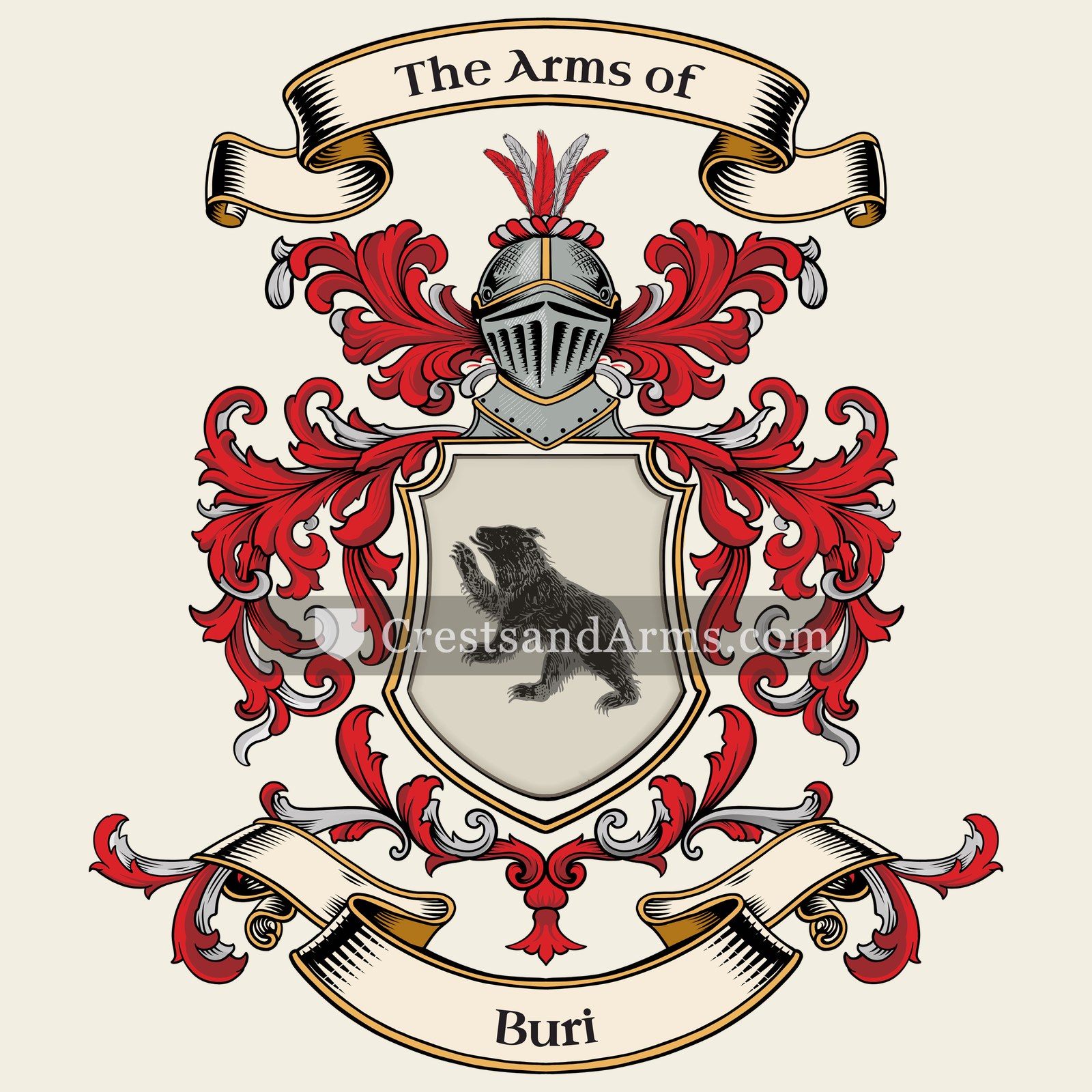


 mountThe ground held, and steadfastness upon it
 fleur de lisPurity, light, and the sixth son