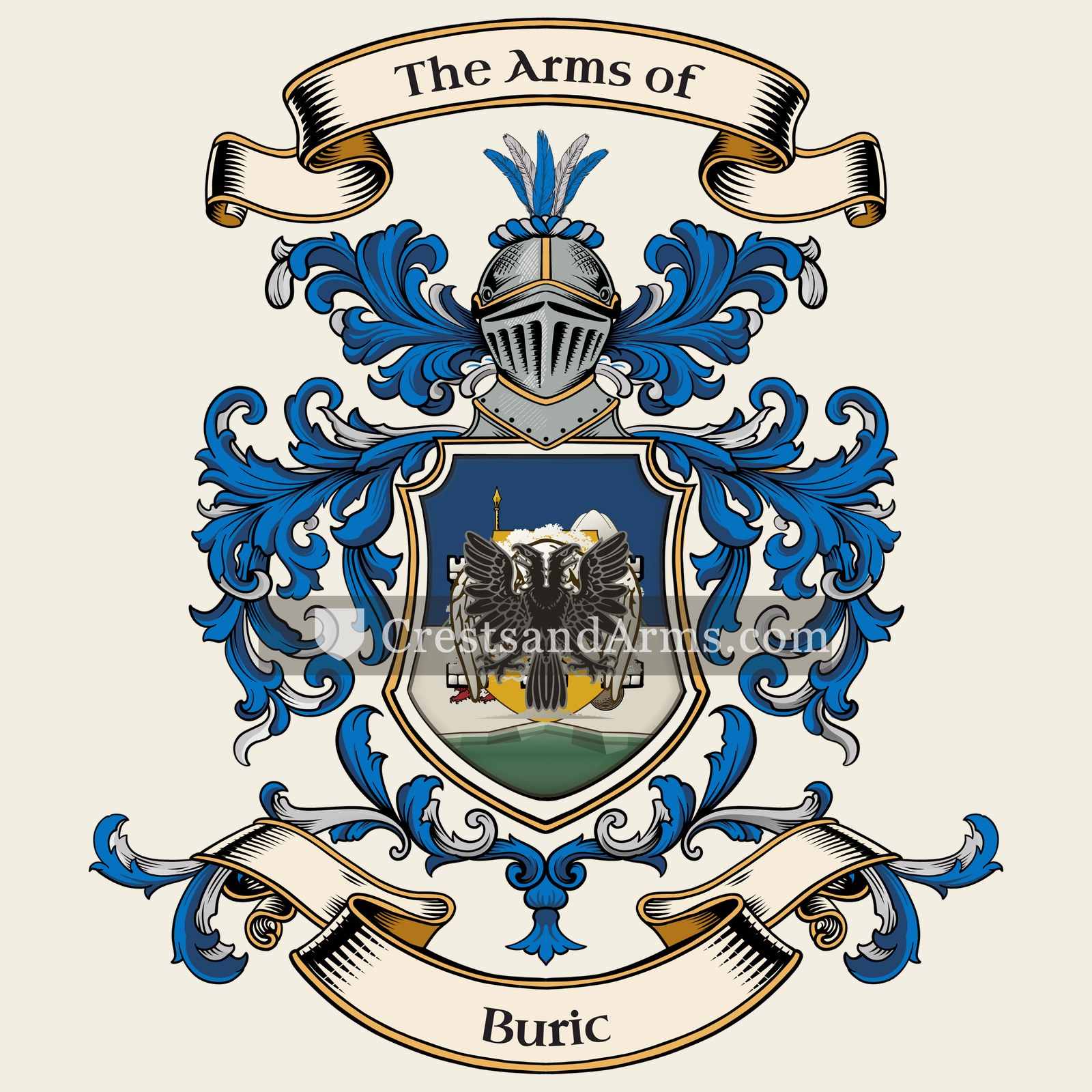
A record of documented arms, meaning and origin, researched for the Buric family of Austria.
Reg. 5144 · Austrian, A–C
Coat of Arms & Family Crest Details
Symbols on this shield
mountThe ground held, and steadfastness upon it
fessThe military belt, and readiness to serve
bridgeOne who joins what was divided
treeLife, endurance and deep roots
cherubDivine protection over the innocent
eagleNobility, strength and a keen mind
lanceKnightly service and the tilt
lionCourage, strength and royalty
bombOne who has faced a great siege
Colours
Blue (Azure)Means: Loyalty and truth
Silver (Argent)Means: Peace and sincerity
Gold (Or)Means: Generosity
Green (Vert)Means: Hope
Black (Sable)Means: Constancy
Red (Gules)Means: Military strength
Historical info
Source
J. B. Rietstap, Armorial Général, Gouda: G. B. van Goor Zonen, 1884–87
Blazon (the actual original written record)
“Coupé: au 1 parti: a. d'azur à une lance de tournoi d'or, en pal, ayant une banderole coupée de sa. sur or, et posée sur un rocher de trois coupeaux d'arg., celui du milieu cour. d'or; b. d'arg. au lion de gu., cour. d'or, brandissant un sabre d'arg., garni d'or, et supp. de sa sen. une grenade allumée, au nat.; au 2 sous un ciel d'azur, un pont crén., bâti de blocs de granit, et jeté sur une rivière, les bords couverts de buissons d'épines. Sur le tout un écusson, cour. d'or aux armes de Buric qui sont coupé: a. de gu. à un ange iss., mouv. du coupé, hab. d'arg., tenant de sa main dextre une palme de sin. et supp. de sa sen. une couronne d'or; b. d'or à une aigle de sa.; et une fasce ondée d'arg., br. sur le coupé. Trois cq. cour. C.: 1º un griffon iss. et cont. d'or, tenant de sa patte dextre une palme de sin. et supp. de sa sen. une couronne d'or; l. d'arg. et d'azur; 2º une banderole coupée de sa. sur or, attachée à une lance de tournoi d'or, en pal; entre un vol coupé alt. d'or et de sa.; l. d'or et de sa.; 3º le lion du 1 b., iss.; l. d'arg. et de gu. T.: deux chevaliers, arm. de toutes pièces au nat., le casque panaché de gu., la main libre appuyée sur un bouclier ovale d'acier.”
Austriac. 1779
Digital archive packCoat of arms PNG, gold border print PDF, vector SVG and the certificate of authenticity. Sent to your email in minutes.
Map of Austria showing where the Buric arms are recorded
The Buric arms were recorded in Austria, c. 1779.
Arms such as these were typically recorded in Tyrol.
Tyrol was mountain country in western Austria, where the valleys were held by families who had been there a very long time. Old tenure counted for more than money, and old families carried arms.
This is where the arms were entered in the register. Families often moved to other parts of the country, so the same name can turn up in more than one region.
Region
Tyrol
First recorded
1779
Granting Authority for the Buric Arms
Imperial and Royal chancery
Sodacan · CC BY-SA 3.0
The body that granted and recorded arms in Austria in this period.
Joseph II, Holy Roman Emperor
Sovereign of the period
Joseph II, Holy Roman Emperor
1765–1790
Reigning in Austria when the Buric arms are first recorded.
How Arms Worked in Austria
Austrian coats of arms were often linked directly to noble titles granted by the Emperor. These symbols belonged to the entire family line rather than just one individual. When a family grew, new branches kept the original design without needing to change it. This system allowed all members of a noble house to share the same identity across many generations.
Granting authority
The Imperial and Royal chancery managed all heraldic matters and controlled the official granting of arms throughout the Austrian lands.
How they got arms
Families typically received their arms through a formal imperial decree that often accompanied the elevation of a person to noble status.
Where arms were recorded
Official records of these grants were kept in the Imperial Register of Nobility which began its formal documentation process in 1453.
The family's standing
Recorded among the armigerous families of Austria.
Origin & History of the Buric Family in Austria
The family name Buric has deep roots in the mountainous regions of Central Europe, with documented evidence placing the family in the Tyrol area by 1779. During the late 18th century, families in this region were often tied to the land through agriculture, forestry, or specialized mountain trades that allowed them to thrive in the rugged Alpine environment. The name itself likely evolved from local linguistic traditions, reflecting the way communities identified individuals based on their occupation, personal traits, or specific geographic locations within the valleys. As the family established itself in Tyrol, they became part of a complex social structure defined by parish records and regional administrative systems. These early ancestors lived through a period of significant change as the region transitioned under various imperial influences, requiring families to maintain strong local ties to preserve their heritage and property. By settling in such a distinct geographic corridor, the Buric family became part of the long history of migration and settlement that shaped the cultural identity of the Eastern Alps.
Related Branches & Arms
Root word
Bura
A strong, cold, northern wind blowing along the Adriatic coast.
This name
BuricDerived from a nickname for someone with a stormy or tempestuous temperament.
also spelled
Buric
Burik de Pournay
Documented Sources
J. B. Rietstap, Armorial Général, Gouda: G. B. van Goor Zonen, 1884–87
Tiroler Landesarchiv, Tauf-, Trauungs- und Sterbebücher der Pfarreien in Tirol, 1779
Huter, Franz, Tiroler Urkundenbuch, 1937
Steinhuber, Andreas, Die Geschichte der Tiroler Landbevölkerung, 1952
Digital archive packCoat of arms PNG, gold border print PDF, vector SVG and the certificate of authenticity. Sent to your email in minutes.


 mountThe ground held, and steadfastness upon it
 fessThe military belt, and readiness to serve
 bridgeOne who joins what was divided
 treeLife, endurance and deep roots
 cherubDivine protection over the innocent
 eagleNobility, strength and a keen mind
 lanceKnightly service and the tilt
 lionCourage, strength and royalty
 bombOne who has faced a great siege