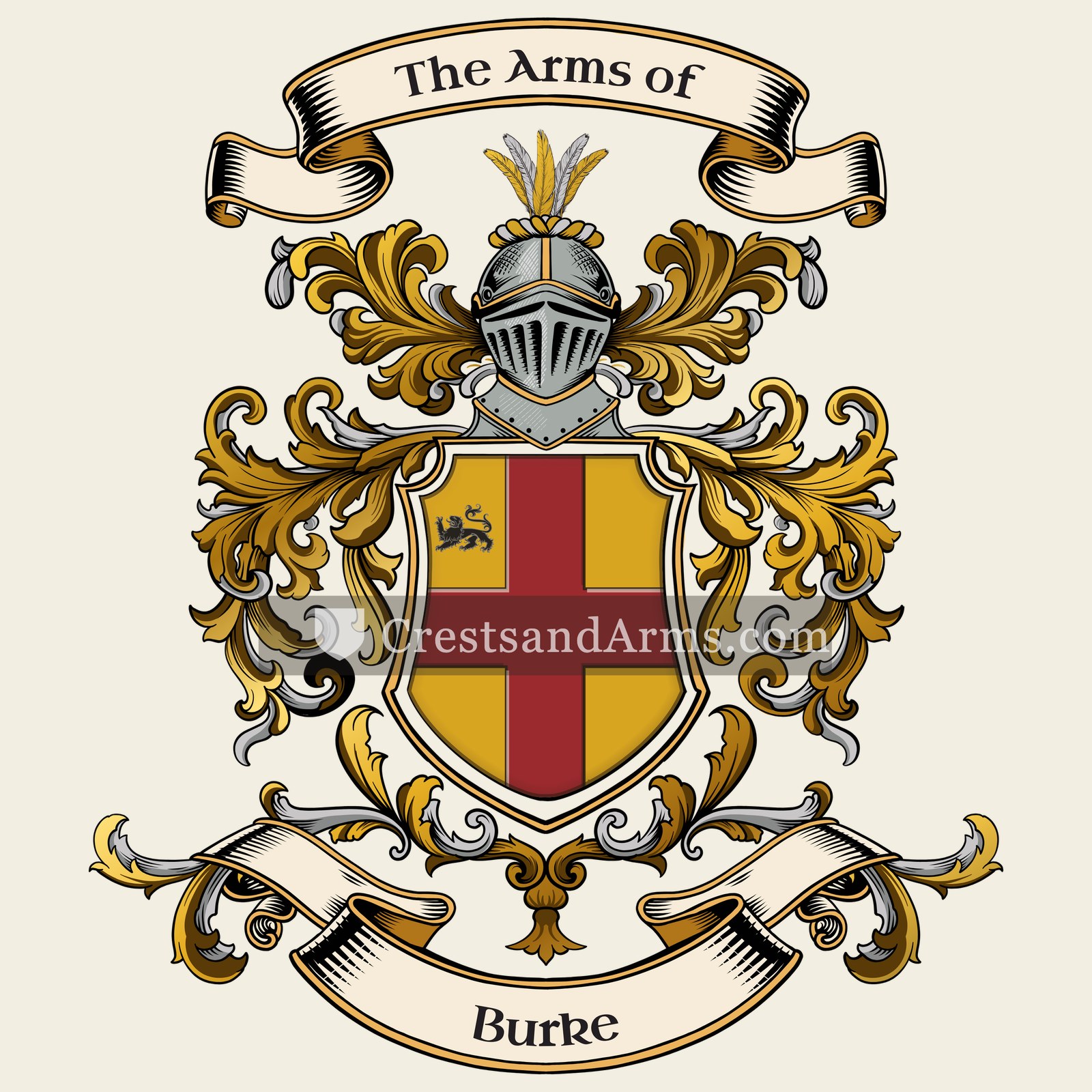
A record of documented arms, meaning and origin, researched for the Burke family lines. Documented in 2 countries.
Reg. 0326 · Britain, A–C
Coat of Arms & Family Crest Details
Symbols on this shield
cross symbolChristian faith and service
lionCourage, strength and royalty
Colours
Gold (Or)Means: Generosity
Red (Gules)Means: Military strength
Black (Sable)Means: Constancy
Historical info
Source
J. B. Rietstap, Armorial Général, Gouda: G. B. van Goor Zonen, 1884–87
Blazon (the actual original written record)
“D'or à la croix de gu., acc. au 1 d'un lion de sa. C.: un chat sauvage assis, au nat., la tête posée de front, coll. et enchainé d'or. D.: UNG ROY, UNG FOY, UNG LOY [Armes du célèbre orateur Edmund Burke. M. John Burke, avocat, et sir Bernard Burke, roi d'armes d'Ulster, auteurs de plusieurs ouvrages héraldiques et généalogiques qui jouissent d'une haute réputation, portent les mêmes armes, écartelées de celles de Dowdall, qui sont d'arg. à cinq étoiles de gu., 3 et 2.]”
Britainc. 1700
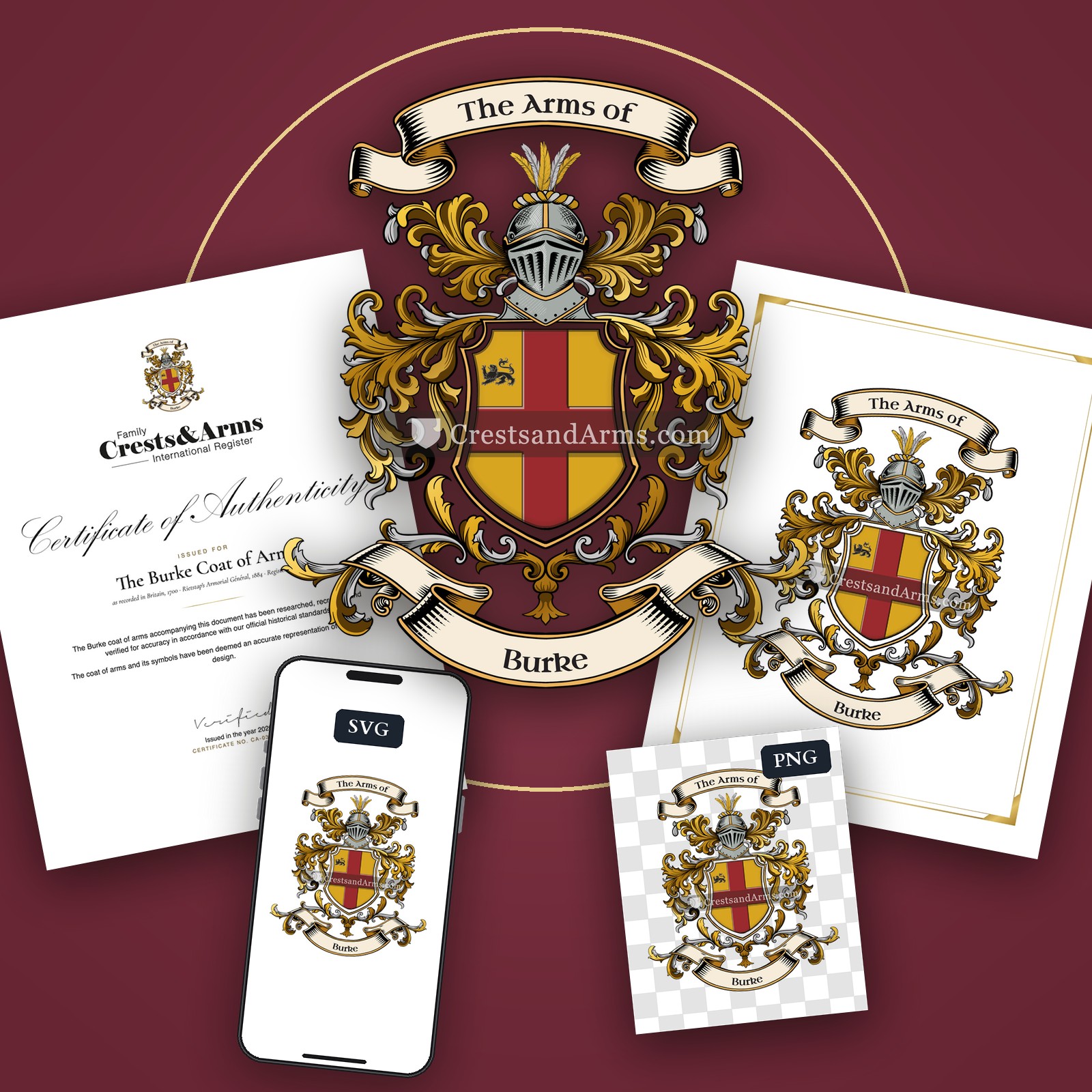
Digital archive packCoat of arms PNG, gold border print PDF, vector SVG and the certificate of authenticity. Sent to your email in minutes.
Map of Britain showing where the Burke arms are recorded
The Burke arms were recorded in Britain, c. 1700.
Arms such as these were typically recorded in Kent.
Kent sits between London and the short crossing to Europe, and the trade passing through made it wealthy. Merchant families bought land with that money, and it was landowners who took coats of arms.
This is where the arms were entered in the register. Families often moved to other parts of the country, so the same name can turn up in more than one region.
The body that granted and recorded arms in Britain in this period.
William III of England
Sovereign of the period
William III of England
1694–1702
Reigning in Britain when the Burke arms are first recorded.
How Arms Worked in Britain
English heraldry allowed arms to be shared by all legitimate descendants of the original owner. These symbols were treated as personal property that moved through the generations to all children. While the eldest son kept the original design, other family members could use the same shield without needing to change it or register their own unique versions.
Granting authority
The College of Arms in London has regulated the use of coats of arms throughout England and Wales since 1484.
How they got arms
Families typically obtained their coats of arms through a formal grant from the Crown or by proving their ancient right to them.
Where arms were recorded
All official coats of arms are recorded in the registers kept at the College of Arms, which date back to the fifteenth century.
The family's standing
Recorded among the armigerous families of Britain.
Origin & History of the Burke Family in Britain
The Burke family name has deep roots that trace back to the Norman influence on the British Isles. While many people associate the name with later migrations, records show that members of the family were well-established in the county of Kent by the year 1700. During this period, families often settled in specific regions to work in agriculture or local trade, which helped them integrate into the growing communities of southern England. The name itself reflects a history of movement and adaptation as families shifted from their ancestral origins to become part of the local fabric of English society. By the turn of the 18th century, the Burkes in Kent were part of a broader trend of families putting down permanent roots in rural parishes, where they contributed to the local economy and social life for generations.
Coat of Arms & Family Crest Details
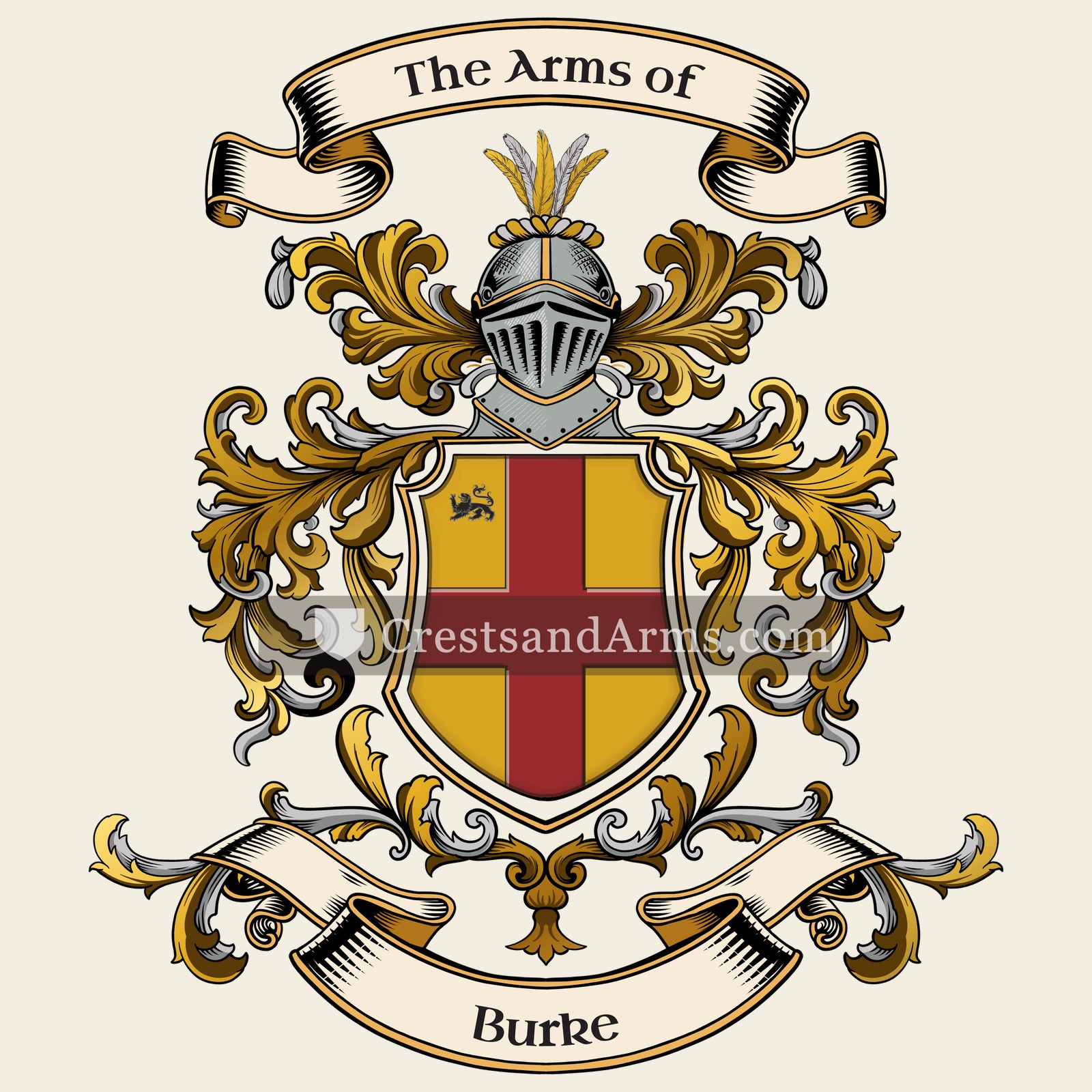
Symbols on this shield
cross symbolChristian faith and service
lionCourage, strength and royalty
Colours
Gold (Or)Means: Generosity
Red (Gules)Means: Military strength
Black (Sable)Means: Constancy
Historical info
Source
Sir Bernard Burke, The General Armory of England, Scotland, Ireland and Wales, London: Harrison & Sons, 1884
Blazon (the actual original written record)
“Or, a cross gu. in the dexter canton a lion ramp. sa”
GalwayGlinsk · Galway, c. 1645
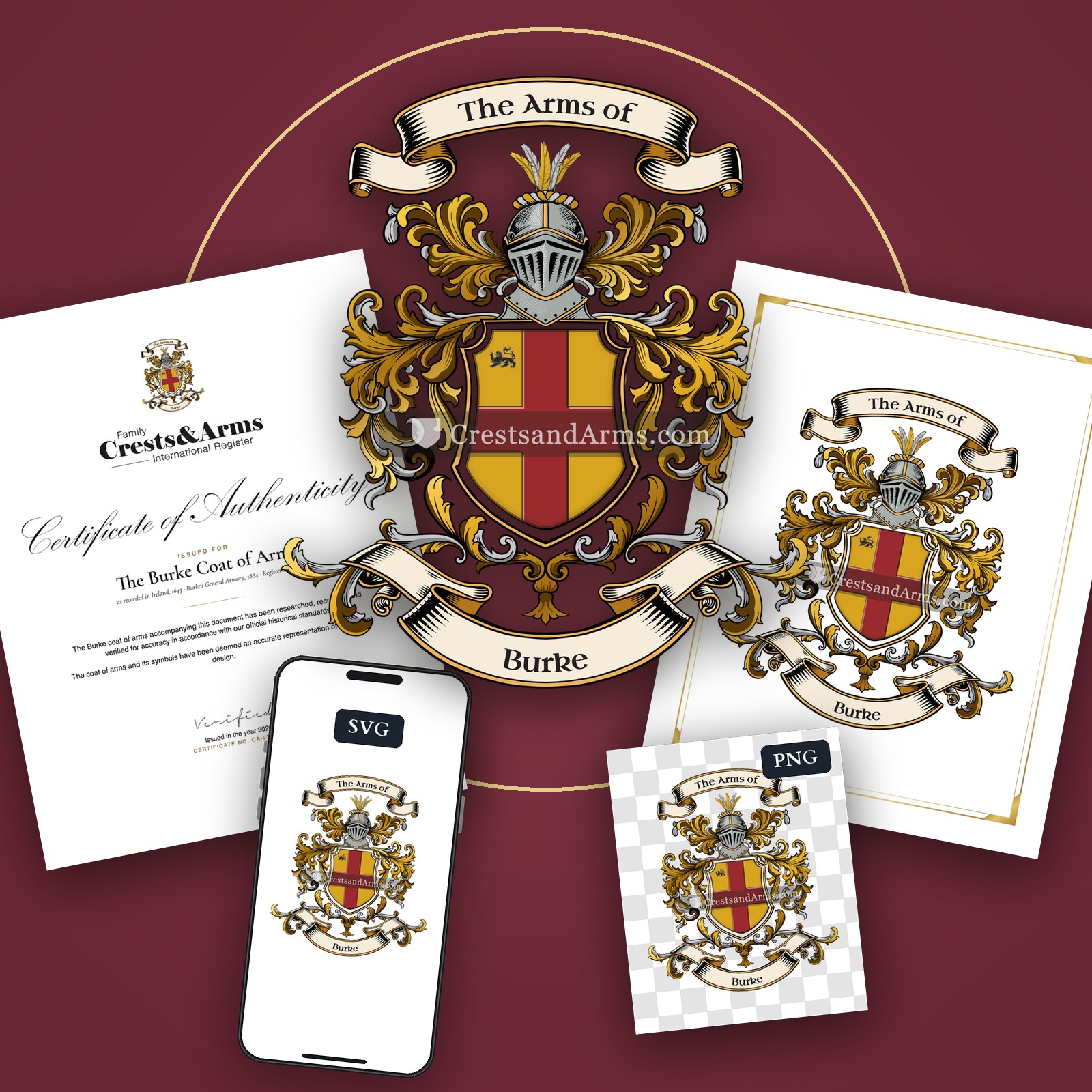
Digital archive packCoat of arms PNG, gold border print PDF, vector SVG and the certificate of authenticity. Sent to your email in minutes.
Map of Ireland showing where the Burke arms are recorded
The Burke arms were recorded in Galway, c. 1645.
Galway was western Irish country of poor land and a rich port. A small group of merchant families ran the town for centuries and held estates around it, and both kinds of property carried arms.
This is where the arms were entered in the register. Families often moved to other parts of the country, so the same name can turn up in more than one region.
The body that granted and recorded arms in Ireland in this period.
Charles I of England
Sovereign of the period
Charles I of England
1625–1649
Reigning in Britain when the Burke arms are first recorded.
How Arms Worked in Ireland
The Ulster King of Arms granted coats of arms to individuals who proved their social standing and good character. These symbols were typically inherited by all legitimate descendants of the original holder. If a family branch wanted a unique look, they could apply for a specific change to their design through the office to ensure their identity remained distinct.
Granting authority
The Ulster King of Arms acted as the official body that regulated and issued all coats of arms throughout Ireland.
How they got arms
Families obtained their arms through formal grants issued by the office after proving their eligibility and paying the required fees.
Where arms were recorded
All official grants were recorded in the registers held by the Ulster King of Arms starting from the year 1552.
The family's standing
Recorded among the armigerous families of Galway.
Origin & History of the Burke Family in Ireland
The Burke family name in Ireland originated from the Norman-French name de Burgh, which arrived in the country following the Anglo-Norman invasion of the 12th century. The family quickly established a powerful presence in the west of Ireland, particularly in County Galway, where they became deeply integrated into the local culture. By the time of the mid-17th century, the Burkes had evolved from foreign settlers into a prominent Irish dynasty that held significant land and influence. Their survival and growth in the region were marked by their ability to adapt to the changing political landscape of the time. By 1645, the family was firmly rooted in Galway society, maintaining strong connections to both their ancestral origins and their adopted Irish home. This transition from Norman knights to influential landowners shaped the history of the name for centuries to come.
Burke Meaning & Related Branches
Root word
burg
An Old English or Germanic term referring to a fortified settlement.
This name
BurkeDerived from a locational name indicating someone who lived near a fortress or castle.
also spelled
Burck
Burk
Bourke
DeBurgh
Related arms
de Burghsimilar arms
Canningsimilar arms
Bourkevariant spelling
Burghrecorded with Burke, same area
Documented Sources
J. B. Rietstap, Armorial Général, Gouda: G. B. van Goor Zonen, 1884–87
Cottle, Basil. The Penguin Dictionary of Surnames. 1967
Reaney, P.H. A Dictionary of British Surnames. 1958
The National Archives, Kew. Parish registers for the county of Kent. 1700
Digital archive packCoat of arms PNG, gold border print PDF, vector SVG and the certificate of authenticity. Sent to your email in minutes.


 cross symbolChristian faith and service
 lionCourage, strength and royalty
 cross symbolChristian faith and service
 lionCourage, strength and royalty