Map of Switzerland showing where the Burkhardt arms are recorded
The Burkhardt arms were recorded in Bâle, c. 1745.
This is where the arms were entered in the register. Families often moved to other parts of the country, so the same name can turn up in more than one region.
The body that granted and recorded arms in Switzerland in this period.
How Arms Worked in Switzerland
In Switzerland, coats of arms were not restricted to the nobility and were often adopted by common citizens and families. These symbols were passed down through generations to show family identity. When branches of a family grew, they often changed small details of the design to distinguish their own line from the original group.
Granting authority
Cantonal and civic authorities managed the use of coats of arms within their specific regions and local jurisdictions.
How they got arms
Families typically assumed their own coats of arms based on local custom rather than receiving them from a central monarch.
Where arms were recorded
Arms were recorded in various cantonal and civic registers starting from the fourteenth century throughout the Swiss region.
The family's standing
Recorded among the armigerous families of Switzerland.
Origin & History of the Burkhardt Family in Switzerland
The surname Burkhardt has deep roots in the German-speaking regions of Switzerland, where it emerged as a variation of the Old High German name Burghard. This name combines the words for fortress and strong, suggesting that early ancestors were likely associated with the protection of local settlements or held positions of authority within their communities. By the mid-eighteenth century, the family established a significant presence in the city of Basel. Records confirm that members of the Burkhardt family were active in the social and economic life of Basel by 1745, often participating in the city's influential guilds and merchant networks. As the family grew, they became well-integrated into the urban fabric of the region, contributing to the administrative and civic development that defined Basel during the Enlightenment era. This transition from rural origins to established city life reflects the broader patterns of social mobility and industrial growth that characterized Swiss history during the seventeen hundreds.
Coat of Arms & Family Crest Details
Symbols on this shield
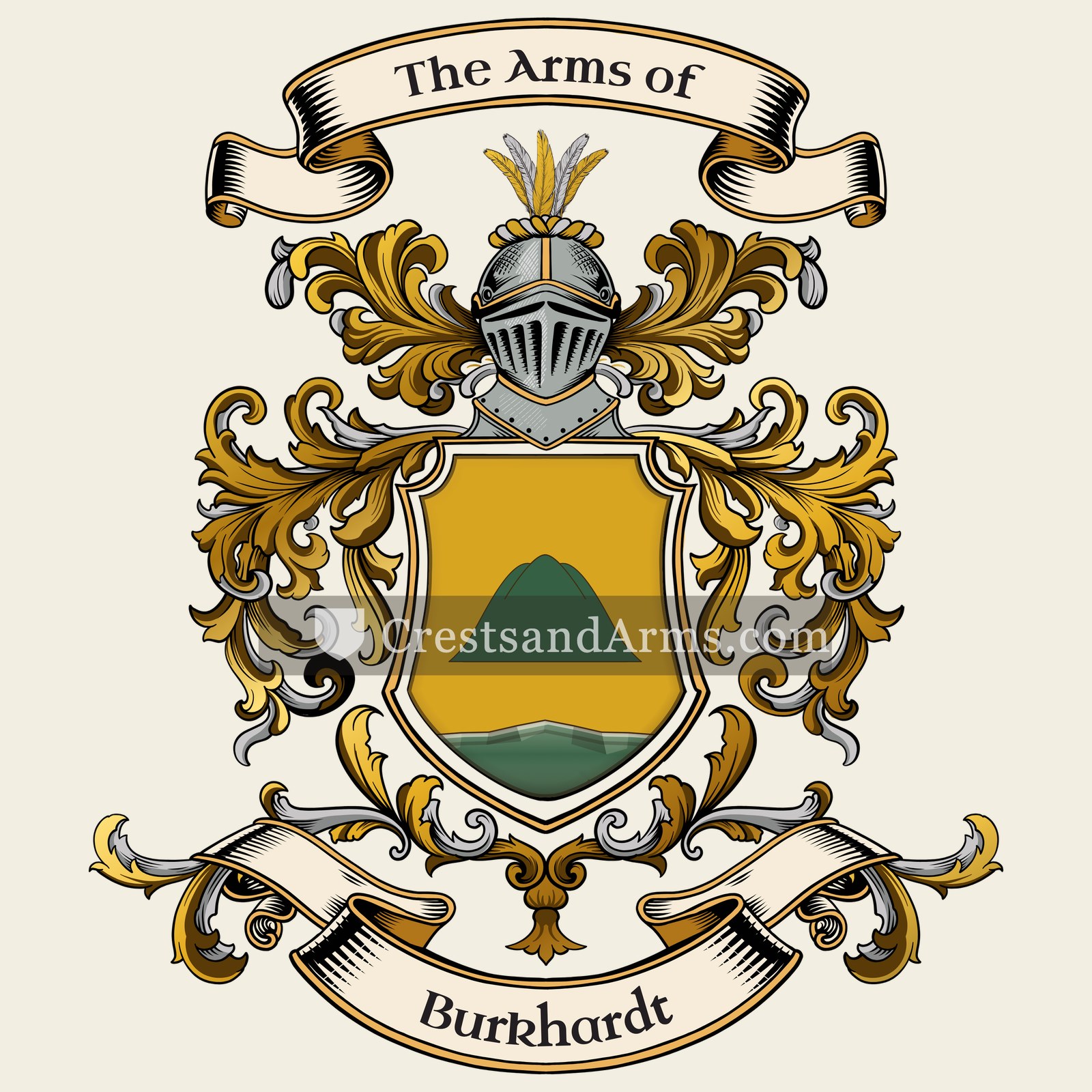
mountThe ground held, and steadfastness upon it
Colours
Gold (Or)Means: Generosity
Green (Vert)Means: Hope
Historical info
Source
J. B. Rietstap, Armorial Général, Gouda: G. B. van Goor Zonen, 1884–87
Blazon (the actual original written record)
“d'or, acc. en p. d'un tertre de trois coupeaux de sin. C.: quatre pl. d'aut., alt. d'azur et d'or. L. d'or et d'azur.”
Germanyc. 1765
Digital archive packCoat of arms PNG, gold border print PDF, vector SVG and the certificate of authenticity. Sent to your email in minutes.
Map of Germany showing where the Burkhardt arms are recorded
The Burkhardt arms were recorded in Germany, c. 1765.
Arms such as these were typically recorded in Bavaria.
Bavaria was a country of old landed families and walled market towns. Estates passed down the same line for centuries, and both the landowners and the leading townsmen kept arms, which is why so many Bavarian names sit in the registers.
This is where the arms were entered in the register. Families often moved to other parts of the country, so the same name can turn up in more than one region.
The body that granted and recorded arms in Germany in this period.
Francis I, Holy Roman Emperor
Sovereign of the period
Francis I, Holy Roman Emperor
1745–1765
Reigning in Switzerland when the Burkhardt arms are first recorded.
How Arms Worked in Germany
In the Holy Roman Empire, coats of arms were often granted to individuals by the Emperor or his representatives. These arms were then passed down through the generations to all legitimate descendants of the original holder. Younger branches of a family usually kept the same shield design without needing to change it, as the arms belonged to the entire lineage.
Granting authority
The Holy Roman Emperor held the sole power to grant new coats of arms throughout his vast imperial territories.
How they got arms
Families typically obtained their coats of arms through a formal imperial grant or by proving their noble status to the authorities.
Where arms were recorded
These grants were officially recorded in the Imperial Chancery registers, which began keeping formal records of such honors during the Middle Ages.
The family's standing
Recorded among the armigerous families of Germany.
Origin & History of the Burkhardt Family in Germany
The name Burkhardt is a classic German surname that evolved from the Old High German name Burghard. This name is composed of two distinct parts. The first part, burg, refers to a fortified place or a castle. The second part, hard, means brave, strong, or hardy. Together, the name originally described a person who was as strong as a fortress. By the time families began using fixed surnames in the eighteenth century, the name was well-established across various German-speaking regions. In Bavaria, where records confirm the presence of the family by 1765, the name was common among farmers and tradespeople who lived near local administrative centers. Because the name was associated with strength and protection, it was often passed down through generations in rural communities. These early Burkhardt families were typically deeply rooted in their local villages, where they contributed to the agricultural and social life of the Bavarian countryside for many decades.
Burkhardt Meaning & Related Branches
Root word
Burghard
Derived from the Germanic elements for fortress and brave or hardy.
This name
BurkhardtA surname signifying a person who is as strong, brave, or resilient as a fortress.
also spelled
Burkhard
Burkhart
Related arms
Burkhardvariant spelling
Ulmerrecorded with Burkhardt, same area
Vaiusrecorded with Burkhardt, same area
Documented Sources
J. B. Rietstap, Armorial Général, Gouda: G. B. van Goor Zonen, 1884–87
Burckhardt, Carl Jacob, Meine Danziger Mission 1937–1939, 1960
Historisches Lexikon der Schweiz, Burckhardt, 2003
Staatsarchiv Basel-Stadt, Bürgerverzeichnisse und Einwohnerregister
Digital archive packCoat of arms PNG, gold border print PDF, vector SVG and the certificate of authenticity. Sent to your email in minutes.


 lozengeHonour and nobility, and the arms of a woman
 lozengeHonour and nobility, and the arms of a woman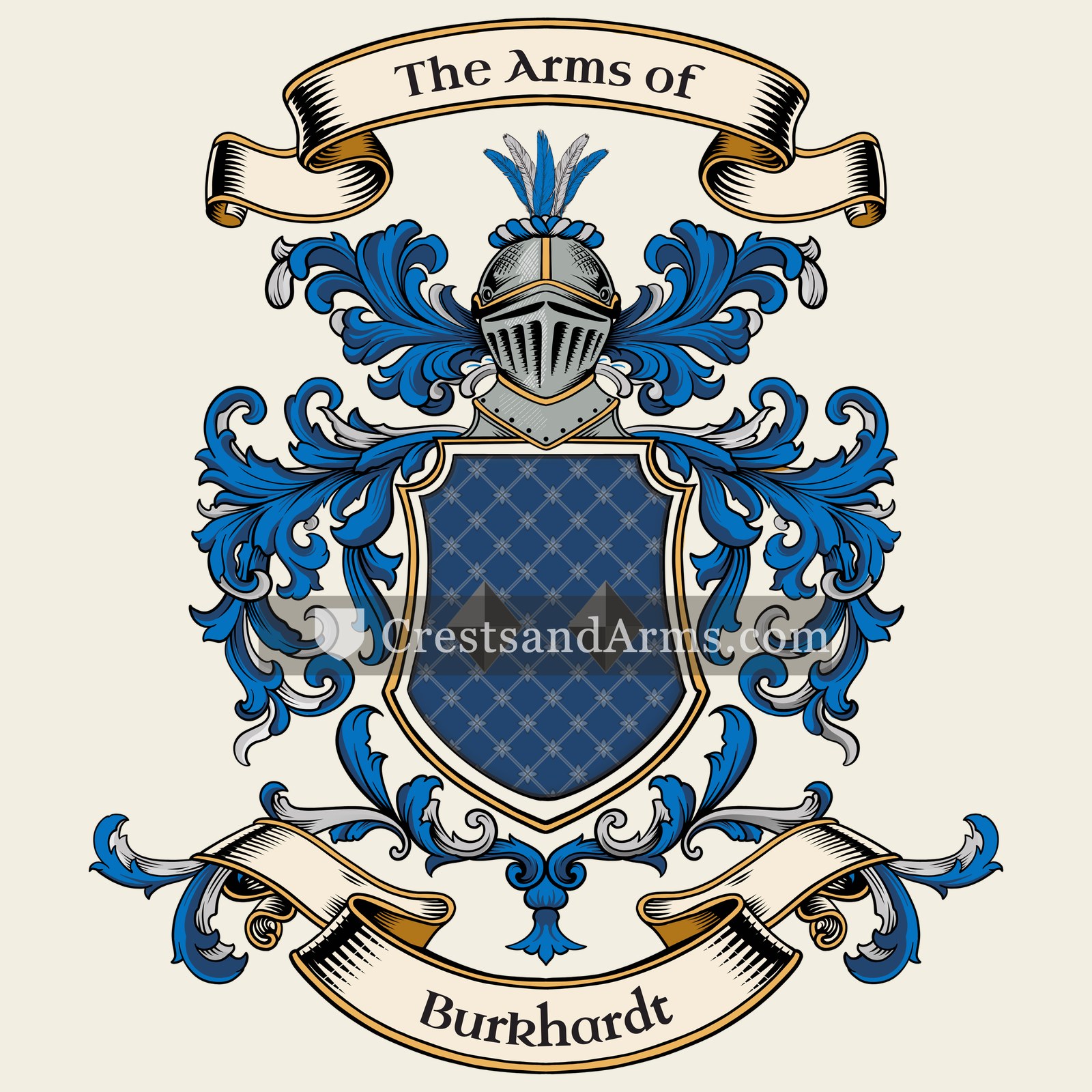

 mountThe ground held, and steadfastness upon it