Map of Scotland showing where the Burnett arms are recorded
The Burnett arms were recorded in Edinburgh, c. 1672.
Edinburgh was the seat of Scotland's government, its courts and its heralds. Families with business there settled nearby, and being close to where arms were recorded is exactly why so many of them appear.
This is where the arms were entered in the register. Families often moved to other parts of the country, so the same name can turn up in more than one region.
The body that granted and recorded arms in Scotland in this period.
Charles II of England
Sovereign of the period
Charles II of England
1660–1685
Reigning in Scotland when the Burnett arms are first recorded.
How Arms Worked in Scotland
Scottish heraldry is unique because it treats a coat of arms as a piece of personal property protected by law. Only one person can own a specific design at any given time. When a family grows, the head keeps the original shield while other relatives must apply for their own distinct version with slight changes to prove their specific identity.
Granting authority
The Court of the Lord Lyon acts as the official body that regulates and controls all heraldic matters throughout Scotland.
How they got arms
Individuals obtain a legal right to their arms through a formal petition process that confirms their identity and family connection.
Where arms were recorded
All valid coats of arms are officially entered into the Public Register of All Arms and Bearings starting from 1672.
The family's standing
Recorded among the armigerous families of Edinburgh.
Origin & History of the Burnett Family in Scotland
The history of the Burnett name in Scotland is deeply rooted in the social and political shifts of the medieval period. While the family name likely originated from a nickname describing someone with brown hair or a dark complexion, it became firmly established in Scottish life through land ownership and local influence. By the time records place the family in Edinburgh in 1672, the Burnetts had already spent centuries integrating into the fabric of Scottish society. They were often found in the northeastern regions of the country, where they served as landowners and local administrators. As the family grew, they moved into urban centers like Edinburgh to participate in the legal and mercantile activities that defined the capital during the seventeenth century. Their presence in the city during this era reflects a broader trend of families transitioning from rural estates to the growing professional circles of Scotland’s administrative heart.
Coat of Arms & Family Crest Details
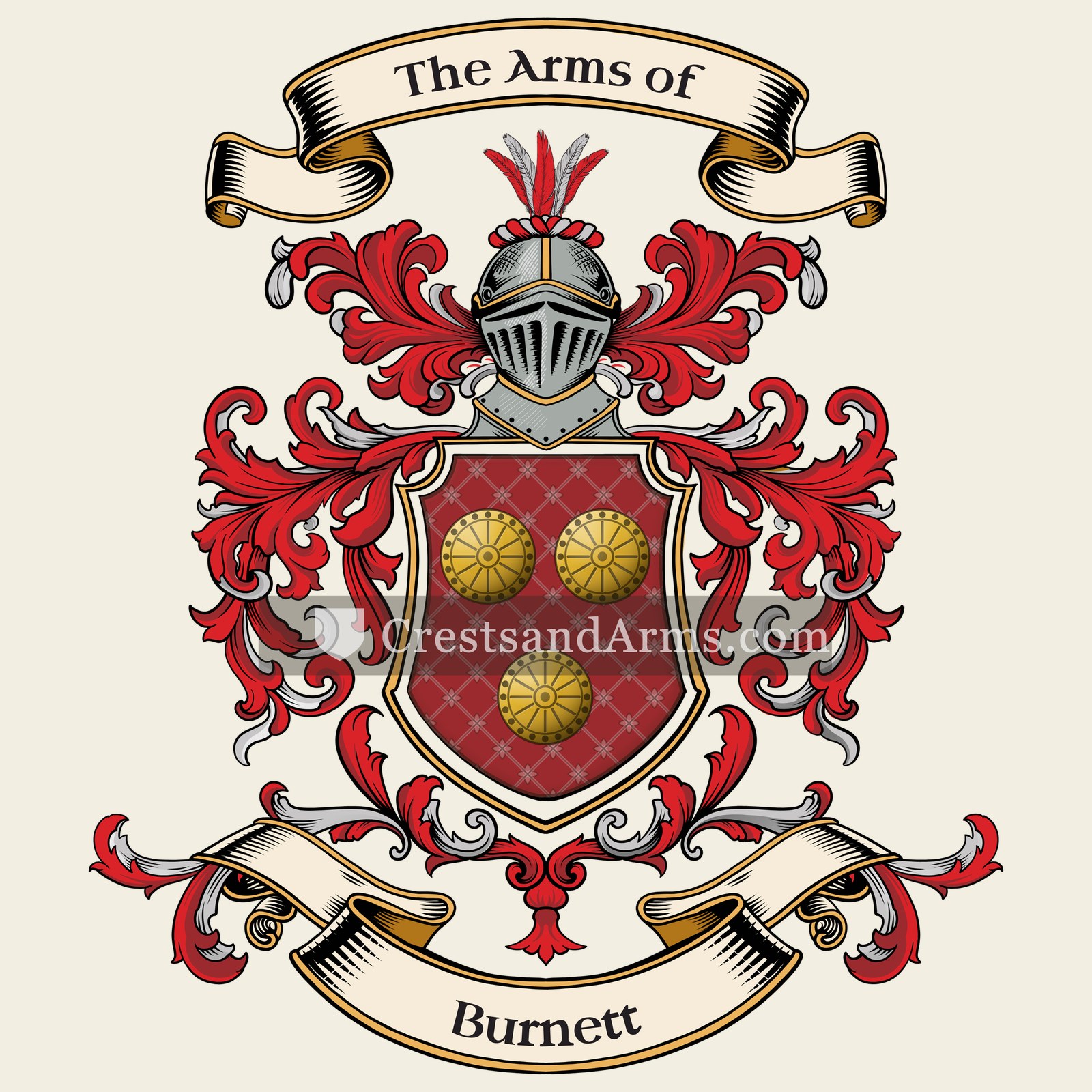
Symbols on this shield
roundelA coin, and one who has been to the crusades
Colours
Red (Gules)Means: Military strength
Gold (Or)Means: Generosity
Historical info
Source
Sir Bernard Burke, The General Armory of England, Scotland, Ireland and Wales, London: Harrison & Sons, 1884
Blazon (the actual original written record)
“Gu. three bezants”
Irelandc. 1645
Digital archive packCoat of arms PNG, gold border print PDF, vector SVG and the certificate of authenticity. Sent to your email in minutes.
Map of Ireland showing where the Burnett arms are recorded
The Burnett arms were recorded in Ireland, c. 1645.
Arms such as these were typically recorded in Dublin.
Dublin was the seat of government in Ireland and the place where grants were sought and recorded. Families with business at the castle or the courts settled nearby, and settling there put their arms on record.
This is where the arms were entered in the register. Families often moved to other parts of the country, so the same name can turn up in more than one region.
The body that granted and recorded arms in Ireland in this period.
Charles I of England
Sovereign of the period
Charles I of England
1625–1649
Reigning in Scotland when the Burnett arms are first recorded.
How Arms Worked in Ireland
The Ulster King of Arms granted coats of arms to individuals who proved their social standing and good character. These symbols were typically inherited by all legitimate descendants of the original holder. If a family branch wanted a unique look, they could apply for a specific change to their design through the office to ensure their identity remained distinct.
Granting authority
The Ulster King of Arms acted as the official body that regulated and issued all coats of arms throughout Ireland.
How they got arms
Families obtained their arms through formal grants issued by the office after proving their eligibility and paying the required fees.
Where arms were recorded
All official grants were recorded in the registers held by the Ulster King of Arms starting from the year 1552.
The family's standing
Recorded among the armigerous families of Ireland.
Origin & History of the Burnett Family in Ireland
The history of the Burnett name in Ireland is deeply connected to the social and political shifts of the seventeenth century. While the family name has roots in other parts of the British Isles, records confirm that members of the Burnett family were well-established in Dublin by 1645. During this period, Dublin served as a central hub for trade and administration, attracting families who were often involved in the professional or merchant classes. As the family settled into the urban landscape of the city, they became part of the complex social fabric of a changing Ireland. Over the following decades, the name appeared in various legal and property documents, reflecting the family's integration into the local community. By tracing these early residents, historians can better understand how families moved across borders to build new lives during a time of significant historical transition.
Burnett Meaning & Related Branches
Root word
Burnet
Derived from the Old French word for brown or dark-colored cloth.
This name
BurnettA topographic name for someone who lived near a brown stream or a person with dark hair.
also spelled
Burnitt
Burnitte
Related arms
Bournettvariant spelling
Dunbarrecorded with Burnett, same area
Kennedyrecorded with Burnett, same area
Nairnrecorded with Burnett, same area
Documented Sources
Sir Bernard Burke, The General Armory of England, Scotland, Ireland and Wales, London: Harrison & Sons, 1884
Black, George F., The Surnames of Scotland: Their Origin, Meaning, and History, 1946
National Records of Scotland, Register of the Privy Council of Scotland, 1672
Digital archive packCoat of arms PNG, gold border print PDF, vector SVG and the certificate of authenticity. Sent to your email in minutes.


 chiefAuthority, wisdom and dominion
 hollyTruth, and protection through winter
 chiefAuthority, wisdom and dominion
 hollyTruth, and protection through winter
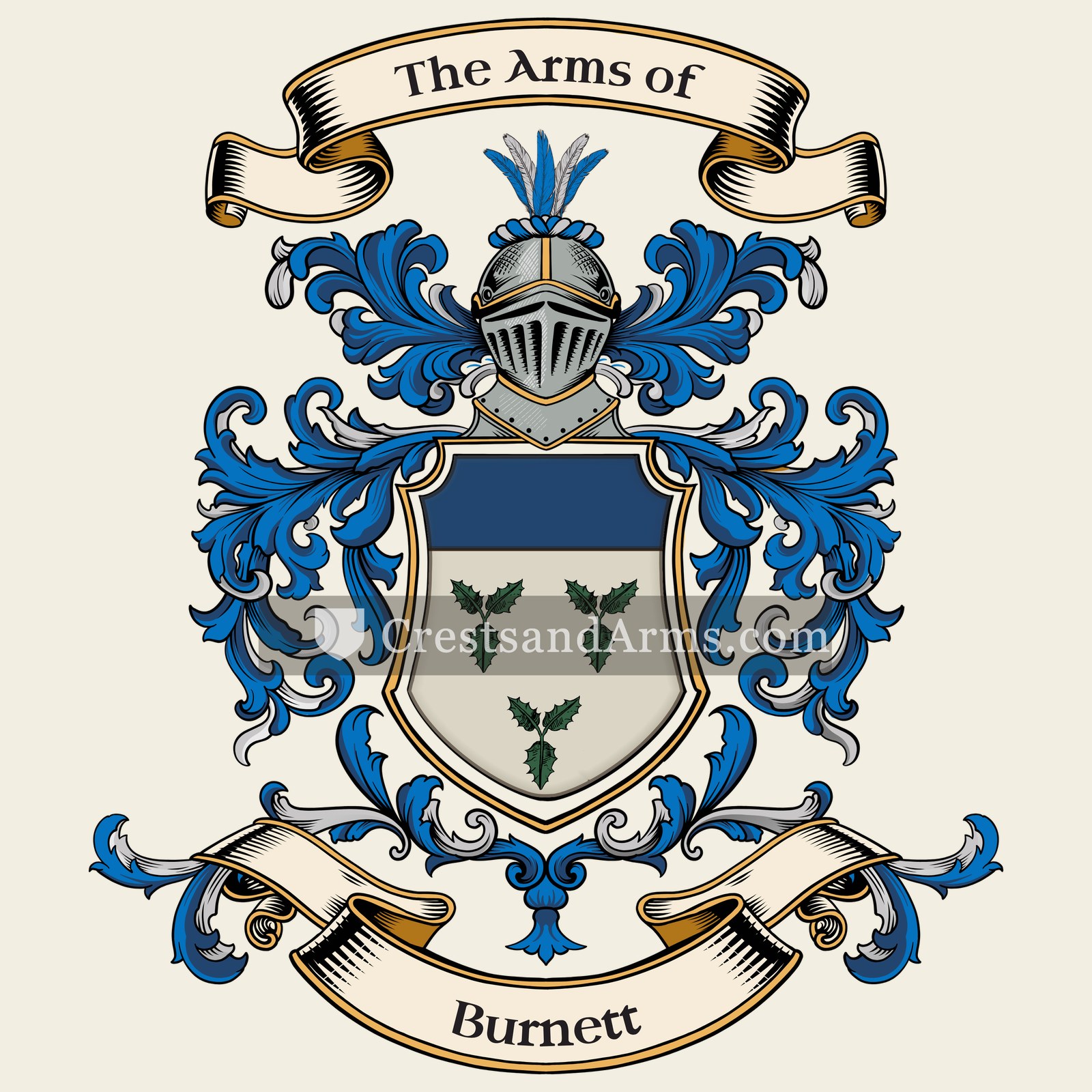


 roundelA coin, and one who has been to the crusades