A record of documented arms, meaning and origin, researched for the Burns family lines. Documented in 2 countries.
Reg. 7868 · Britain, A–C
Coat of Arms & Family Crest Details
Symbols on this shield
mountThe ground held, and steadfastness upon it
oakGreat age, strength and steadfastness
duckResourcefulness on land and water
Colours
Blue (Azure)Means: Loyalty and truth
Silver (Argent)Means: Peace and sincerity
Historical info
Source
J. B. Rietstap, Armorial Général, Gouda: G. B. van Goor Zonen, 1884–87
Blazon (the actual original written record)
“D'azur à un chêne d'arg., terrassé du même, surm. d'une canne et d'un huchet d'arg., passés en saut. C.: une colombe perchée sur un rameau de sin. et surm. des mots: WOODNOTES WILD. D.: BETTER WEE BUSH THAN NAE BIELD [Armes du poète Robert Burns.]”
Britainc. 1700
Digital archive packCoat of arms PNG, gold border print PDF, vector SVG and the certificate of authenticity. Sent to your email in minutes.
Map of Britain showing where the Burns arms are recorded
The Burns arms were recorded in Britain, c. 1700.
Arms such as these were typically recorded in Kent.
Kent sits between London and the short crossing to Europe, and the trade passing through made it wealthy. Merchant families bought land with that money, and it was landowners who took coats of arms.
This is where the arms were entered in the register. Families often moved to other parts of the country, so the same name can turn up in more than one region.
The body that granted and recorded arms in Britain in this period.
William III of England
Sovereign of the period
William III of England
1694–1702
Reigning in Britain when the Burns arms are first recorded.
How Arms Worked in Britain
English heraldry allowed arms to be shared by all legitimate descendants of the original owner. These symbols were treated as personal property that moved through the generations to all children. While the eldest son kept the original design, other family members could use the same shield without needing to change it or register their own unique versions.
Granting authority
The College of Arms in London has regulated the use of coats of arms throughout England and Wales since 1484.
How they got arms
Families typically obtained their coats of arms through a formal grant from the Crown or by proving their ancient right to them.
Where arms were recorded
All official coats of arms are recorded in the registers kept at the College of Arms, which date back to the fifteenth century.
The family's standing
Recorded among the armigerous families of Britain.
Origin & History of the Burns Family in Britain
The surname Burns is primarily rooted in the geography of the British Isles, as it functions as a topographic name derived from the Middle English word "burn," meaning a stream or a small river. People who lived near such a water source often adopted this term to distinguish themselves within their local communities. While the name has strong historical associations with Scotland, families carrying this name were well-established in the English county of Kent by the early 1700s. During this period, the name appeared frequently in parish registers as families settled into agricultural and trade roles in the region. These early records suggest that the name spread southward as individuals moved across Britain in search of new opportunities, carrying their regional identity with them into the southern English landscape.
Coat of Arms & Family Crest Details
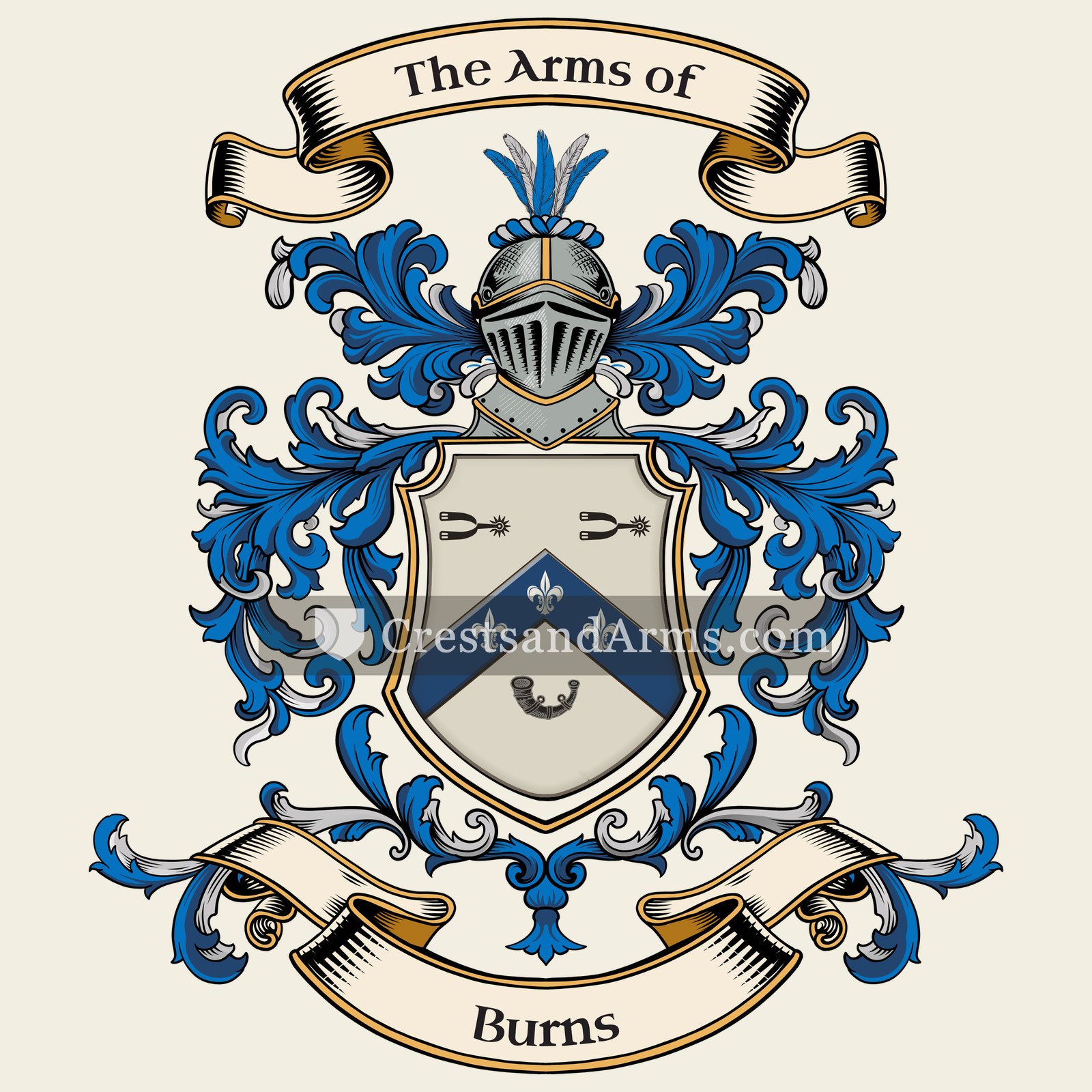
Symbols on this shield
chevronProtection, and faithful service completed
spurKnighthood, and readiness to spur on
hunting horn stringedOne who delights in the chase
fleur de lisPurity, light, and the sixth son
Colours
Silver (Argent)Means: Peace and sincerity
Blue (Azure)Means: Loyalty and truth
Black (Sable)Means: Constancy
Historical info
Source
Sir Bernard Burke, The General Armory of England, Scotland, Ireland and Wales, London: Harrison & Sons, 1884
Blazon (the actual original written record)
“Ar. on a chev. az. betw. two spur rowels in chief and a hunting horn in base sa., three fleurs-de-lis of the field”
DumbartonBloomhall · Dumbarton, c. 1856
Digital archive packCoat of arms PNG, gold border print PDF, vector SVG and the certificate of authenticity. Sent to your email in minutes.
Map of Scotland showing where the Burns arms are recorded
The Burns arms were recorded in Dumbarton, c. 1856.
Dumbartonshire sat where the Clyde meets the Highlands, guarded by a royal castle. Families held land in return for service, and service in arms brought a shield with it.
This is where the arms were entered in the register. Families often moved to other parts of the country, so the same name can turn up in more than one region.
The body that granted and recorded arms in Scotland in this period.
Victoria
Sovereign of the period
Victoria
1837–1901
Reigning in Britain when the Burns arms are first recorded.
How Arms Worked in Scotland
Scottish heraldry is unique because it treats a coat of arms as a piece of personal property protected by law. Only one person can own a specific design at any given time. When a family grows, the head keeps the original shield while other relatives must apply for their own distinct version with slight changes to prove their specific identity.
Granting authority
The Court of the Lord Lyon acts as the official body that regulates and controls all heraldic matters throughout Scotland.
How they got arms
Individuals obtain a legal right to their arms through a formal petition process that confirms their identity and family connection.
Where arms were recorded
All valid coats of arms are officially entered into the Public Register of All Arms and Bearings starting from 1672.
The family's standing
Recorded among the armigerous families of Dumbarton.
Origin & History of the Burns Family in Scotland
The surname Burns is a topographic name that originated in Scotland, where it was used to describe people who lived near a stream or a burn. In the Scots language, the word burn refers to a small river or a brook, making it a common descriptor for families living in rural areas near flowing water. By the mid-19th century, the name was well-established across the Scottish Lowlands, including the town of Dumbarton. Records from 1856 confirm that families bearing this name were active members of the Dumbarton community during this period, contributing to the local industrial and social life of the region. As the Industrial Revolution drew many people toward urban centers like Dumbarton, the name became increasingly associated with the labor and trade that defined the growth of Scottish towns in the Victorian era.
Burns Meaning & Related Branches
Root word
burna
Old English term referring to a small stream or brook.
This name
BurnsA topographic name for someone who lived near a stream or creek.
also spelled
Burnes
Burness
Related arms
Burnes de Montrosevariant spelling
Burnesvariant spelling
Burnessvariant spelling
Documented Sources
J. B. Rietstap, Armorial Général, Gouda: G. B. van Goor Zonen, 1884–87
Reaney, P.H. and Wilson, R.M., A Dictionary of English Surnames, 1991
Kent History and Library Centre, Parish Registers of Kent, 1700–1750
Digital archive packCoat of arms PNG, gold border print PDF, vector SVG and the certificate of authenticity. Sent to your email in minutes.


 mountThe ground held, and steadfastness upon it
 oakGreat age, strength and steadfastness
 duckResourcefulness on land and water
 mountThe ground held, and steadfastness upon it
 oakGreat age, strength and steadfastness
 duckResourcefulness on land and water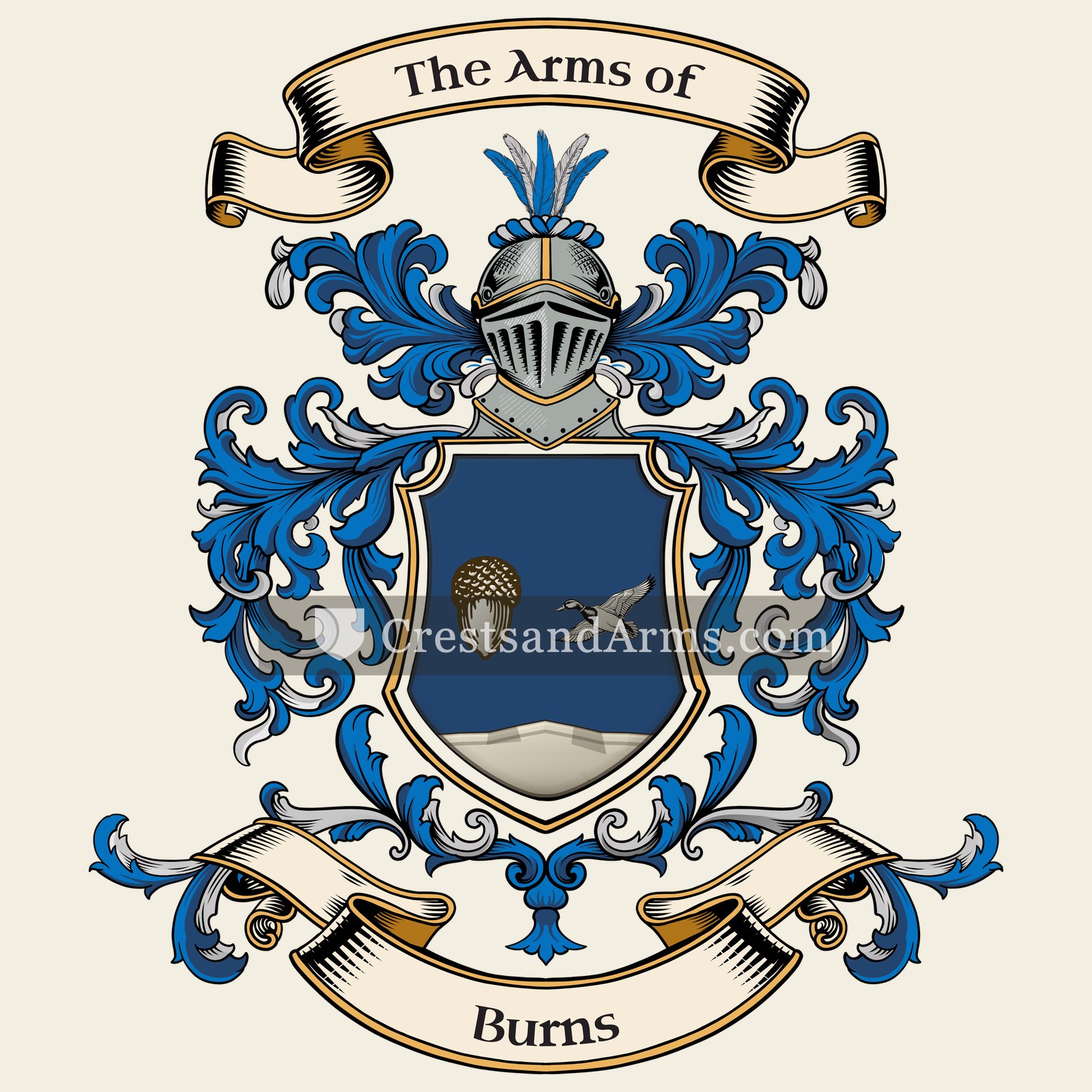


 chevronProtection, and faithful service completed
 spurKnighthood, and readiness to spur on
 hunting horn stringedOne who delights in the chase
 fleur de lisPurity, light, and the sixth son