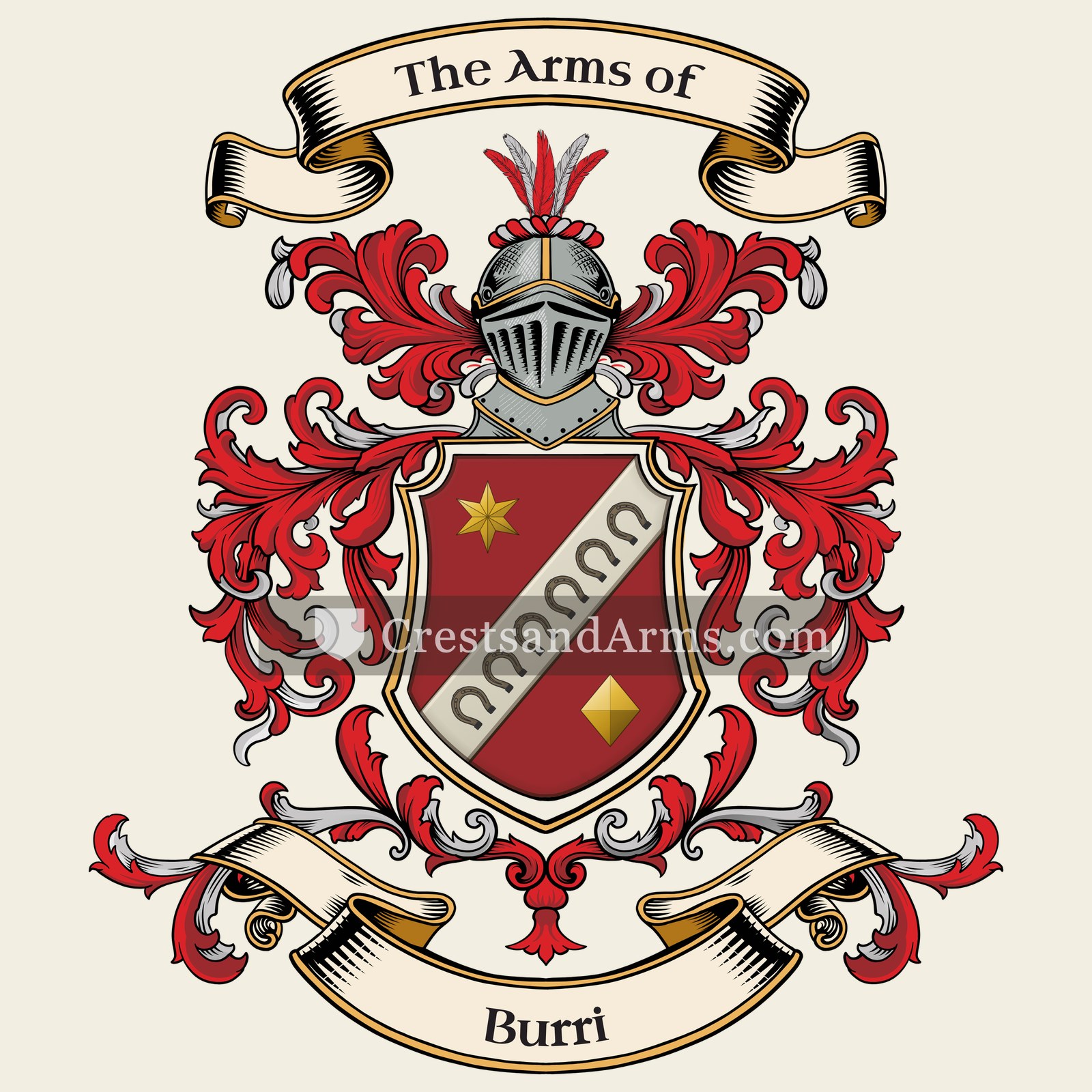
A record of documented arms, meaning and origin, researched for the Burri family of Switzerland.
Reg. 7810 · Swiss, A–C
Coat of Arms & Family Crest Details
Symbols on this shield
horseshoeGood fortune and protection from harm
starThe celestial goddess, and nobility
lozengeHonour and nobility, and the arms of a woman
Colours
Red (Gules)Means: Military strength
Silver (Argent)Means: Peace and sincerity
Gold (Or)Means: Generosity
Historical info
Source
J. B. Rietstap, Armorial Général, Gouda: G. B. van Goor Zonen, 1884–87
Blazon (the actual original written record)
“De gu. à la barre d'arg., ch. de six fers-à-cheval au nat., posés dans le sens de la barre, les bouts en bas; ladite barre acc. en chef d'une étoile d'or et en p. d'un fuseau d'or, posés en barre. C.: un homme iss., hab. de gu., rebr. d'or, au rabat du même, supp. de sa main dextre une étoile d'or, la sen. appuyée sur sa hanche.”
SwitzerlandWinterthur, c. 1725
Digital archive packCoat of arms PNG, gold border print PDF, vector SVG and the certificate of authenticity. Sent to your email in minutes.
Map of Switzerland showing where the Burri arms are recorded
The Burri arms were recorded in Winterthur, c. 1725.
This is where the arms were entered in the register. Families often moved to other parts of the country, so the same name can turn up in more than one region.
The body that granted and recorded arms in Switzerland in this period.
How Arms Worked in Switzerland
In Switzerland, coats of arms were not restricted to the nobility and were often adopted by common citizens and families. These symbols were passed down through generations to show family identity. When branches of a family grew, they often changed small details of the design to distinguish their own line from the original group.
Granting authority
Cantonal and civic authorities managed the use of coats of arms within their specific regions and local jurisdictions.
How they got arms
Families typically assumed their own coats of arms based on local custom rather than receiving them from a central monarch.
Where arms were recorded
Arms were recorded in various cantonal and civic registers starting from the fourteenth century throughout the Swiss region.
The family's standing
Recorded among the armigerous families of Switzerland.
Origin & History of the Burri Family in Switzerland
The family name Burri has deep roots in the German-speaking regions of Switzerland, particularly within the canton of Zurich. Historical records confirm that members of the Burri family were established residents of the city of Winterthur by 1725. During this period, Winterthur was a growing hub for trade and craftsmanship, and families like the Burris often played essential roles in the local economy as artisans or merchants. The name itself is thought to be a variation of older Germanic terms related to a small dwelling or a farmer, suggesting that the earliest ancestors were likely people who worked the land or lived in modest rural homes before moving into town centers. As the family became integrated into the life of Winterthur, they contributed to the social and civic development of the region over many generations.
Burri Meaning & Related Branches
Root word
Bur
Old High German term for a small house, dwelling, or hut.
This name
BurriRefers to a person who lived in or worked at a small farmstead.
also spelled
Burry
Burrie
Bury
Buri
Related arms
Buryvariant spelling
Documented Sources
J. B. Rietstap, Armorial Général, Gouda: G. B. van Goor Zonen, 1884–87
Staatsarchiv des Kantons Zürich, Kirchenbücher der Stadt Winterthur, 1725
Zürcher Familiennamenbuch, Familiennamenbuch der Schweiz, 1989
Digital archive packCoat of arms PNG, gold border print PDF, vector SVG and the certificate of authenticity. Sent to your email in minutes.


 horseshoeGood fortune and protection from harm
 starThe celestial goddess, and nobility
 lozengeHonour and nobility, and the arms of a woman
 horseshoeGood fortune and protection from harm
 starThe celestial goddess, and nobility
 lozengeHonour and nobility, and the arms of a woman