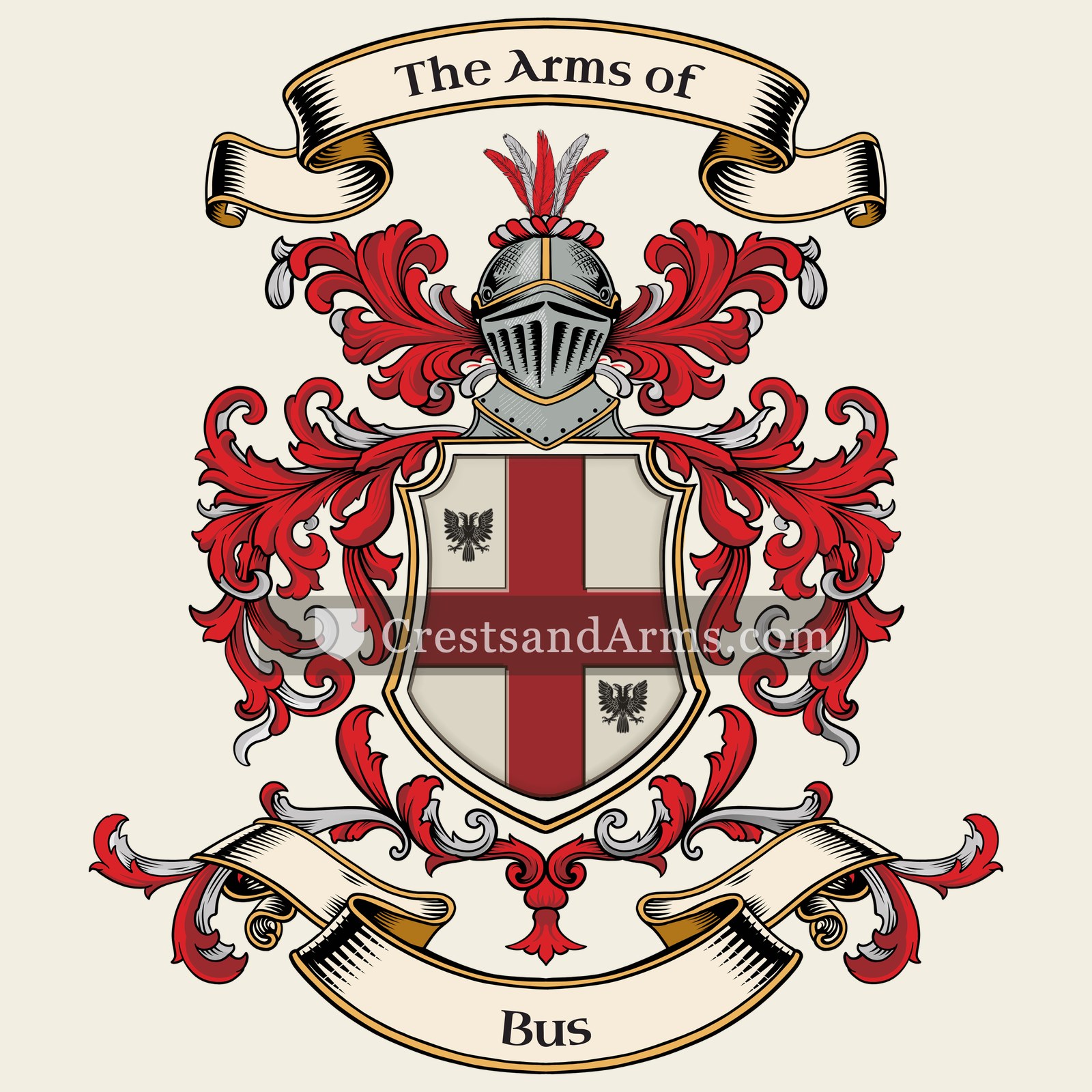
A record of documented arms, meaning and origin, researched for the Bus family of Germany.
Reg. 2085 · German, A–C
Coat of Arms & Family Crest Details
Symbols on this shield
cross symbolChristian faith and service
eagleNobility, strength and a keen mind
Colours
Silver (Argent)Means: Peace and sincerity
Red (Gules)Means: Military strength
Black (Sable)Means: Constancy
Historical info
Source
J. B. Rietstap, Armorial Général, Gouda: G. B. van Goor Zonen, 1884–87
Blazon (the actual original written record)
“Coupé: au 1 d'arg. à la croix alésée de gu.; au 2 parti : a. de gu. à une demi-aigle de sa., mouv. du parti, la poitrine ch. d'une tour d'arg.; b. d'or à une aigle de sa. Deux cq. cour. C. : 1° un demi-vol de sa., ch. d'une tour d'arg.; 1. d'arg. et de gu.; 2° une aigle de sa.; l. d'or et de sa.”
GermanyBade, c. 1863
Digital archive packCoat of arms PNG, gold border print PDF, vector SVG and the certificate of authenticity. Sent to your email in minutes.
Map of Germany showing where the Bus arms are recorded
The Bus arms were recorded in Bade, c. 1863.
This is where the arms were entered in the register. Families often moved to other parts of the country, so the same name can turn up in more than one region.
The body that granted and recorded arms in Germany in this period.
Wilhelm I
Sovereign of the period
Wilhelm I
1861–1888
Reigning in Germany when the Bus arms are first recorded.
How Arms Worked in Germany
Prussian heraldry was strictly tied to social rank and noble status rather than being a free choice for every citizen. These symbols were treated as permanent family property that moved through the generations to all legitimate heirs. If a family branch wanted to change their design to stand out, they had to apply for official permission to alter their specific version of the shield.
Granting authority
The Prussian Heroldsamt acted as the central state office that managed and strictly controlled all noble titles and coats of arms.
How they got arms
Families usually obtained their arms through formal royal grants or by proving their long-standing noble status to the state authorities.
Where arms were recorded
All official coats of arms were kept in the rolls of the Prussian Heroldsamt, which functioned from 1706 until 1918.
The family's standing
Recorded among the armigerous families of Germany.
Origin & History of the Bus Family in Germany
The family name Bus is deeply rooted in the historical landscape of the region surrounding Bade, where records confirm family members were established by 1863. The name likely originated as a topographic or occupational descriptor, a common practice in European naming conventions where families were identified by the land they cultivated or the specific trade they practiced within their village. During the mid-19th century, families in this area were often tied closely to the agricultural cycles of the local countryside, and the name Bus served as a primary identifier within the tight-knit social structure of the community. As the family grew and moved through the changing political and economic conditions of the 1800s, the name remained a constant link to their ancestral origins in Bade. This history reflects the broader patterns of migration and settlement that defined life in rural communities during that era.
Bus Meaning & Related Branches
Root word
Burkhard
Derived from the Germanic elements for fortress and hardy or brave.
This name
BusA shortened form of names like Burkhard, historically used as a nickname for a sturdy or protected individual.
also spelled
Bus
Documented Sources
J. B. Rietstap, Armorial Général, Gouda: G. B. van Goor Zonen, 1884–87


 cross symbolChristian faith and service
 eagleNobility, strength and a keen mind
 cross symbolChristian faith and service
 eagleNobility, strength and a keen mind