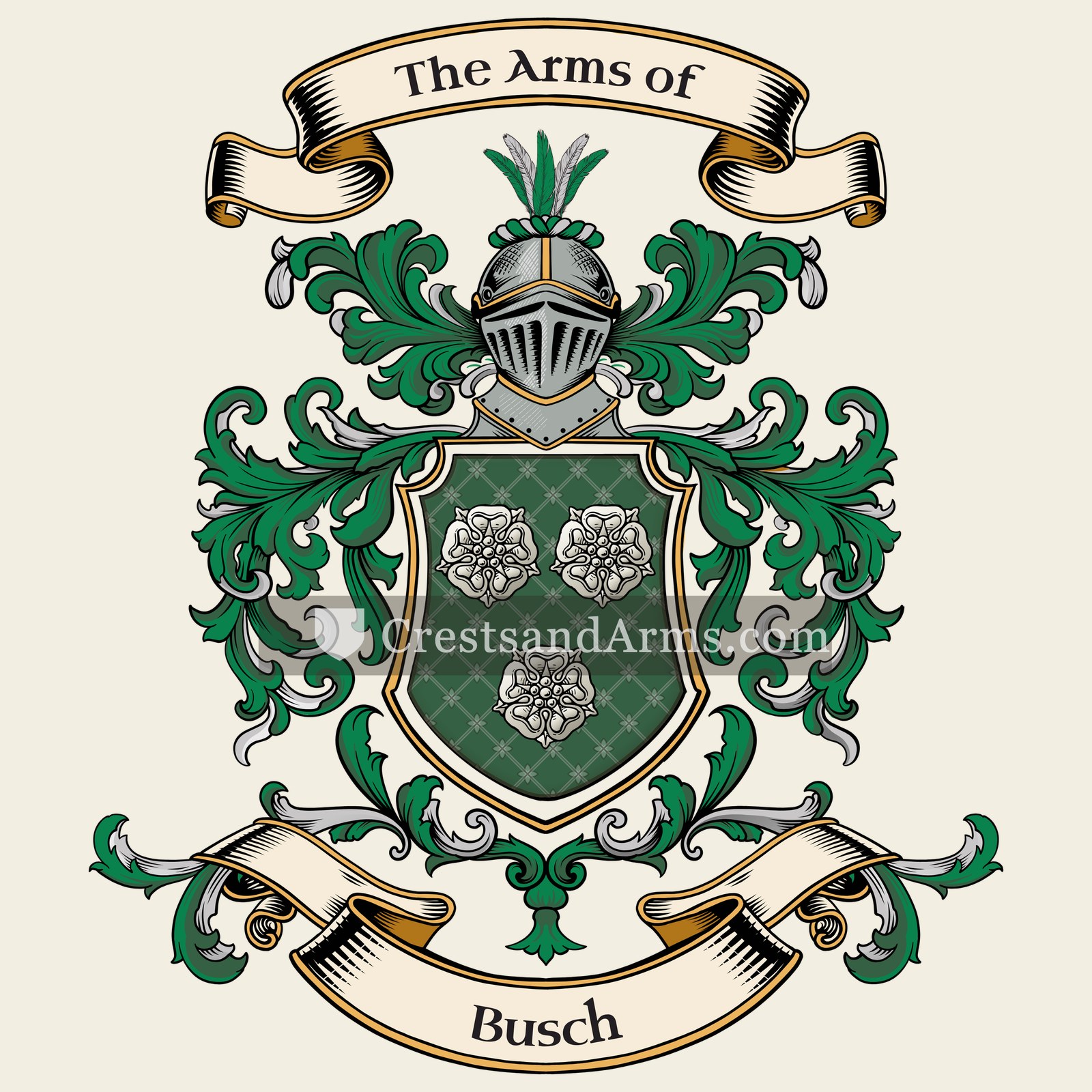
A record of documented arms, meaning and origin, researched for the Busch family lines. Documented in 2 countries.
Reg. 2015 · Dutch, A–C
Coat of Arms & Family Crest Details
Symbols on this shield
mountThe ground held, and steadfastness upon it
stagPeace and harmony, and one who will not fight unprovoked
treeLife, endurance and deep roots
Colours
Silver (Argent)Means: Peace and sincerity
Red (Gules)Means: Military strength
Historical info
Source
J. B. Rietstap, Armorial Général, Gouda: G. B. van Goor Zonen, 1884–87
Blazon (the actual original written record)
“D'arg. au cerf de gu., gravissant un rocher au nat., mouv. du flanc dextre; le tout soutenu d'une terrasse de sin., supp. à sen. deux arbres du même.”
NetherlandsRotterdam, c. 1815
Digital archive packCoat of arms PNG, gold border print PDF, vector SVG and the certificate of authenticity. Sent to your email in minutes.
Map of Netherlands showing where the Busch arms are recorded
The Busch arms were recorded in Rotterdam, c. 1815.
This is where the arms were entered in the register. Families often moved to other parts of the country, so the same name can turn up in more than one region.
Region
Rotterdam
Town
Rotterdam
First recorded
1815
Granting Authority for the Busch Arms
Hoge Raad van Adel
Photograph made by me · CC BY-SA 3.0
The body that granted and recorded arms in Netherlands in this period.
William I of the Netherlands
Sovereign of the period
William I of the Netherlands
1815–1840
Reigning in Netherlands when the Busch arms are first recorded.
How Arms Worked in Netherlands
In the Netherlands, coats of arms were often used by noble families and those who held specific public offices. These arms were passed down through the generations to legitimate descendants. Younger branches of a family usually kept the original design without needing to add special marks. This system ensured that the family identity remained clear and consistent over many years.
Granting authority
The Hoge Raad van Adel is the official body that regulates and manages noble titles and coats of arms in the Netherlands.
How they got arms
Families typically obtained their coats of arms through official royal grants or by proving their long-standing historical use of the symbols.
Where arms were recorded
Coats of arms are officially recorded in the registers held by the Hoge Raad van Adel, which began its work in 1814.
The family's standing
Recorded among the armigerous families of Netherlands.
Origin & History of the Busch Family in Netherlands
The family name Busch finds its roots in the Germanic and Dutch word for a small forest or a thicket. In the Netherlands, this name served as a topographic identifier for people who lived near a wooded area or a common grove. By the time the family was firmly established in Rotterdam in 1815, the city was a bustling center of trade and maritime activity. During this period, the Netherlands was undergoing significant social changes as it transitioned into the United Kingdom of the Netherlands following the Napoleonic era. Families like the Busch line often integrated into the urban fabric of port cities, contributing to the local economy through skilled labor or merchant activities. The name reflects a long history of connection to the land, evolving from a simple description of a person’s home into a permanent family identity that persisted through generations of growth in the Dutch landscape.
Coat of Arms & Family Crest Details
Symbols on this shield
roseThe seventh son, and beauty with grace
Colours
Silver (Argent)Means: Peace and sincerity
Historical info
Source
J. B. Rietstap, Armorial Général, Gouda: G. B. van Goor Zonen, 1884–87
Blazon (the actual original written record)
“De sin. à trois roses d'arg., tigées du même, mouv. d'un pot de gu.”
BavariaBavaria, c. 1730
Digital archive packCoat of arms PNG, gold border print PDF, vector SVG and the certificate of authenticity. Sent to your email in minutes.
Map of Germany showing where the Busch arms are recorded
The Busch arms were recorded in Bavaria, c. 1730.
Bavaria was a country of old landed families and walled market towns. Estates passed down the same line for centuries, and both the landowners and the leading townsmen kept arms, which is why so many Bavarian names sit in the registers.
This is where the arms were entered in the register. Families often moved to other parts of the country, so the same name can turn up in more than one region.
The body that granted and recorded arms in Germany in this period.
Charles VI, Holy Roman Emperor
Sovereign of the period
Charles VI, Holy Roman Emperor
1711–1740
Reigning in Netherlands when the Busch arms are first recorded.
How Arms Worked in Germany
In the Holy Roman Empire, coats of arms were often granted to individuals by the Emperor or his representatives. These arms were then passed down through the generations to all legitimate descendants of the original holder. Younger branches of a family usually kept the same shield design without needing to change it, as the arms belonged to the entire lineage.
Granting authority
The Holy Roman Emperor held the sole power to grant new coats of arms throughout his vast imperial territories.
How they got arms
Families typically obtained their coats of arms through a formal imperial grant or by proving their noble status to the authorities.
Where arms were recorded
These grants were officially recorded in the Imperial Chancery registers, which began keeping formal records of such honors during the Middle Ages.
The family's standing
Recorded among the armigerous families of Bavaria.
Origin & History of the Busch Family in Germany
The surname Busch is a classic example of a topographic name, which means it was originally given to people based on the landscape where they lived. In the German language, the word *Busch* refers to a thicket, a small wood, or a patch of brushland. During the Middle Ages, families often adopted these descriptive names to identify themselves by their proximity to a specific local landmark. By the time records confirm the presence of the Busch family in Bavaria in 1730, the name had already been established for centuries across various German-speaking regions. These early ancestors were likely farmers or forest dwellers who lived near the dense woodlands that covered much of the Bavarian countryside. As the family grew and moved through the region, the name remained a simple way to connect their identity to the natural environment that shaped their daily lives.
Busch Meaning & Related Branches
Root word
busc
A Germanic term referring to a thicket, shrub, or wooded area.
This name
BuschA topographic name for someone who lived near a forest or a thicket.
also spelled
Bush
Busche
Bousch
Related arms
Brink (von dem)recorded with Busch, same area
Merzrecorded with Busch, same area
Oheimbrecorded with Busch, same area
Strodlrecorded with Busch, same area
Documented Sources
J. B. Rietstap, Armorial Général, Gouda: G. B. van Goor Zonen, 1884–87


 mountThe ground held, and steadfastness upon it
 stagPeace and harmony, and one who will not fight unprovoked
 treeLife, endurance and deep roots
 mountThe ground held, and steadfastness upon it
 stagPeace and harmony, and one who will not fight unprovoked
 treeLife, endurance and deep roots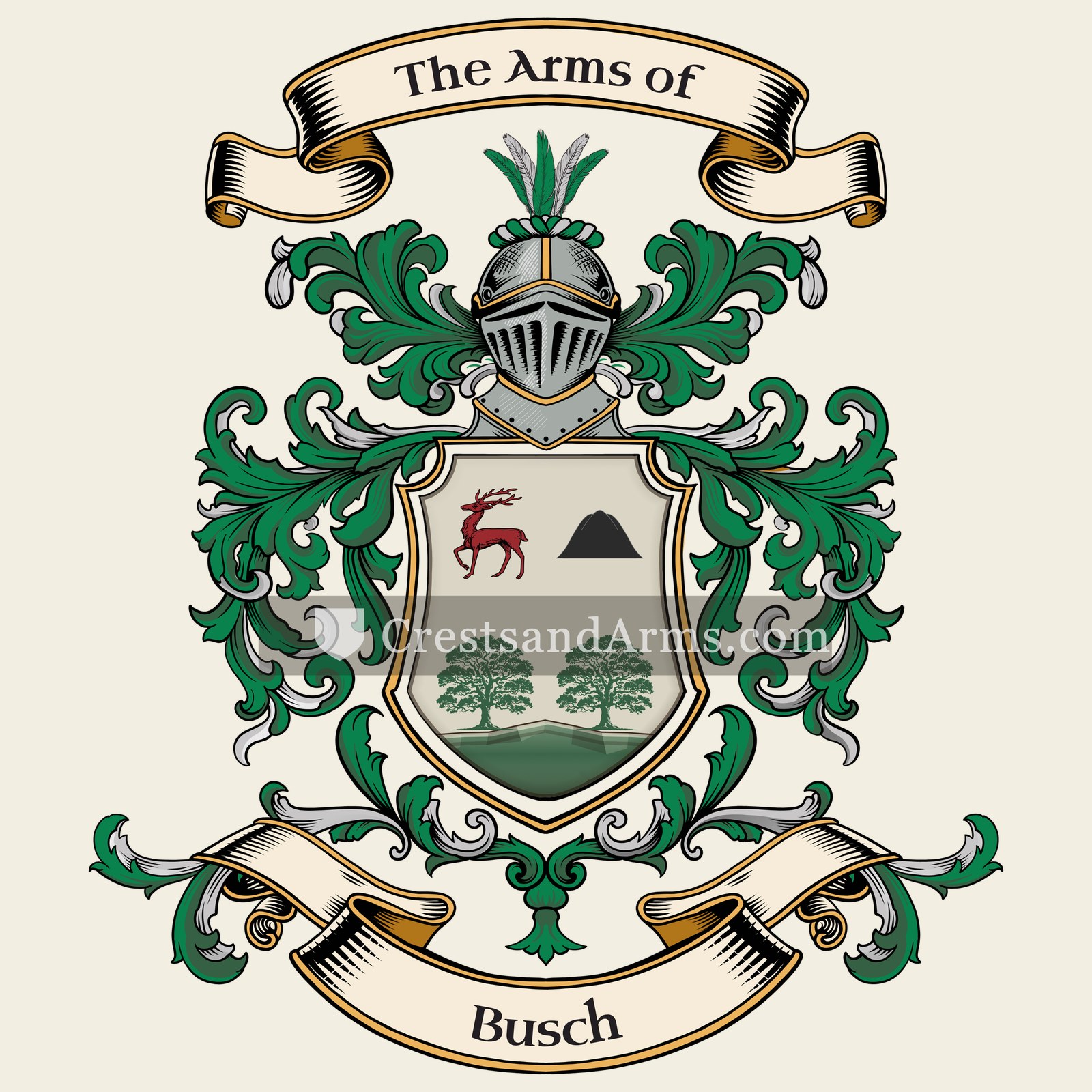


 roseThe seventh son, and beauty with grace