Map of Denmark showing where the Busse arms are recorded
The Busse arms were recorded in Denmark, c. 1722.
Arms such as these were typically recorded in Sjaælland.
Zealand held the Danish court, the crown's offices and Copenhagen itself. Families who served the king kept estates within reach of it, and royal service was the ordinary route to a coat of arms.
This is where the arms were entered in the register. Families often moved to other parts of the country, so the same name can turn up in more than one region.
The body that granted and recorded arms in Denmark in this period.
Frederik IV of Denmark
Sovereign of the period
Frederik IV of Denmark
1699–1730
Reigning in Denmark when the Busse arms are first recorded.
How Arms Worked in Denmark
Danish heraldry during this period was closely tied to noble status and royal favor rather than being open to all citizens. Arms were typically granted by the monarch to individuals, and these symbols were then shared by all members of the noble house. If a family line died out, the right to use those specific arms ended with them.
Granting authority
The Danish royal chancery held the power to issue and regulate official coats of arms for the kingdom.
How they got arms
Families usually received their arms through a formal royal grant that confirmed their noble status and rights.
Where arms were recorded
These grants were officially recorded in the Danish Royal Chancery records starting in the sixteenth century.
The family's standing
Recorded among the armigerous families of Denmark.
Origin & History of the Busse Family in Denmark
The family name Busse has deep roots in the Danish landscape, with documented evidence placing members of the family on the island of Sjælland as early as 1722. During this period, the name was often associated with families living in rural parishes where they worked as farmers or craftsmen. Because surnames were not strictly regulated in Denmark until the late 19th century, the name likely functioned as a way to identify a specific household or a person’s trade within their local community. As the family moved across the island, they integrated into the social and economic fabric of the Danish countryside. These early ancestors helped establish the foundation for the name in the region, leaving behind a trail of church records that document births, marriages, and deaths in the local parishes of Sjælland.
Coat of Arms & Family Crest Details
Symbols on this shield
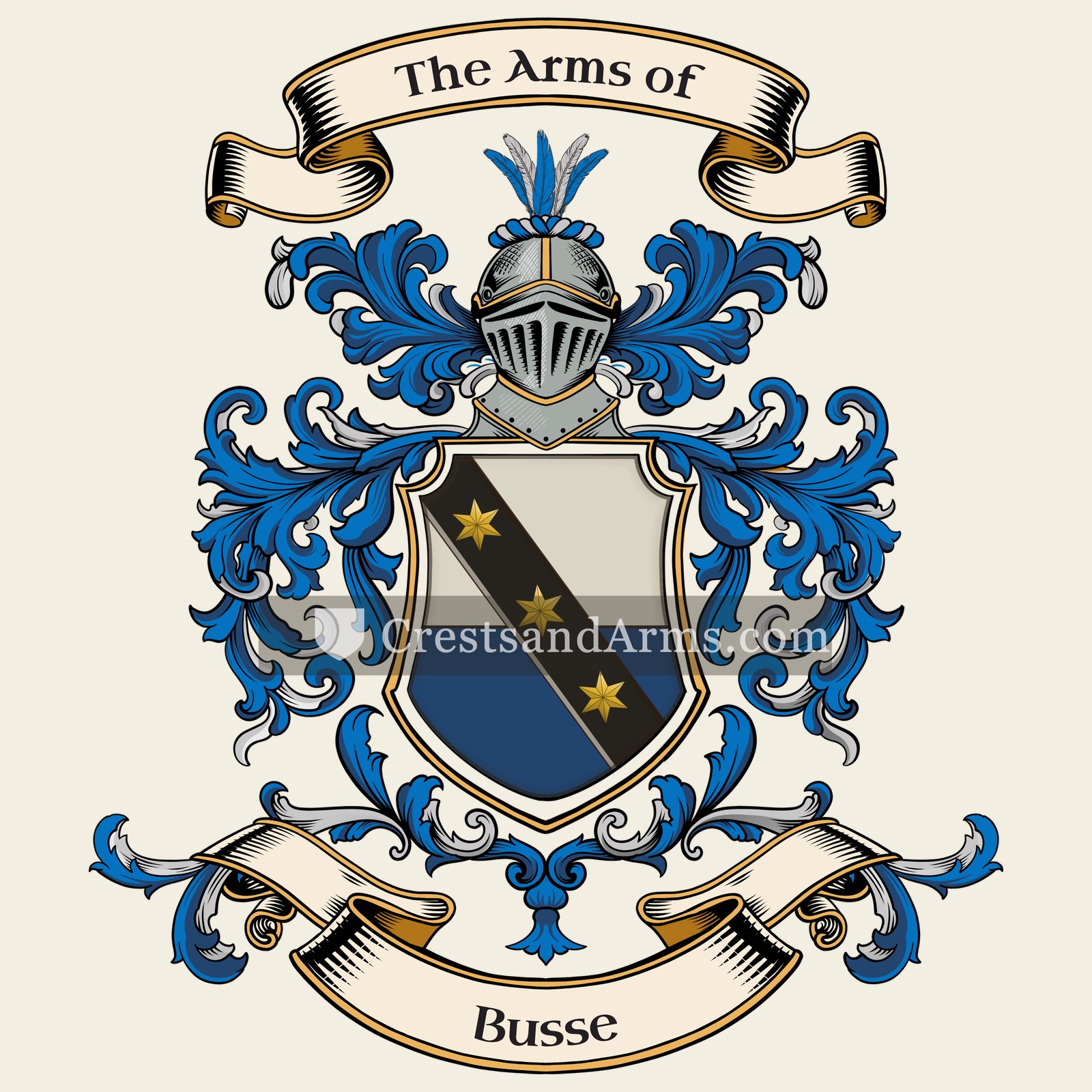
cross symbolChristian faith and service
roseThe seventh son, and beauty with grace
Colours
Blue (Azure)Means: Loyalty and truth
Gold (Or)Means: Generosity
Red (Gules)Means: Military strength
Historical info
Source
J. B. Rietstap, Armorial Général, Gouda: G. B. van Goor Zonen, 1884–87
Blazon (the actual original written record)
“D'azur à une croix latine d'or, acc. de trois roses de gu., bout. du sec., barbées de sin., deux accostant le pied de la croix, la troisième en p. Cq. cour. C.: la croix de l'écu. L. d'or et d'azur.”
SaxonySaxony, c. 1811
Digital archive packCoat of arms PNG, gold border print PDF, vector SVG and the certificate of authenticity. Sent to your email in minutes.
Map of Germany showing where the Busse arms are recorded
The Busse arms were recorded in Saxony, c. 1811.
Saxony had mines, trade and old landed families all at once. Silver made some fortunes and land held others, and both sorts of family kept arms, which is why Saxon names appear so often in the registers.
This is where the arms were entered in the register. Families often moved to other parts of the country, so the same name can turn up in more than one region.
The body that granted and recorded arms in Germany in this period.
Frederick William III of Prussia
Sovereign of the period
Frederick William III of Prussia
1797–1840
Reigning in Denmark when the Busse arms are first recorded.
How Arms Worked in Germany
Prussian heraldry was strictly tied to social rank and noble status rather than being a free choice for every citizen. These symbols were treated as permanent family property that moved through the generations to all legitimate heirs. If a family branch wanted to change their design to stand out, they had to apply for official permission to alter their specific version of the shield.
Granting authority
The Prussian Heroldsamt acted as the central state office that managed and strictly controlled all noble titles and coats of arms.
How they got arms
Families usually obtained their arms through formal royal grants or by proving their long-standing noble status to the state authorities.
Where arms were recorded
All official coats of arms were kept in the rolls of the Prussian Heroldsamt, which functioned from 1706 until 1918.
The family's standing
Recorded among the armigerous families of Saxony.
Origin & History of the Busse Family in Germany
The surname Busse is a German name that originated as a short form of the personal name Burkhard. During the Middle Ages, it was common for people to shorten long names to make them easier to use in daily life. The name gained popularity across northern and central Germany, particularly in regions like Saxony. By the early 19th century, families carrying the name were well-established in Saxon communities, where they often worked as farmers or skilled tradespeople. Because the name was tied to a common personal name rather than a specific location or job, it spread naturally as families moved through the German countryside. The presence of the Busse family in Saxony by 1811 reflects this long history of deep roots within the local population, where the name was passed down through generations as a marker of their regional identity.
Coat of Arms & Family Crest Details
Symbols on this shield
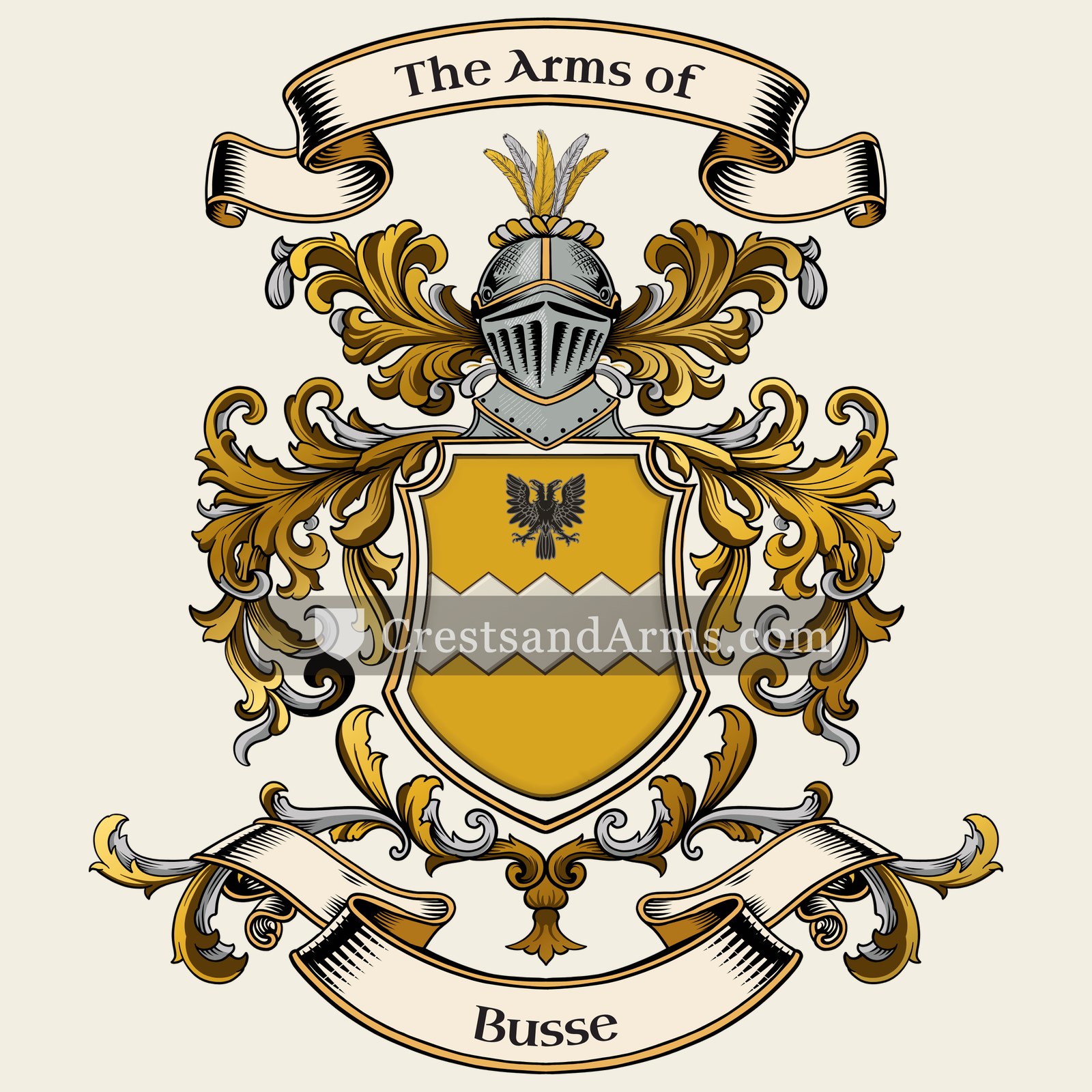
fessThe military belt, and readiness to serve
eagleNobility, strength and a keen mind
Colours
Gold (Or)Means: Generosity
Red (Gules)Means: Military strength
Silver (Argent)Means: Peace and sincerity
Black (Sable)Means: Constancy
Historical info
Source
J. B. Rietstap, Armorial Général, Gouda: G. B. van Goor Zonen, 1884–87
Blazon (the actual original written record)
“Coupé: au 1 d'or à l'aigle de sa., bq. et m. d'or; au 2 de gu. à la fasce vivrée alésée d'arg. Cq. cour. C.: cinq pl. d'aut., alt. de gu. et d'arg. L. d'arg. et de gu.”
Polandc. 1772
Digital archive packCoat of arms PNG, gold border print PDF, vector SVG and the certificate of authenticity. Sent to your email in minutes.
Map of Poland showing where the Busse arms are recorded
The Busse arms were recorded in Poland, c. 1772.
Arms such as these were typically recorded in Mazovia.
Mazovia held Warsaw, the Polish court and the assemblies where the szlachta met. Poland's nobles were unusually numerous and every one of them bore arms, and Warsaw is where those arms were argued over and recorded.
This is where the arms were entered in the register. Families often moved to other parts of the country, so the same name can turn up in more than one region.
Region
Mazovia
First recorded
1772
Granting Authority for the Busse Arms
Ennoblement by the Sejm
Author: Olek Remesz · CC BY-SA 3.0
The body that granted and recorded arms in Poland in this period.
Stanisław August Poniatowski
Sovereign of the period
Stanisław August Poniatowski
1764–1795
Reigning in Denmark when the Busse arms are first recorded.
How Arms Worked in Poland
Polish noble families shared a single coat of arms across many different surnames, creating large clans rather than individual designs. These symbols were held collectively by all members of the clan regardless of their specific family name. When a new family joined the nobility, they were adopted into an existing clan and began using that group's established shield.
Granting authority
The Sejm, which was the Polish parliament, held the power to grant noble status and the right to bear arms.
How they got arms
Families typically received their coat of arms through a formal act of ennoblement granted by the Sejm for distinguished service.
Where arms were recorded
These grants were officially recorded in the Crown Metrica, which served as the central archive for state documents starting in the sixteenth century.
The family's standing
Recorded among the armigerous families of Poland.
Origin & History of the Busse Family in Poland
The history of the Busse family in Poland is deeply rooted in the regional development of the Mazovia province during the late eighteenth century. By 1772, members of the family were already established within this area, which was a time of significant political transition and social change for the region. The name itself likely originated from Germanic roots, often serving as a short form for names like Burkhard, and it gradually integrated into the local Polish population as families settled into agricultural and trade communities. During this period, Mazovia served as a vital crossroads for movement and commerce, allowing families like the Busses to build lives within the local parish structures. These early ancestors were part of a broader demographic shift that saw families adapting to the changing borders and administrative systems of the Polish-Lithuanian Commonwealth. Their presence in the records of the time highlights a history of steady settlement and participation in the everyday life of the Mazovian landscape.
Busse Meaning & Related Branches
Root word
Burkhard
Derived from the Germanic elements for fortress and hardy or brave.
This name
BusseA diminutive form of names starting with Burkhard, signifying a protected or strong individual.
also spelled
Buse
Buss
Related arms
Busevariant spelling
Documented Sources
J. B. Rietstap, Armorial Général, Gouda: G. B. van Goor Zonen, 1884–87
Danish National Archives (Rigsarkivet), Kirkebøger (Parish Registers) for Sjællands Stift
Danish National Archives (Rigsarkivet), Folketællinger (Census Records) for Sjælland
Nielsen, Oluf. Kjøbenhavns Diplomatarium. 1872
Steenstrup, Johannes. Danske Stednavne. 1908
Digital archive packCoat of arms PNG, gold border print PDF, vector SVG and the certificate of authenticity. Sent to your email in minutes.


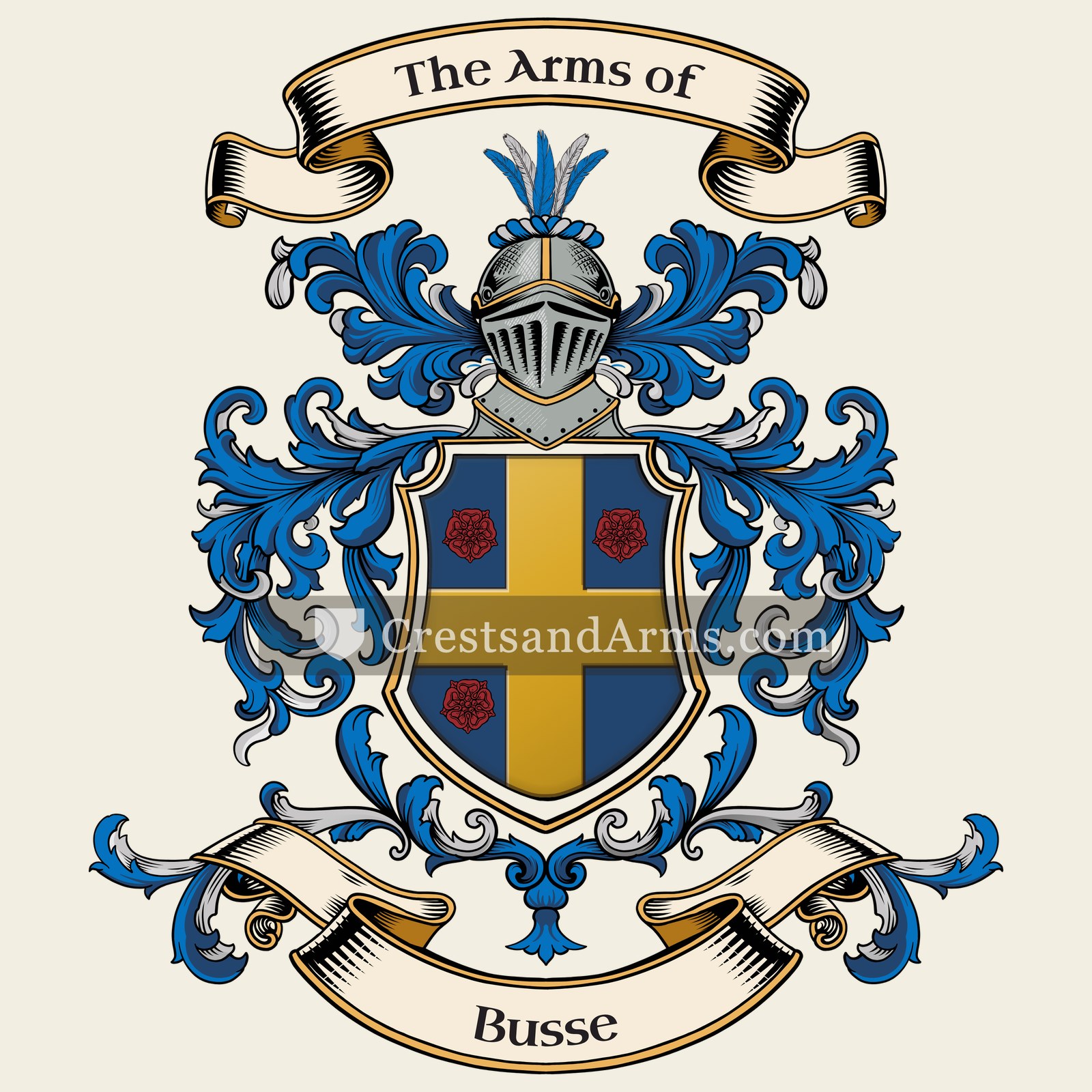
 bendDefence, and the scarf of a commander
 starThe celestial goddess, and nobility
 bendDefence, and the scarf of a commander
 starThe celestial goddess, and nobility


 cross symbolChristian faith and service
 roseThe seventh son, and beauty with grace


 fessThe military belt, and readiness to serve
 eagleNobility, strength and a keen mind