A record of documented arms, meaning and origin, researched for the Bussy family lines. Documented in 3 countries.
Reg. 3274 · German, A–C
Coat of Arms & Family Crest Details
Symbols on this shield
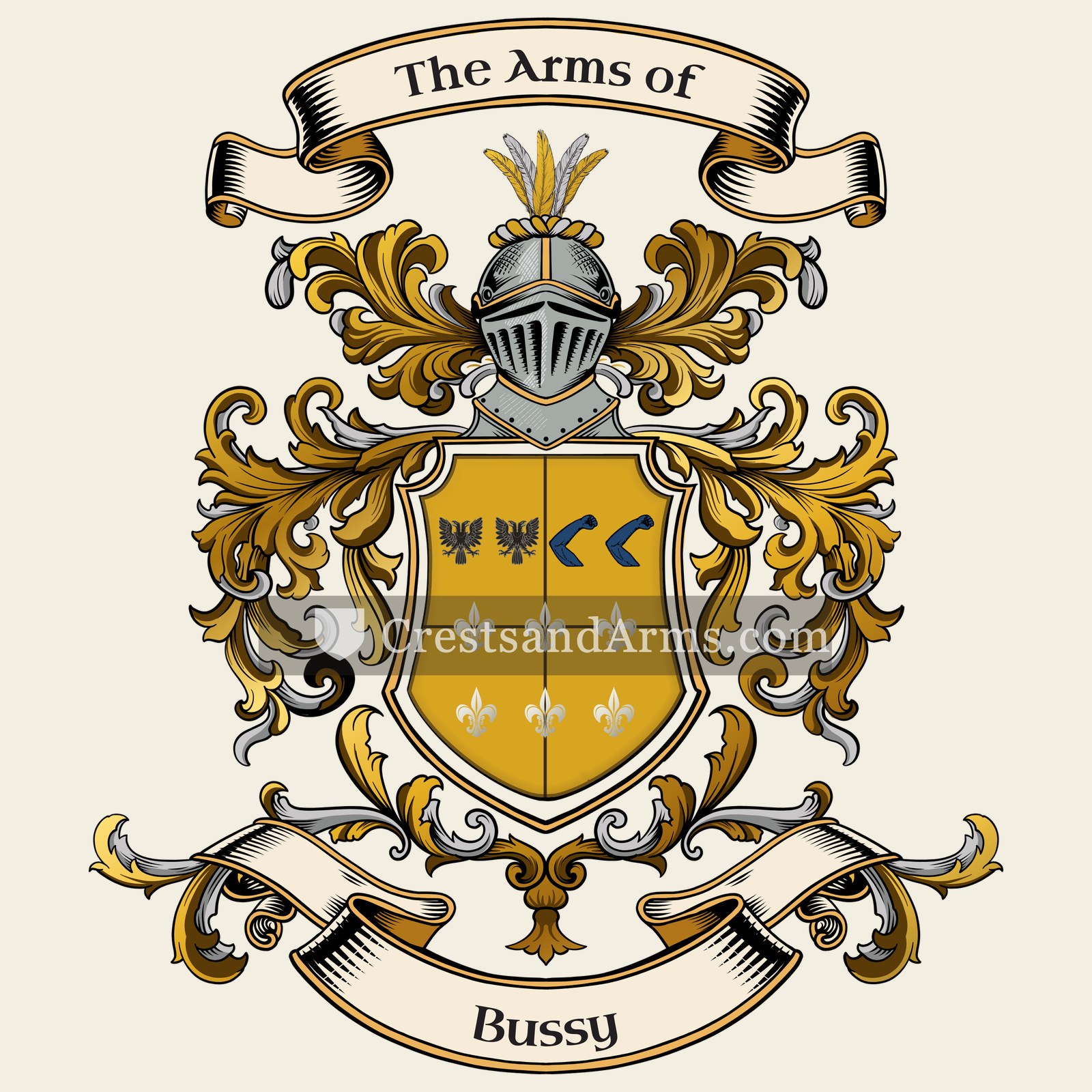
eagleNobility, strength and a keen mind
armA person of action, industrious and laborious
fleur de lisPurity, light, and the sixth son
Colours
Gold (Or)Means: Generosity
Black (Sable)Means: Constancy
Blue (Azure)Means: Loyalty and truth
Silver (Argent)Means: Peace and sincerity
Historical info
Source
J. B. Rietstap, Armorial Général, Gouda: G. B. van Goor Zonen, 1884–87
Blazon (the actual original written record)
“Ec.: aux 1 et 4 d'or à l'aigle de sa., cour. d'or, celle du 1 cont.; aux 2 et 3 de gu. à un bras, arm. d'azur, mouv. du flanc de l'écu, tenant un hêtre arr. au nat., acc. de trois fleurs-de-lis d'arg., dont deux près de la ligne du parti, l'une sur l'autre, et la troisième au-dessus de la courbe du bras. Cq. cour. C.: un hêtre au nat., entre un vol de gu., chaque aile ch. d'une fleur-de-lis d'arg. L.: à dextre d'or et de sa., à sen. d'arg. et de gu.”
SaxonySaxony, c. 1779
Digital archive packCoat of arms PNG, gold border print PDF, vector SVG and the certificate of authenticity. Sent to your email in minutes.
Map of Germany showing where the Bussy arms are recorded
The Bussy arms were recorded in Saxony, c. 1779.
Saxony had mines, trade and old landed families all at once. Silver made some fortunes and land held others, and both sorts of family kept arms, which is why Saxon names appear so often in the registers.
This is where the arms were entered in the register. Families often moved to other parts of the country, so the same name can turn up in more than one region.
The body that granted and recorded arms in Germany in this period.
Joseph II, Holy Roman Emperor
Sovereign of the period
Joseph II, Holy Roman Emperor
1765–1790
Reigning in Germany when the Bussy arms are first recorded.
How Arms Worked in Germany
In the Holy Roman Empire, coats of arms were often granted to individuals by the Emperor or his representatives. These arms were then passed down through the generations to all legitimate descendants of the original holder. Younger branches of a family usually kept the same shield design without needing to change it, as the arms belonged to the entire lineage.
Granting authority
The Holy Roman Emperor held the sole power to grant new coats of arms throughout his vast imperial territories.
How they got arms
Families typically obtained their coats of arms through a formal imperial grant or by proving their noble status to the authorities.
Where arms were recorded
These grants were officially recorded in the Imperial Chancery registers, which began keeping formal records of such honors during the Middle Ages.
The family's standing
Recorded among the armigerous families of Saxony.
Origin & History of the Bussy Family in Germany
The family name Bussy has deep roots in the historical landscape of Saxony, where members of the lineage were firmly established by 1779. During this period, the region was part of the Electorate of Saxony, a time marked by significant agricultural development and the growth of local administrative centers. Families like the Bussys often held positions within the local social structure that allowed them to participate in the evolving economy of the German states. As the eighteenth century progressed, the name became associated with the steady migration patterns of families moving between rural estates and growing towns. This movement was often driven by the need to secure stable land rights or to pursue new trade opportunities within the Saxon heartland. By settling in this region, the early Bussy family members became part of a long tradition of families who helped shape the cultural and social identity of eastern Germany during the Enlightenment era.
Coat of Arms & Family Crest Details
Symbols on this shield
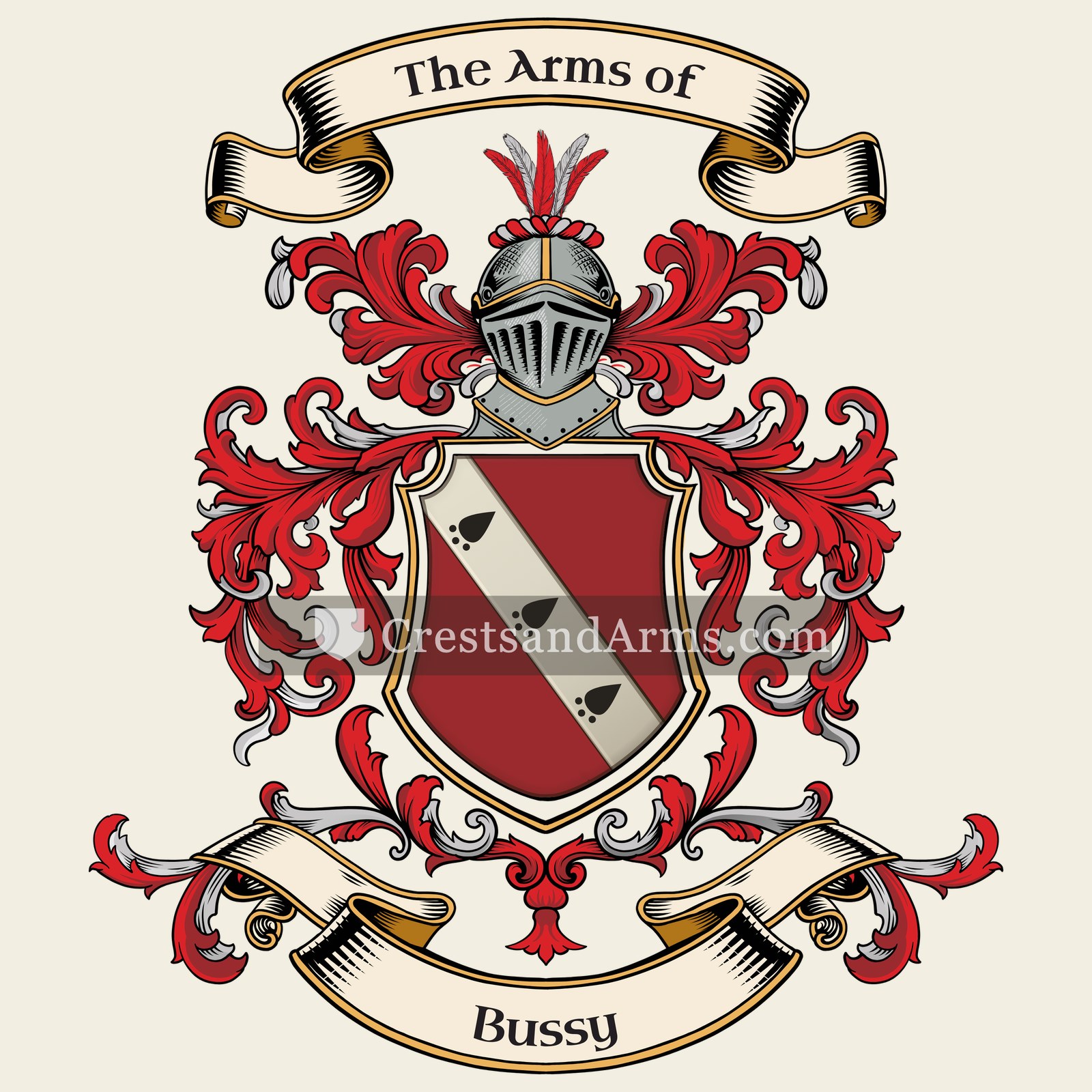
bendDefence, and the scarf of a commander
ermineDignity and rank
Colours
Red (Gules)Means: Military strength
Silver (Argent)Means: Peace and sincerity
Black (Sable)Means: Constancy
Historical info
Source
J. B. Rietstap, Armorial Général, Gouda: G. B. van Goor Zonen, 1884–87
Blazon (the actual original written record)
“De gu. à la bande d'arg., ch. de trois mouch. d'herm. de sa., posées chacune en pal.”
Switzerlandc. 1745
Digital archive packCoat of arms PNG, gold border print PDF, vector SVG and the certificate of authenticity. Sent to your email in minutes.
Map of Switzerland showing where the Bussy arms are recorded
The Bussy arms were recorded in Switzerland, c. 1745.
Arms such as these were typically recorded in Bern.
Bern was the largest of the Swiss cantons and ran itself, with its own council and its own courts. Its governing families held office for generations, and office of that kind carried a shield with it.
This is where the arms were entered in the register. Families often moved to other parts of the country, so the same name can turn up in more than one region.
The body that granted and recorded arms in Switzerland in this period.
How Arms Worked in Switzerland
In Switzerland, coats of arms were not restricted to the nobility and were often adopted by common citizens and families. These symbols were passed down through generations to show family identity. When branches of a family grew, they often changed small details of the design to distinguish their own line from the original group.
Granting authority
Cantonal and civic authorities managed the use of coats of arms within their specific regions and local jurisdictions.
How they got arms
Families typically assumed their own coats of arms based on local custom rather than receiving them from a central monarch.
Where arms were recorded
Arms were recorded in various cantonal and civic registers starting from the fourteenth century throughout the Swiss region.
The family's standing
Recorded among the armigerous families of Switzerland.
Origin & History of the Bussy Family in Switzerland
The family name Bussy has deep roots in the Swiss region of Bern, where records confirm members of the family were established by 1745. The name itself is likely topographic in origin, often linked to locations characterized by thickets or woods, which suggests the family’s earliest ancestors may have lived near such natural landmarks. During the eighteenth century, families in Bern were often integrated into the local civic and social structures, with many individuals working as skilled craftsmen or merchants to support the growing economy of the city. As the Bussy family settled into this environment, they became part of the local fabric of Swiss life, contributing to the community through their trade and daily interactions. Over time, the name persisted through generations, reflecting the stability and continuity of families who helped shape the historical landscape of the Bernese region.
Coat of Arms & Family Crest Details
Symbols on this shield
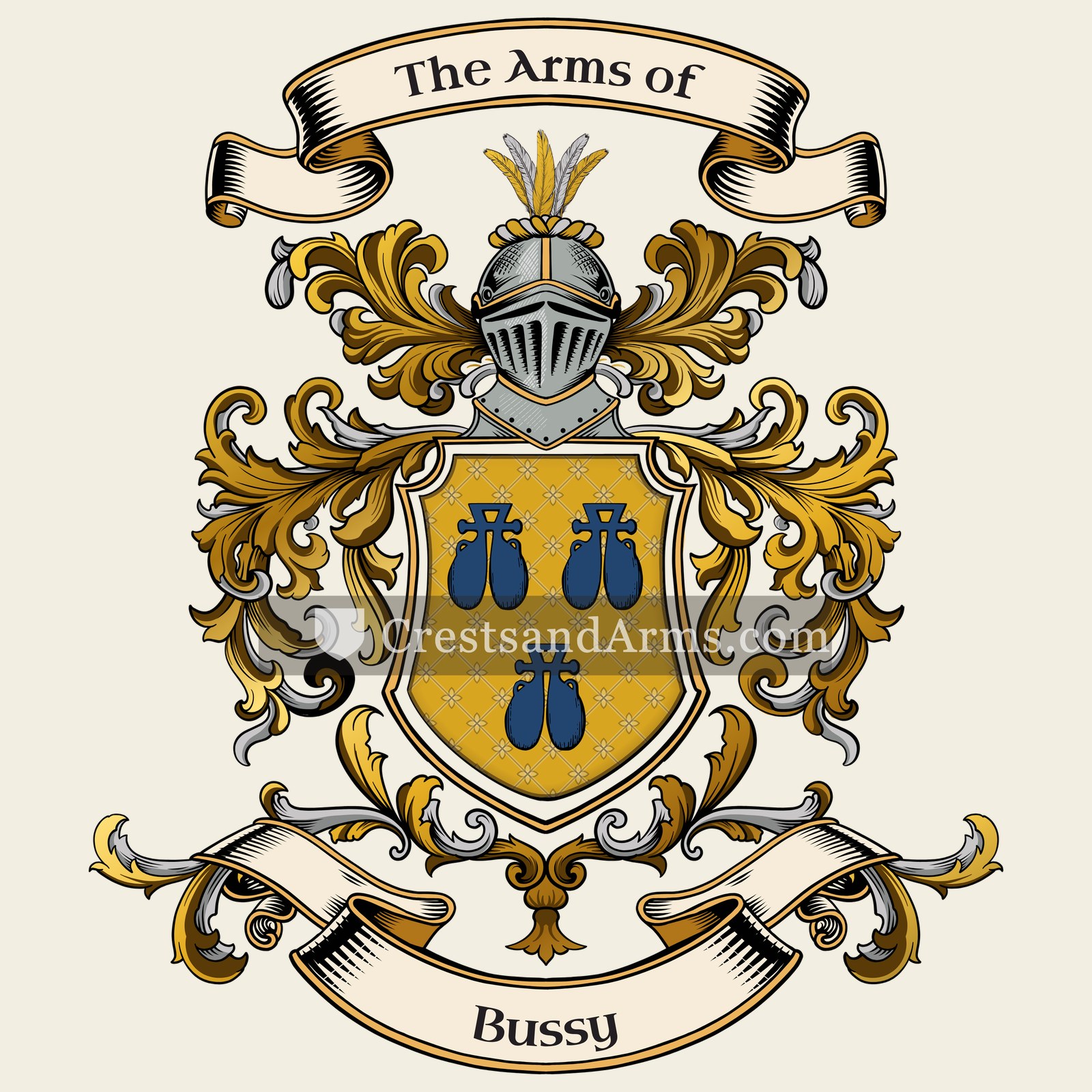
water bougetThe crusader's water carrier, and a journey made
Colours
Gold (Or)Means: Generosity
Blue (Azure)Means: Loyalty and truth
Historical info
Source
Sir Bernard Burke, The General Armory of England, Scotland, Ireland and Wales, London: Harrison & Sons, 1884
Blazon (the actual original written record)
“Or, three water bougets az”
Englandc. 1620
Digital archive packCoat of arms PNG, gold border print PDF, vector SVG and the certificate of authenticity. Sent to your email in minutes.
Map of England showing where the Bussy arms are recorded
The Bussy arms were recorded in England, c. 1620.
Arms such as these were typically recorded in York.
Yorkshire is the largest of the English counties, and it held more gentry families than any other. Land there was split among a great many households rather than a few, so a great many of them carried arms.
This is where the arms were entered in the register. Families often moved to other parts of the country, so the same name can turn up in more than one region.
The body that granted and recorded arms in England in this period.
James VI and I
Sovereign of the period
James VI and I
1603–1625
Reigning in Germany when the Bussy arms are first recorded.
How Arms Worked in England
English heraldry allowed arms to be shared by all legitimate descendants of the original owner. These symbols were treated as personal property that moved through the generations to all children. While the eldest son kept the original design, other family members could use the same shield without needing to change it or register their own unique versions.
Granting authority
The College of Arms in London has regulated the use of coats of arms throughout England and Wales since 1484.
How they got arms
Families typically obtained their coats of arms through a formal grant from the Crown or by proving their ancient right to them.
Where arms were recorded
All official coats of arms are recorded in the registers kept at the College of Arms, which date back to the fifteenth century.
The family's standing
Recorded among the armigerous families of England.
Origin & History of the Bussy Family in England
The family name Bussy has roots that stretch back to the medieval period, though its presence in England became firmly established through local records over several centuries. By the year 1620, the family was well-settled in the city of York, where they were active members of the community during a time of significant social change. The name itself is thought to be locational in origin, likely derived from places in northern France that were brought to England following the Norman Conquest. As the family integrated into English life, they transitioned from their continental origins to become part of the growing merchant and professional classes in northern England. Their presence in York suggests that they were involved in the regional trade and civic administration that defined the city during the early seventeenth century. This transition reflects the broader movement of families who settled in English urban centers and helped shape the local history of their respective counties.
Bussy Meaning & Related Branches
Root word
Bus
A Germanic personal name derived from the word for bush or thicket.
This name
BussyA topographic name for someone who lived near a thicket or wooded area.
also spelled
Bussi
Bussie
Busee
Bussey
Related arms
Bleymannsimilar arms
Dornbergsimilar arms
Friesenhausensimilar arms
Bussivariant spelling
Documented Sources
J. B. Rietstap, Armorial Général, Gouda: G. B. van Goor Zonen, 1884–87
Katalog der Deutschen Nationalbibliothek, Verzeichnis der in den deutschen Bibliotheken vorhandenen Kirchenbücher, 1995
Sächsisches Staatsarchiv, Bestand 10001: Ältere Akten der Landesregierung, 1779
Friedrich Bülau, Geschichte der sächsischen Staaten von der frühesten Zeit bis auf die Gegenwart, 1854
Digital archive packCoat of arms PNG, gold border print PDF, vector SVG and the certificate of authenticity. Sent to your email in minutes.


 eagleNobility, strength and a keen mind
 armA person of action, industrious and laborious
 fleur de lisPurity, light, and the sixth son
 eagleNobility, strength and a keen mind
 armA person of action, industrious and laborious
 fleur de lisPurity, light, and the sixth son


 bendDefence, and the scarf of a commander
 ermineDignity and rank

 water bougetThe crusader's water carrier, and a journey made