A record of documented arms, meaning and origin, researched for the Butt family lines. Documented in 3 countries.
Reg. 8182 · German, A–C
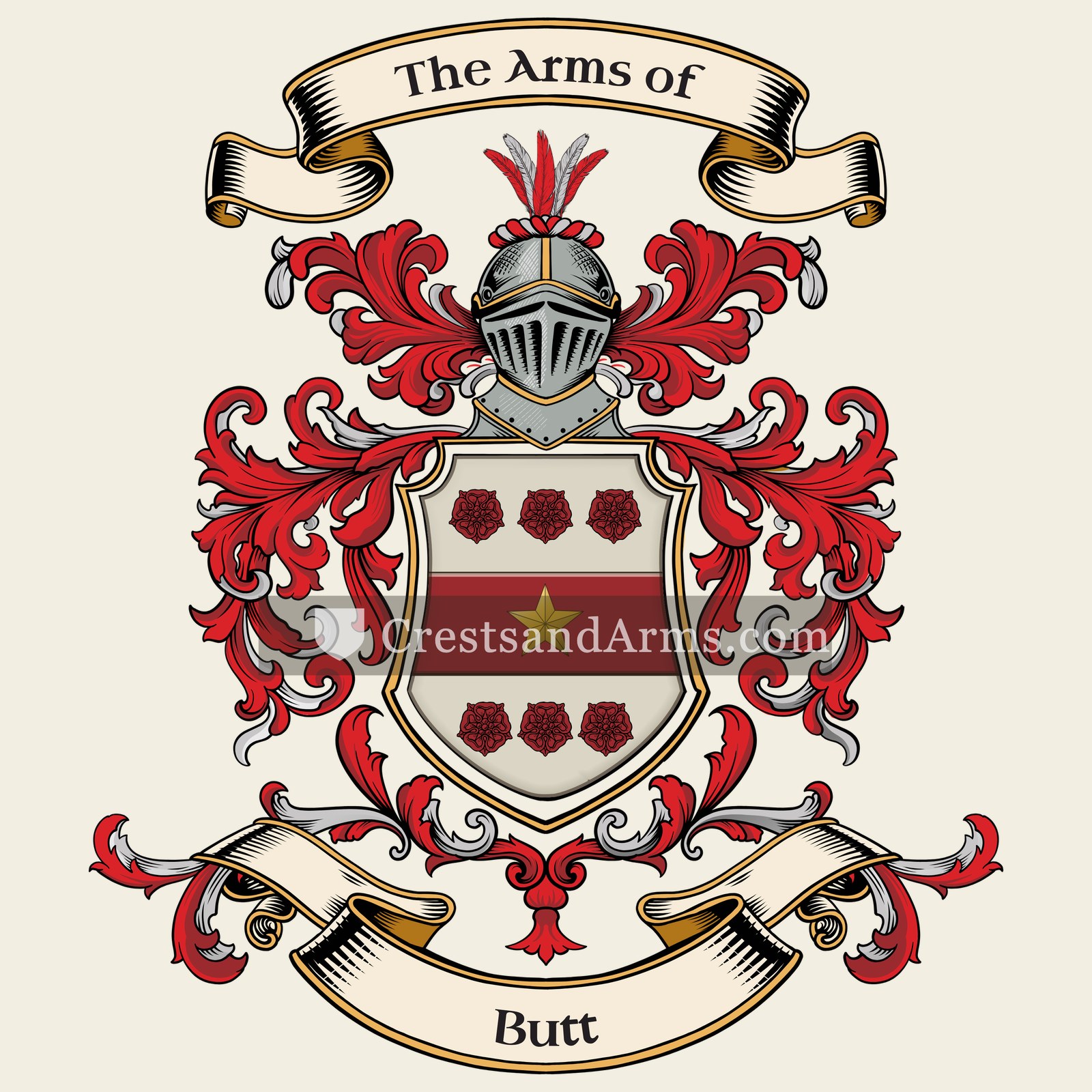
Coat of Arms & Family Crest Details
Symbols on this shield
fessThe military belt, and readiness to serve
mulletThe third son, and a divine quality from above
roseThe seventh son, and beauty with grace
Colours
Silver (Argent)Means: Peace and sincerity
Red (Gules)Means: Military strength
Gold (Or)Means: Generosity
Historical info
Source
J. B. Rietstap, Armorial Général, Gouda: G. B. van Goor Zonen, 1884–87
Blazon (the actual original written record)
“D'arg. à une fasce de gu., ch. d'une plie d'or et acc. de six roses du sec.”
Germanyc. 1802
Where the Butt Arms Were Recorded
Bavaria
Map of Germany showing where the Butt arms are recorded
The Butt arms were recorded in Germany, c. 1802.
Arms such as these were typically recorded in Bavaria.
Bavaria was a country of old landed families and walled market towns. Estates passed down the same line for centuries, and both the landowners and the leading townsmen kept arms, which is why so many Bavarian names sit in the registers.
This is where the arms were entered in the register. Families often moved to other parts of the country, so the same name can turn up in more than one region.
The body that granted and recorded arms in Germany in this period.
Francis II, Holy Roman Emperor
Sovereign of the period
Francis II, Holy Roman Emperor
1792–1806
Reigning in Germany when the Butt arms are first recorded.
How Arms Worked in Germany
In the Holy Roman Empire, coats of arms were often granted to individuals by the Emperor or his representatives. These arms were then passed down through the generations to all legitimate descendants of the original holder. Younger branches of a family usually kept the same shield design without needing to change it, as the arms belonged to the entire lineage.
Granting authority
The Holy Roman Emperor held the sole power to grant new coats of arms throughout his vast imperial territories.
How they got arms
Families typically obtained their coats of arms through a formal imperial grant or by proving their noble status to the authorities.
Where arms were recorded
These grants were officially recorded in the Imperial Chancery registers, which began keeping formal records of such honors during the Middle Ages.
The family's standing
Recorded among the armigerous families of Germany.
Origin & History of the Butt Family in Germany
The surname Butt has deep roots in the German-speaking regions of Europe, where it functioned as a descriptive name for ancestors who lived long ago. In the German language, the word *Butt* often referred to a type of flatfish, such as a flounder or a turbot. It is likely that the name began as a nickname for a person who worked as a fisherman or perhaps someone who had physical traits that others compared to the fish. By the time members of the family were documented in Bavaria in 1802, the name had already been established for generations within local communities. These early families were often part of the agrarian society that defined the region, living in small villages where their trade or personal characteristics became their permanent identifier. As the family moved and grew throughout the nineteenth century, they carried this history with them, transitioning from a simple nickname into a formal family name that connected them to their Bavarian origins.
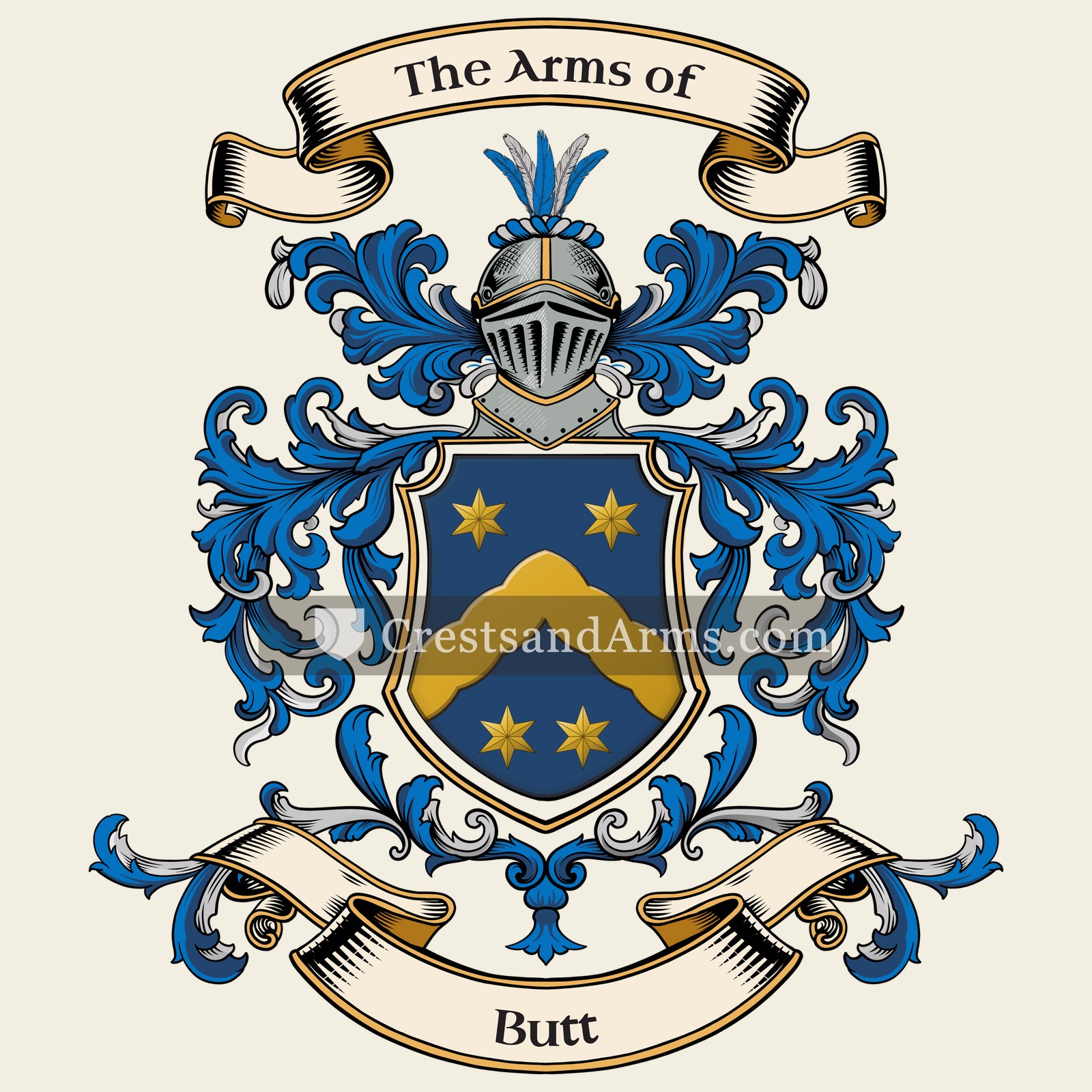
Coat of Arms & Family Crest Details
Symbols on this shield
chevronProtection, and faithful service completed
starThe celestial goddess, and nobility
Colours
Blue (Azure)Means: Loyalty and truth
Gold (Or)Means: Generosity
Historical info
Source
Sir Bernard Burke, The General Armory of England, Scotland, Ireland and Wales, London: Harrison & Sons, 1884
Blazon (the actual original written record)
“Az. two chev. engr. betw. four estoiles, three in chief and one in base or”
MiddlesexMiddlesex, c. 1620
Where the Butt Arms Were Recorded
Middlesex
Map of England showing where the Butt arms are recorded
The Butt arms were recorded in Middlesex, c. 1620.
Middlesex was the county around London, and City money flowed straight into it. Merchants and officials bought estates within reach of the capital, and a new estate brought a coat of arms with it.
This is where the arms were entered in the register. Families often moved to other parts of the country, so the same name can turn up in more than one region.
The body that granted and recorded arms in England in this period.
James VI and I
Sovereign of the period
James VI and I
1603–1625
Reigning in Germany when the Butt arms are first recorded.
How Arms Worked in England
English heraldry allowed arms to be shared by all legitimate descendants of the original owner. These symbols were treated as personal property that moved through the generations to all children. While the eldest son kept the original design, other family members could use the same shield without needing to change it or register their own unique versions.
Granting authority
The College of Arms in London has regulated the use of coats of arms throughout England and Wales since 1484.
How they got arms
Families typically obtained their coats of arms through a formal grant from the Crown or by proving their ancient right to them.
Where arms were recorded
All official coats of arms are recorded in the registers kept at the College of Arms, which date back to the fifteenth century.
The family's standing
Recorded among the armigerous families of Middlesex.
Origin & History of the Butt Family in England
The surname Butt has roots that stretch deep into the social landscape of medieval England, where it likely originated as a descriptive nickname or a reference to a specific location. In many cases, the name was linked to individuals who lived near a boundary marker or a target used for archery practice, which was known as a butt. By the early 17th century, the family had established a clear presence in Middlesex, a county that served as a vital hub for trade and administration near London. Records from 1620 confirm that members of the Butt family were active within this region during a time of significant social change and expansion. As these early ancestors navigated life in Middlesex, they contributed to the local community through their work and daily interactions, helping to cement the name within the historical fabric of the English countryside.
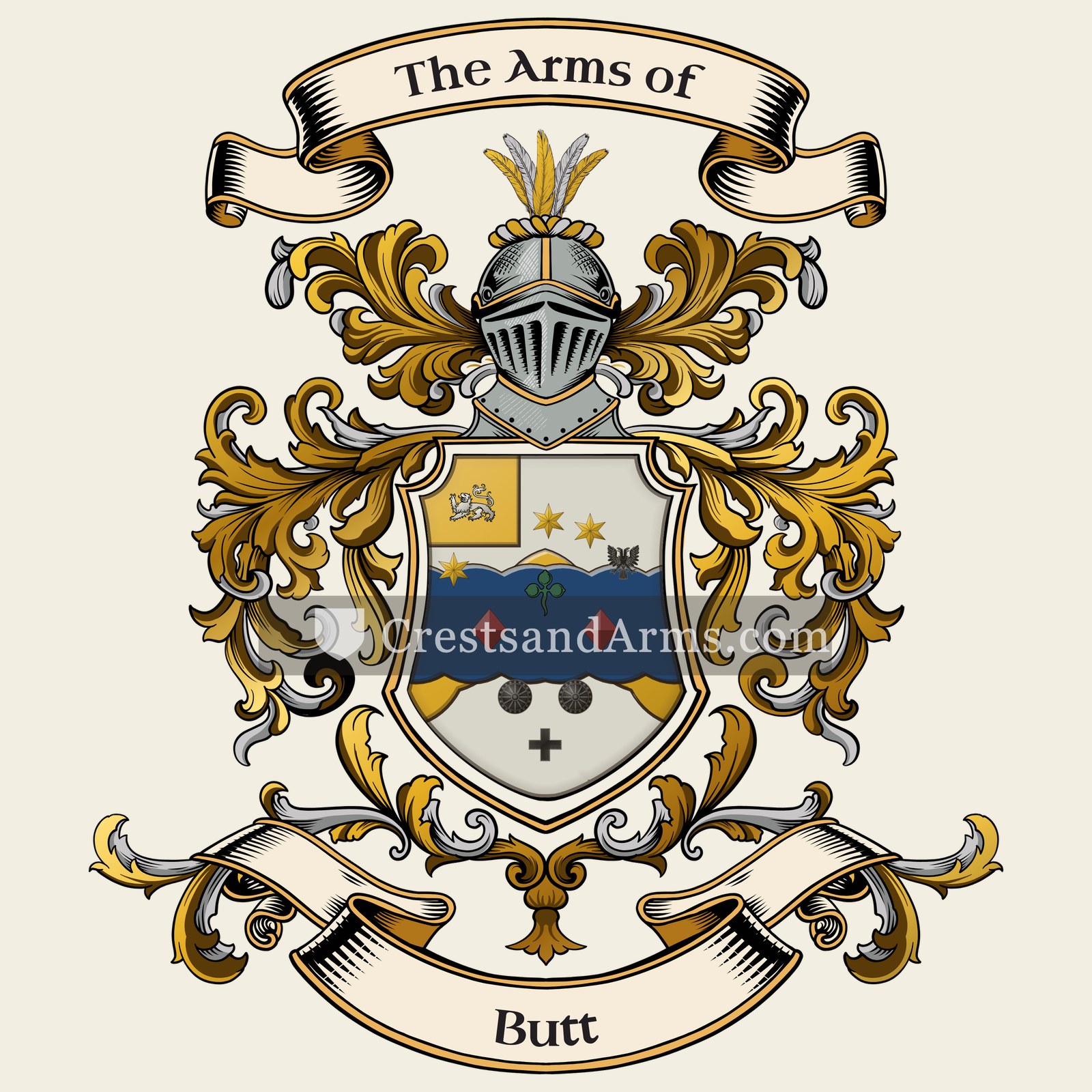
Coat of Arms & Family Crest Details
Symbols on this shield
chevronProtection, and faithful service completed
cantonA mark of honour granted by the sovereign
cross symbolChristian faith and service
trefoilPerpetuity, and the Trinity
starThe celestial goddess, and nobility
lozengeHonour and nobility, and the arms of a woman
lionCourage, strength and royalty
eagleNobility, strength and a keen mind
roundelA coin, and one who has been to the crusades
Colours
Gold (Or)Means: Generosity
Blue (Azure)Means: Loyalty and truth
Green (Vert)Means: Hope
Red (Gules)Means: Military strength
Silver (Argent)Means: Peace and sincerity
Black (Sable)Means: Constancy
Historical info
Source
Sir Bernard Burke, The General Armory of England, Scotland, Ireland and Wales, London: Harrison & Sons, 1884
Blazon (the actual original written record)
“Quarterly, 1st and 4th, gu. on a chev. engr. betw. three estoiles or, a trefoil vert betw. two lozenges of the field, for BUTT; 2nd, or, three bars az. on a canton gu. a lion's head erased ar., for Cox; 3rd, ar. an eagle displ. and in chief betw. two pellets a cross crosslet fitchée sa., for RAMSAY (the cross crosslet being adopted in commemoration of a descent through the RAMSAYS from the family of O'DONNELL)”
LimerickLimerick, c. 1645
Where the Butt Arms Were Recorded
Limerick
Map of Ireland showing where the Butt arms are recorded
The Butt arms were recorded in Limerick, c. 1645.
Limerick was river country in western Ireland with a walled city at its centre. Merchant families ran the city and bought land around it, and both the trade and the land brought arms.
This is where the arms were entered in the register. Families often moved to other parts of the country, so the same name can turn up in more than one region.
The body that granted and recorded arms in Ireland in this period.
Charles I of England
Sovereign of the period
Charles I of England
1625–1649
Reigning in Germany when the Butt arms are first recorded.
How Arms Worked in Ireland
The Ulster King of Arms granted coats of arms to individuals who proved their social standing and good character. These symbols were typically inherited by all legitimate descendants of the original holder. If a family branch wanted a unique look, they could apply for a specific change to their design through the office to ensure their identity remained distinct.
Granting authority
The Ulster King of Arms acted as the official body that regulated and issued all coats of arms throughout Ireland.
How they got arms
Families obtained their arms through formal grants issued by the office after proving their eligibility and paying the required fees.
Where arms were recorded
All official grants were recorded in the registers held by the Ulster King of Arms starting from the year 1552.
The family's standing
Recorded among the armigerous families of Limerick.
Origin & History of the Butt Family in Ireland
The family name Butt has a distinct history in Ireland, with early records placing members of the family in County Limerick by the year 1645. While the name is often associated with English origins, its presence in Ireland during the mid-seventeenth century suggests that these individuals were part of the complex migration patterns occurring during that era. Historians believe that families with this name were likely involved in the local trade and agricultural life of the Shannon region. Over the following decades, the name became more established within the social fabric of the province of Munster. By settling in Limerick, the family integrated into a landscape defined by both urban growth and the political shifts of the time. Their presence in these early records highlights how families moved across the Irish Sea to build new lives in changing Irish towns.
Related Branches & Arms
Root word
Butte
A prominent isolated hill or mound of earth.
This name
ButtA topographic name for someone who lived near a distinct hill or mound.
also spelled
But
Related arms
Bute, Marquess ofvariant spelling
Butsvariant spelling
Documented Sources
J. B. Rietstap, Armorial Général, Gouda: G. B. van Goor Zonen, 1884–87
Bahlow, Hans, Deutsches Namenlexikon: Familien- und Vornamen nach Ursprung und Sinn erklärt, 1967
Heintze, Albert, Die deutschen Familiennamen: geschichtlich, geographisch, sprachlich, 1903
Bayerisches Hauptstaatsarchiv, Kirchenbücher und Standesamtunterlagen, 1802
Digital archive packCoat of arms PNG, gold border print PDF, vector SVG and the certificate of authenticity. Sent to your email in minutes.


 fessThe military belt, and readiness to serve
 mulletThe third son, and a divine quality from above
 roseThe seventh son, and beauty with grace
 fessThe military belt, and readiness to serve
 mulletThe third son, and a divine quality from above
 roseThe seventh son, and beauty with grace

 chevronProtection, and faithful service completed
 starThe celestial goddess, and nobility

 cantonA mark of honour granted by the sovereign
 cross symbolChristian faith and service
 trefoilPerpetuity, and the Trinity
 lozengeHonour and nobility, and the arms of a woman
 lionCourage, strength and royalty
 eagleNobility, strength and a keen mind
 roundelA coin, and one who has been to the crusades