Map of Germany showing where the Byrne arms are recorded
The Byrne arms were recorded in Saxony, c. 1765.
Saxony had mines, trade and old landed families all at once. Silver made some fortunes and land held others, and both sorts of family kept arms, which is why Saxon names appear so often in the registers.
This is where the arms were entered in the register. Families often moved to other parts of the country, so the same name can turn up in more than one region.
The body that granted and recorded arms in Germany in this period.
Francis I, Holy Roman Emperor
Sovereign of the period
Francis I, Holy Roman Emperor
1745–1765
Reigning in Germany when the Byrne arms are first recorded.
How Arms Worked in Germany
In the Holy Roman Empire, coats of arms were often granted to individuals by the Emperor or his representatives. These arms were then passed down through the generations to all legitimate descendants of the original holder. Younger branches of a family usually kept the same shield design without needing to change it, as the arms belonged to the entire lineage.
Granting authority
The Holy Roman Emperor held the sole power to grant new coats of arms throughout his vast imperial territories.
How they got arms
Families typically obtained their coats of arms through a formal imperial grant or by proving their noble status to the authorities.
Where arms were recorded
These grants were officially recorded in the Imperial Chancery registers, which began keeping formal records of such honors during the Middle Ages.
The family's standing
Recorded among the armigerous families of Saxony.
Origin & History of the Byrne Family in Germany
The family name Byrne carries a distinct history that traces back to the heart of Saxony by the year 1765. During this period, the region was a center of significant cultural and industrial growth under the rule of the Electors of Saxony. Families bearing this name were likely integrated into the local social fabric as artisans or landholders during a time of great transition in Central Europe. While the name is often associated with other regions, its presence in German records highlights the movement of people across borders during the eighteenth century. These early ancestors lived through a time when Saxony was recovering from major regional conflicts and focusing on the development of its local economy. By settling in this area, the family became part of a long tradition of German civic life that valued trade, record-keeping, and community stability.
Meaning of the Byrne family crest colors & symbols
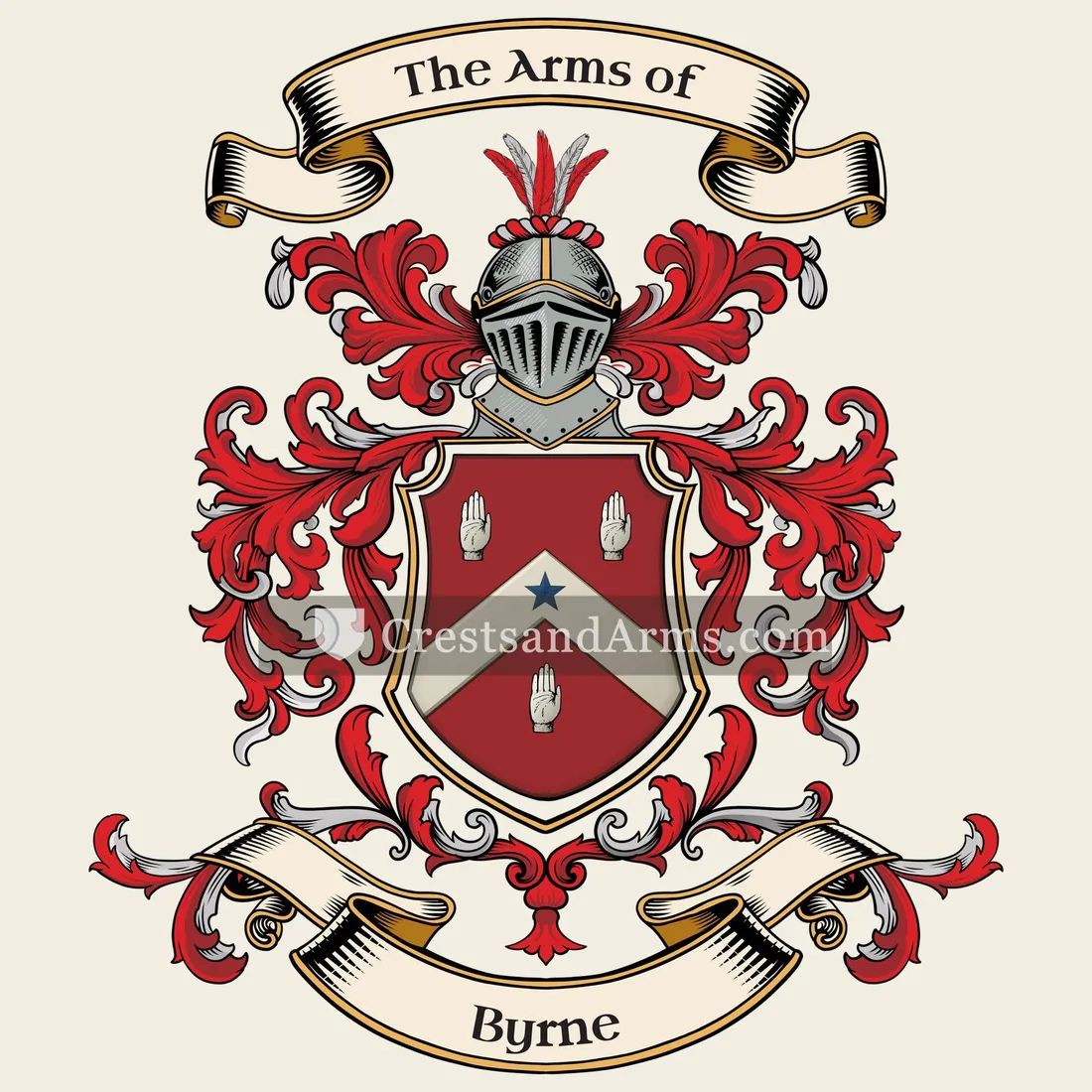
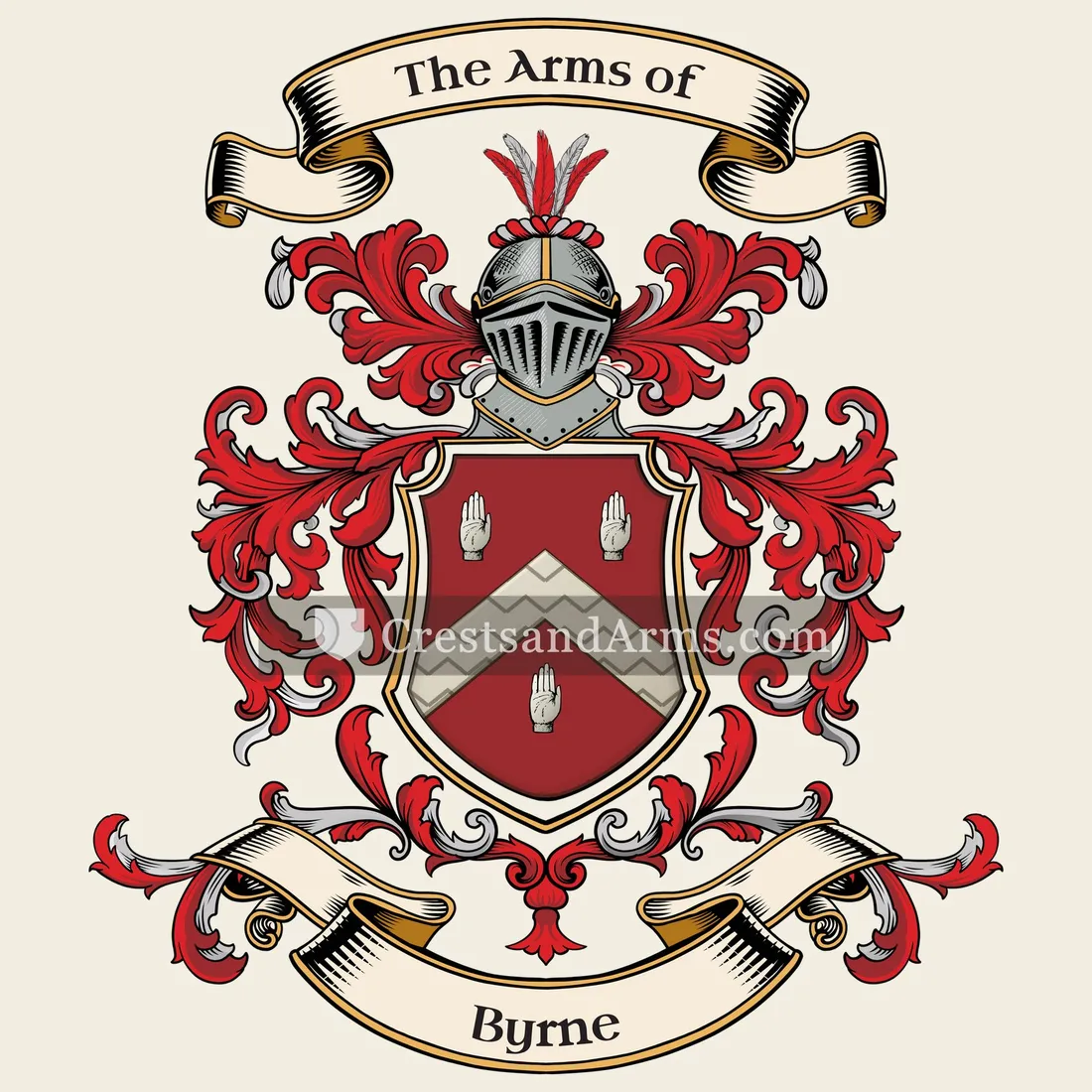
Symbols on this shield
chevronProtection, and faithful service completed
handFaith, sincerity and justice
mulletThe third son, and a divine quality from above
Colours
Red (Gules)Means: Military strength
Silver (Argent)Means: Peace and sincerity
Blue (Azure)Means: Loyalty and truth
Historical info
Source
Sir Bernard Burke, The General Armory of England, Scotland, Ireland and Wales, London: Harrison & Sons, 1884
Blazon (the actual original written record)
“Gu. on a chev. betw. three dexter hands couped ar. a mullet az”
LouthLisnawilly · Louth, c. 1645
Digital archive packCoat of arms PNG, gold border print PDF, vector SVG and the certificate of authenticity. Sent to your email in minutes.
Map of Ireland showing where the Byrne arms are recorded
The Byrne arms were recorded in Louth, c. 1645.
Louth is the smallest Irish county but sat on the road north from Dublin. Norman families took it early, held it under arms, and stayed, which is what put their shields on record.
This is where the arms were entered in the register. Families often moved to other parts of the country, so the same name can turn up in more than one region.
The body that granted and recorded arms in Ireland in this period.
Charles I of England
Sovereign of the period
Charles I of England
1625–1649
Reigning in Germany when the Byrne arms are first recorded.
How Arms Worked in Ireland
The Ulster King of Arms granted coats of arms to individuals who proved their social standing and good character. These symbols were typically inherited by all legitimate descendants of the original holder. If a family branch wanted a unique look, they could apply for a specific change to their design through the office to ensure their identity remained distinct.
Granting authority
The Ulster King of Arms acted as the official body that regulated and issued all coats of arms throughout Ireland.
How they got arms
Families obtained their arms through formal grants issued by the office after proving their eligibility and paying the required fees.
Where arms were recorded
All official grants were recorded in the registers held by the Ulster King of Arms starting from the year 1552.
The family's standing
Recorded among the armigerous families of Louth.
Origin & History of the Byrne Family in Ireland
The family name Byrne is an anglicized version of the ancient Irish Gaelic name Ó Broin, which translates to descendant of Bran. The name originated in County Kildare, where the clan held significant power as kings of Leinster for many centuries. As English influence expanded across Ireland, many families were forced to relocate or faced the loss of their ancestral lands. By the middle of the seventeenth century, records confirm that members of the family were established in County Louth by 1645. This period was a time of great upheaval due to the Cromwellian conquest, which often pushed families away from their traditional territories and into new regions. The presence of the family in Louth during this era reflects the broader movement of Irish clans as they navigated the changing political landscape of the seventeenth century.
Byrne Meaning & Related Branches
Root word
bjorn
Old Norse word meaning bear.
This name
ByrneDerived from an Irish Gaelic name meaning descendant of the bear.
also spelled
Byrnee
Byrn
Byrni
Burn
Birne
Related arms
Beirnevariant spelling
Birn, or Brinvariant spelling
Birnevariant spelling
Documented Sources
J. B. Rietstap, Armorial Général, Gouda: G. B. van Goor Zonen, 1884–87
Blaschke, Karlheinz, Bevölkerungsgeschichte von Sachsen bis zur industriellen Revolution, 1967
Sächsisches Staatsarchiv, Kirchenbücher der evangelisch-lutherischen Landeskirche Sachsens, 1765
Digital archive packCoat of arms PNG, gold border print PDF, vector SVG and the certificate of authenticity. Sent to your email in minutes.


 chevronProtection, and faithful service completed
 handFaith, sincerity and justice
 chevronProtection, and faithful service completed
 handFaith, sincerity and justice


 mulletThe third son, and a divine quality from above