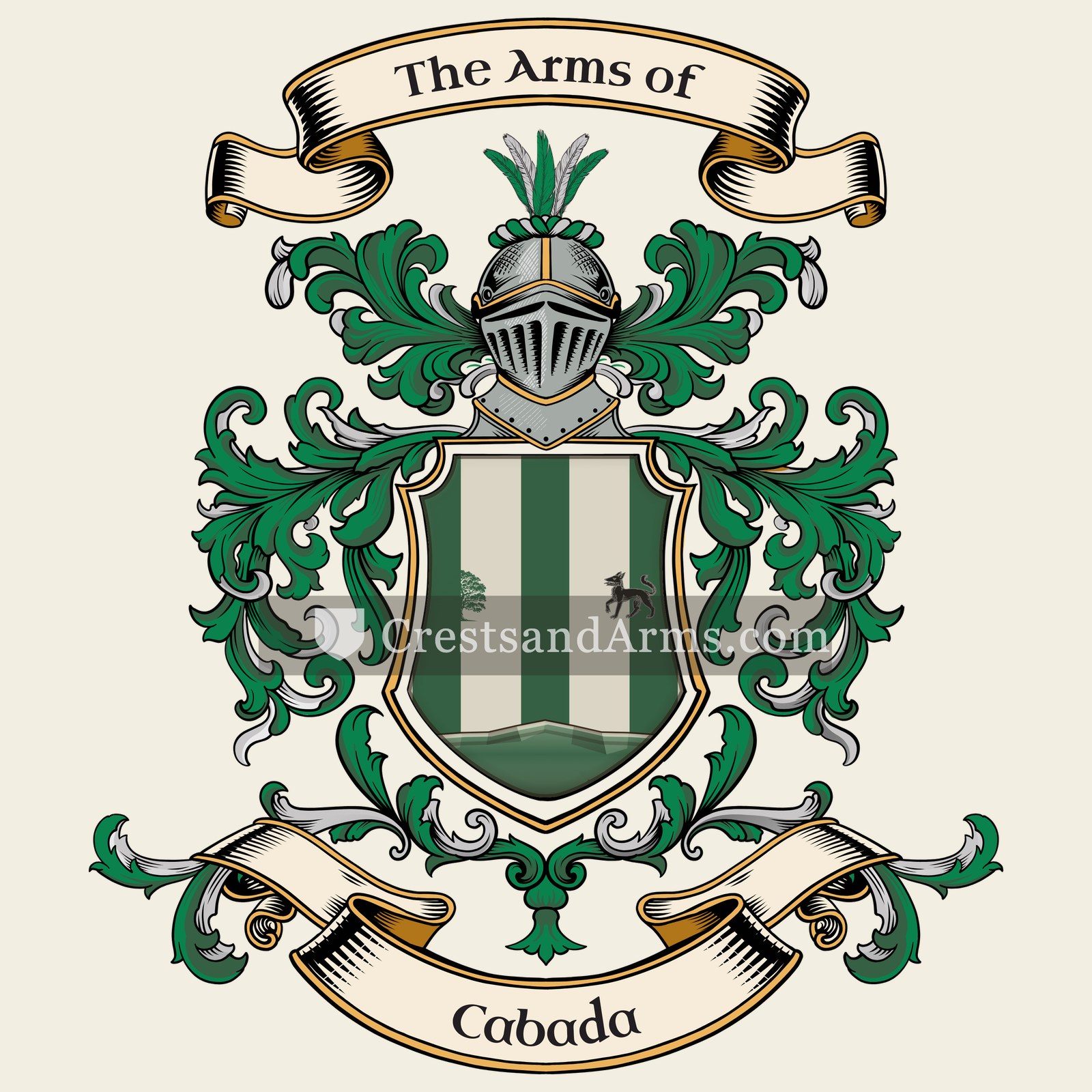
A record of documented arms, meaning and origin, researched for the Cabada family of Austria.
Reg. 3367 · Austrian, A–C
Coat of Arms & Family Crest Details
Symbols on this shield
paleMilitary strength, and a fortified defence
mountThe ground held, and steadfastness upon it
treeLife, endurance and deep roots
wolfReward from long service and hard work
Colours
Silver (Argent)Means: Peace and sincerity
Green (Vert)Means: Hope
Black (Sable)Means: Constancy
Historical info
Source
J. B. Rietstap, Armorial Général, Gouda: G. B. van Goor Zonen, 1884–87
Blazon (the actual original written record)
“Parti: au 1 d'arg. à trois pals de sin.; au 2 d'arg. à un arbre de sin., senestré d'un loup de sa., ramp. contre le fût, le tout soutenu d'une terrasse de sin.”
Austriac. 1772
Digital archive packCoat of arms PNG, gold border print PDF, vector SVG and the certificate of authenticity. Sent to your email in minutes.
Map of Austria showing where the Cabada arms are recorded
The Cabada arms were recorded in Austria, c. 1772.
Arms such as these were typically recorded in Tyrol.
Tyrol was mountain country in western Austria, where the valleys were held by families who had been there a very long time. Old tenure counted for more than money, and old families carried arms.
This is where the arms were entered in the register. Families often moved to other parts of the country, so the same name can turn up in more than one region.
Region
Tyrol
First recorded
1772
Granting Authority for the Cabada Arms
Imperial and Royal chancery
Sodacan · CC BY-SA 3.0
The body that granted and recorded arms in Austria in this period.
Joseph II, Holy Roman Emperor
Sovereign of the period
Joseph II, Holy Roman Emperor
1765–1790
Reigning in Austria when the Cabada arms are first recorded.
How Arms Worked in Austria
Austrian coats of arms were often linked directly to noble titles granted by the Emperor. These symbols belonged to the entire family line rather than just one individual. When a family grew, new branches kept the original design without needing to change it. This system allowed all members of a noble house to share the same identity across many generations.
Granting authority
The Imperial and Royal chancery managed all heraldic matters and controlled the official granting of arms throughout the Austrian lands.
How they got arms
Families typically received their arms through a formal imperial decree that often accompanied the elevation of a person to noble status.
Where arms were recorded
Official records of these grants were kept in the Imperial Register of Nobility which began its formal documentation process in 1453.
The family's standing
Recorded among the armigerous families of Austria.
Origin & History of the Cabada Family in Austria
The family name Cabada has deep roots tied to the rugged landscapes of the Tyrol region, where early ancestors were documented as residents by 1772. During this period, the Tyrol area served as a vital crossroads for trade and cultural exchange between the Germanic north and the Italian south. Families living in these alpine valleys often relied on agriculture, forestry, or specialized mountain crafts to sustain their households. Because the region was part of the Habsburg Empire, life was shaped by strict local administration and the influence of the Catholic Church, which kept meticulous records of births, marriages, and deaths. The name likely evolved as a reflection of the family’s specific geographic location or their role within the tight-knit mountain communities of the eighteenth century. As these early members navigated the challenges of high-altitude living, they helped establish the foundations of a lineage that would eventually spread far beyond the borders of their original home.
Related Branches & Arms
Root word
Caput
Latin term referring to the head or a top extremity.
This name
CabadaA topographic surname denoting someone who lived near a headland or mountain peak.
also spelled
Kavada
Cavadda
Cavade
Documented Sources
J. B. Rietstap, Armorial Général, Gouda: G. B. van Goor Zonen, 1884–87
Tiroler Landesarchiv, Tauf-, Heirats- und Sterbematriken (Parish registers), 1772
Huter, Franz, Tiroler Urkundenbuch, 1937
Obermair, Hannes, Soziale Produktion von Geschichte: Das Beispiel der Tiroler Landstände, 2005
Digital archive packCoat of arms PNG, gold border print PDF, vector SVG and the certificate of authenticity. Sent to your email in minutes.


 paleMilitary strength, and a fortified defence
 mountThe ground held, and steadfastness upon it
 treeLife, endurance and deep roots
 wolfReward from long service and hard work
 paleMilitary strength, and a fortified defence
 mountThe ground held, and steadfastness upon it
 treeLife, endurance and deep roots
 wolfReward from long service and hard work