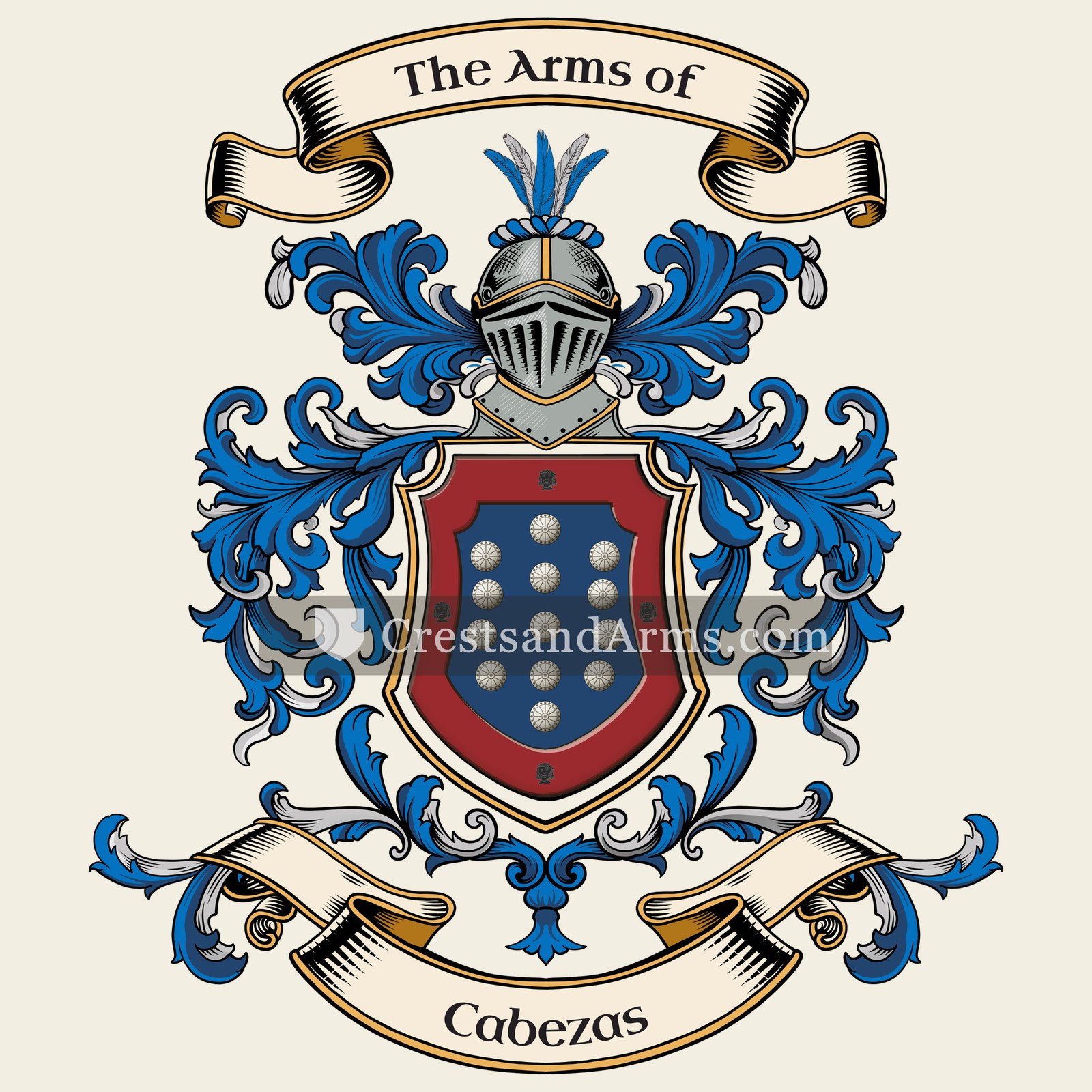
A record of documented arms, meaning and origin, researched for the Cabezas family of Spain.
Reg. 2110 · Spanish, A–C
Coat of Arms & Family Crest Details
Symbols on this shield
roundelA coin, and one who has been to the crusades
saracens head affronty coupedA crusade fought, and an enemy met in the field
Colours
Blue (Azure)Means: Loyalty and truth
Red (Gules)Means: Military strength
Silver (Argent)Means: Peace and sincerity
Historical info
Source
J. B. Rietstap, Armorial Général, Gouda: G. B. van Goor Zonen, 1884–87
Blazon (the actual original written record)
“D'azur à treize bes. d'arg., 3, 3, 3, 3 et 1; à la bord. de gu., ch. de quatre têtes de Sarasin de carn., posées de profil, coiffées de turbans rayés d'arg. et de gu., 1 en chef, 1 à chaque flanc et 1 en p.”
SpainCordoue, c. 1725
Digital archive packCoat of arms PNG, gold border print PDF, vector SVG and the certificate of authenticity. Sent to your email in minutes.
Map of Spain showing where the Cabezas arms are recorded
The Cabezas arms were recorded in Cordoue, c. 1725.
This is where the arms were entered in the register. Families often moved to other parts of the country, so the same name can turn up in more than one region.
The body that granted and recorded arms in Spain in this period.
Philip V of Spain
Sovereign of the period
Philip V of Spain
1724–1746
Reigning in Spain when the Cabezas arms are first recorded.
How Arms Worked in Spain
In Spain, a coat of arms was considered a form of property that belonged to the entire family line. These arms were passed down from a father to all his children equally. Younger branches of the family usually kept the original design without needing to add any special marks to distinguish their specific line.
Granting authority
The Cronista Rey de Armas was the official body that regulated and granted coats of arms throughout Spain.
How they got arms
Families often obtained their arms through royal grants or by proving their noble status to the official heraldic authority.
Where arms were recorded
Coats of arms were officially recorded in the registers of the Cronista Rey de Armas starting in 1496.
The family's standing
Recorded among the armigerous families of Spain.
Origin & History of the Cabezas Family in Spain
The surname Cabezas originates from the Spanish word for heads, and it likely began as a descriptive nickname for a person with a prominent head or perhaps someone who held a position of leadership. By the early 18th century, the family was well-established in the city of Córdoba, Spain. Historical records confirm that members of the Cabezas family were living there by 1725, where they participated in the social and economic life of the region. During this era, families in Córdoba often held roles in local administration or agriculture, contributing to the development of the city during the Bourbon period. As the family grew, they became part of the local fabric of Andalusian society, maintaining their presence in the city through generations of community involvement and record-keeping.
Cabezas Meaning & Related Branches
Root word
Caput
Latin term meaning head or top of a body.
This name
CabezasA topographic or descriptive surname referring to someone with a large head or living near a headland.
also spelled
Cabessas
Kabezas
Cabeza
Related arms
Angulorecorded with Cabezas, same area
Baenarecorded with Cabezas, same area
Cardenasrecorded with Cabezas, same area
Clavijorecorded with Cabezas, same area
Documented Sources
J. B. Rietstap, Armorial Général, Gouda: G. B. van Goor Zonen, 1884–87
Archivo Histórico Provincial de Córdoba, Protocolos Notariales de Córdoba
Molina Recio, Raúl, La élite de poder en Córdoba durante el siglo XVIII, 2004
Real Academia Española, Diccionario de la lengua española, 2023
Digital archive packCoat of arms PNG, gold border print PDF, vector SVG and the certificate of authenticity. Sent to your email in minutes.


 roundelA coin, and one who has been to the crusades
 saracens head affronty coupedA crusade fought, and an enemy met in the field
 roundelA coin, and one who has been to the crusades
 saracens head affronty coupedA crusade fought, and an enemy met in the field