Map of France showing where the Cabot arms are recorded
The Cabot arms were recorded in Jersey, c. 1725.
Arms such as these were typically recorded in Bretagne.
More families held coats of arms in Bretagne than anywhere else in France. The land was divided into many small estates rather than a few large ones, so far more households counted as gentry, and each needed a shield of its own to be told apart.
This is where the arms were entered in the register. Families often moved to other parts of the country, so the same name can turn up in more than one region.
The body that granted and recorded arms in France in this period.
Louis XV of France
Sovereign of the period
Louis XV of France
1715–1774
Reigning in France when the Cabot arms are first recorded.
How Arms Worked in France
In France, a coat of arms was a mark of honor that passed down through the male line to all legitimate descendants. Families often used the same shield without changes to show their shared heritage. If a branch wanted to stand out, they could add a small mark to their shield to show their specific place in the family tree.
Granting authority
The Juge d'armes de France acted as the official authority that regulated and verified coats of arms across the country.
How they got arms
Families typically inherited their arms from ancestors, though they could also receive them through royal grants or by proving their noble status.
Where arms were recorded
Coats of arms were officially recorded in the Armorial Général de France, which began its main collection in the year 1696.
The family's standing
Recorded among the armigerous families of France.
Origin & History of the Cabot Family in France
The family name Cabot has deep roots in the historical landscape of France, where it emerged as a surname linked to the social and professional structures of the medieval and early modern periods. Etymologists often trace the name to the Old French word "cabot," which was a term used to describe a type of small fish or a person of modest stature. By the time the family was firmly established in the region of Bretagne in 1725, they were part of a society defined by local trade, agriculture, and the rigid social hierarchies of the French provinces. During this era, families in Bretagne were often deeply connected to the land and the specific customs of their parish. The presence of the Cabot name in these records suggests a family that was integrated into the local community life of western France long before the diaspora that would eventually carry the name across the Atlantic.
Coat of Arms & Family Crest Details
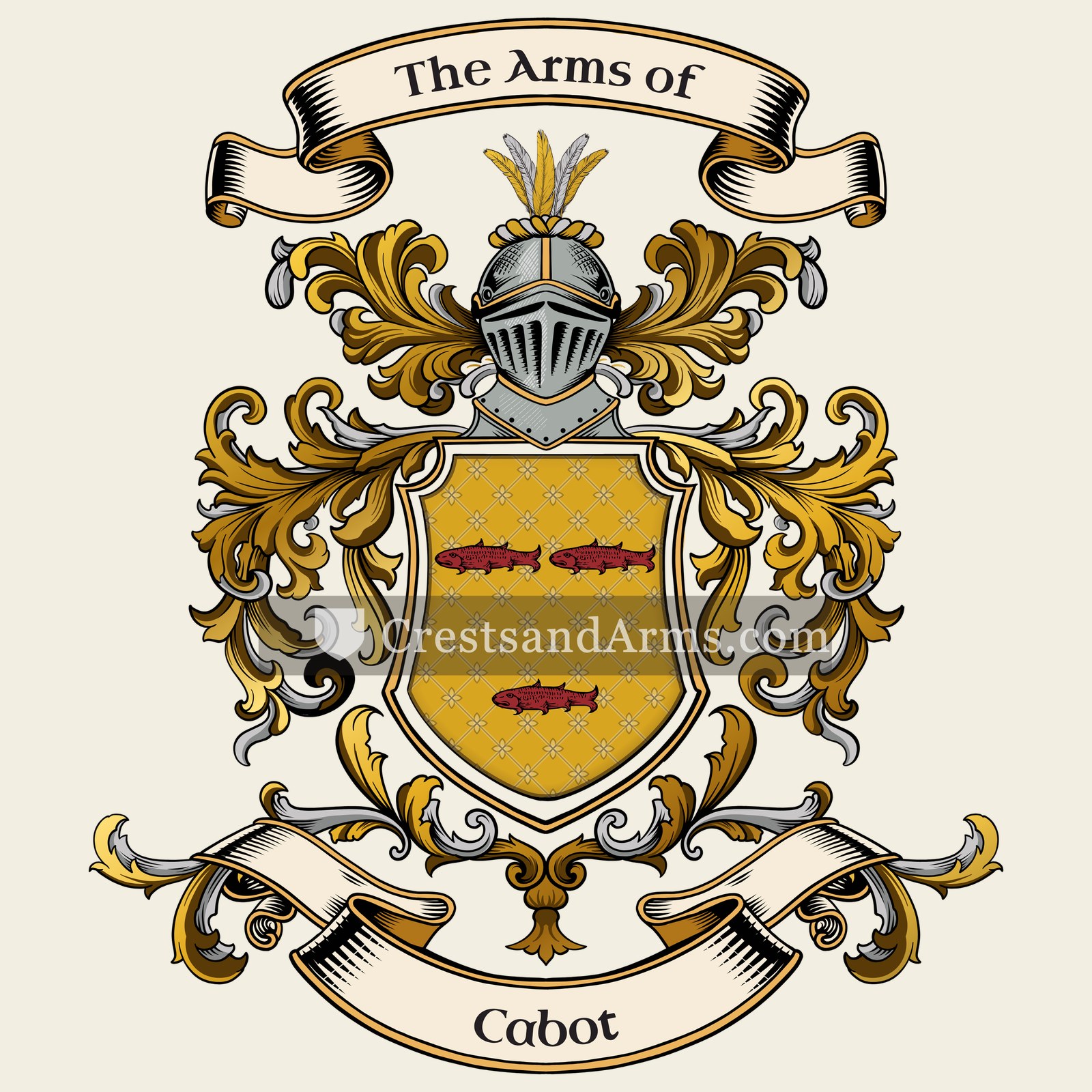
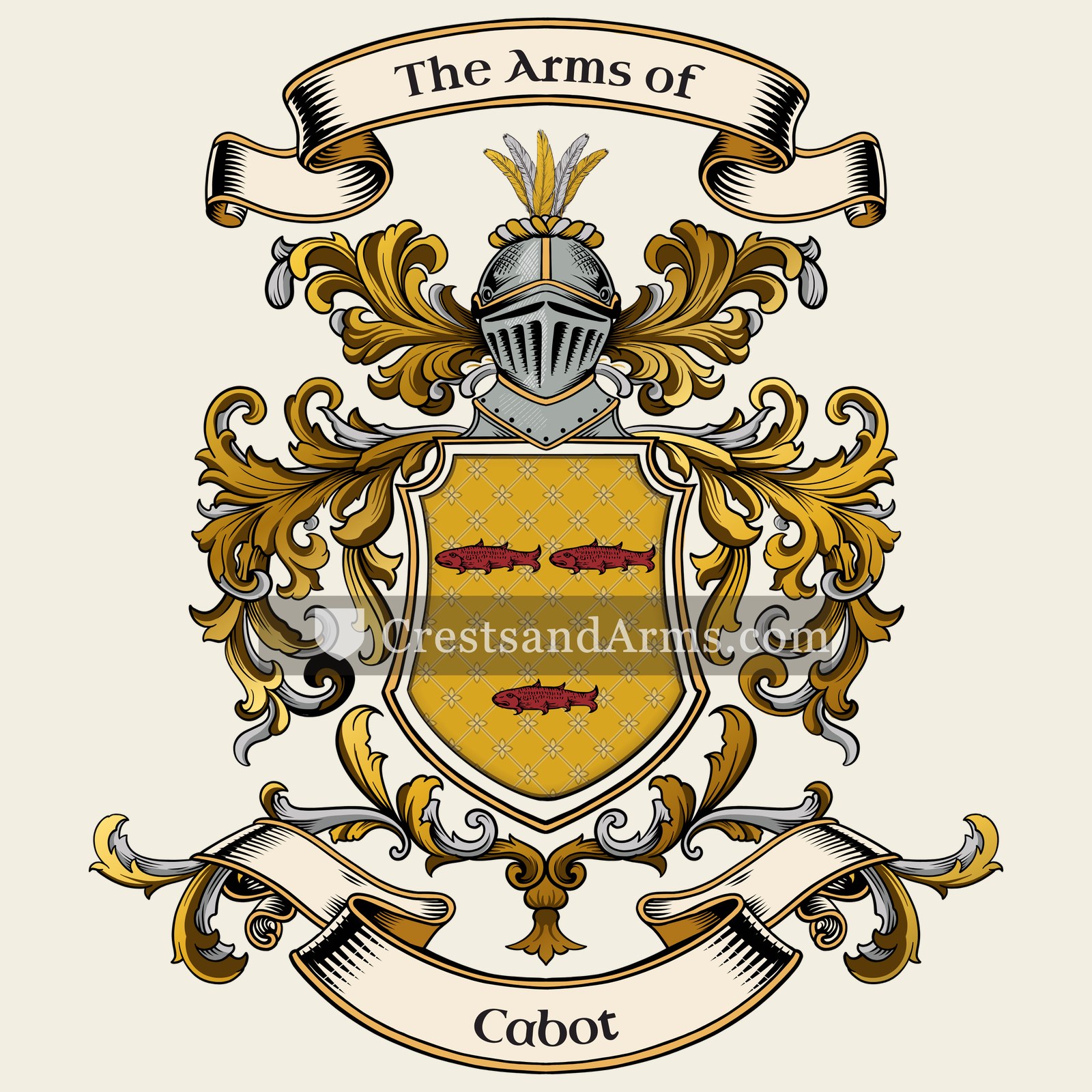
Symbols on this shield
fishA true and generous mind, and Christian faith
Colours
Gold (Or)Means: Generosity
Red (Gules)Means: Military strength
Historical info
Source
Sir Bernard Burke, The General Armory of England, Scotland, Ireland and Wales, London: Harrison & Sons, 1884
Blazon (the actual original written record)
“Or, three chabots haurient gu”
JerseyJersey, c. 1688
Digital archive packCoat of arms PNG, gold border print PDF, vector SVG and the certificate of authenticity. Sent to your email in minutes.
The body that granted and recorded arms in Jersey in this period.
James II of England
Sovereign of the period
James II of England
1685–1688
Reigning in France when the Cabot arms are first recorded.
How Arms Worked in Jersey
Arms in the Channel Islands were granted and recorded by the College of Arms in London, under the same law of arms as England. They could be used by all legitimate descendants of the original owner: the eldest son kept the original design, and other family members used the same shield without registering a version of their own.
Granting authority
The College of Arms in London has regulated the use of coats of arms for Jersey and the other Channel Islands since 1484.
How they got arms
Families typically obtained their coats of arms through a formal grant from the Crown or by proving their ancient right to them.
Where arms were recorded
All official coats of arms are recorded in the registers kept at the College of Arms, which date back to the fifteenth century.
The family's standing
Recorded among the armigerous families of Jersey.
Origin & History of the Cabot Family in Jersey
The Cabot family established a significant presence on the island of Jersey by the late seventeenth century, with records confirming their residence there as early as 1688. The name itself is thought to be of Norman origin, reflecting the deep cultural and linguistic ties between the Channel Islands and mainland France. During this period, the Cabots were integrated into the island's unique social structure, which operated under its own legal system known as Norman Customary Law. As islanders, they were likely involved in the traditional maritime economy, which relied heavily on fishing, trade, and small-scale agriculture. Life in Jersey during the late 1600s was defined by a rugged independence and a blend of French and English influences, providing a stable environment for families like the Cabots to grow and eventually expand their reach across the Atlantic.
Cabot Meaning & Related Branches
Root word
caput
Latin term meaning head or top.
This name
CabotA nickname for someone with a large head or a person of high status.
also spelled
Kabot
Kabo
Chabot
Related arms
Chabotvariant spelling
Documented Sources
J. B. Rietstap, Armorial Général, Gouda: G. B. van Goor Zonen, 1884–87
Dauzat, Albert. Dictionnaire étymologique des noms et prénoms de France. 1951
Archives départementales d'Ille-et-Vilaine. Registres paroissiaux et d'état civil. 1725
Morlet, Marie-Thérèse. Dictionnaire étymologique des noms de famille. 1991
Digital archive packCoat of arms PNG, gold border print PDF, vector SVG and the certificate of authenticity. Sent to your email in minutes.


 fishA true and generous mind, and Christian faith
 fishA true and generous mind, and Christian faith