Map of Portugal showing where the Cabriales arms are recorded
The Cabriales arms were recorded in Portugal, c. 1706.
Arms such as these were typically recorded in Lisboa.
Lisbon was the seat of the Portuguese crown and the port its wealth came through. Families made rich by trade and by service to the king took arms, and the crown's heralds recorded them there.
This is where the arms were entered in the register. Families often moved to other parts of the country, so the same name can turn up in more than one region.
The body that granted and recorded arms in Portugal in this period.
Peter II of Portugal
Sovereign of the period
Peter II of Portugal
1683–1706
Reigning in Portugal when the Cabriales arms are first recorded.
How Arms Worked in Portugal
In Portugal, a coat of arms was a family possession that passed from a father to his children. Every legitimate descendant had the right to use the family shield without needing to change it. Younger branches of the family kept the original design, though they sometimes added small symbols to distinguish their specific line from the main branch.
Granting authority
The Cartório da Nobreza acted as the official body that managed and regulated noble titles and coats of arms in Portugal.
How they got arms
Families typically inherited their arms through bloodline, though they could also receive new grants from the crown for distinguished service.
Where arms were recorded
Coats of arms were officially recorded in the books of the Cartório da Nobreza starting in the year 1512.
The family's standing
Recorded among the armigerous families of Portugal.
Origin & History of the Cabriales Family in Portugal
The Cabriales family name traces its roots to the Iberian Peninsula, with documented evidence placing members of the family in Lisboa by the year 1706. During the early eighteenth century, Lisboa was a bustling maritime hub that served as a center for trade, culture, and migration between Europe and the expanding colonial territories. Families living in the city at this time often occupied roles within the merchant class or the administrative bureaucracy that supported the Portuguese Empire. The name itself likely evolved from regional linguistic patterns common to the area, reflecting the diverse cultural influences that shaped the local population. As the family established itself in this urban environment, they became part of a society that was rapidly changing due to global exploration and the movement of people across the Atlantic. This early presence in a major capital city suggests that the Cabriales family was well-positioned to participate in the social and economic developments of the era.
Related Branches & Arms
Root word
Capra
Latin term referring to a female goat.
This name
CabrialesA topographic or occupational surname indicating a place where goats were kept or a goat herder.
also spelled
Kabral
Documented Sources
J. B. Rietstap, Armorial Général, Gouda: G. B. van Goor Zonen, 1884–87
Arquivo Nacional da Torre do Tombo, Registos Paroquiais de Lisboa, 1706
Boxer, C.R., The Portuguese Seaborne Empire 1415-1825, 1969
Lisboa, Arquivo Municipal de Lisboa: Documentação Administrativa, 1706
Digital archive packCoat of arms PNG, gold border print PDF, vector SVG and the certificate of authenticity. Sent to your email in minutes.


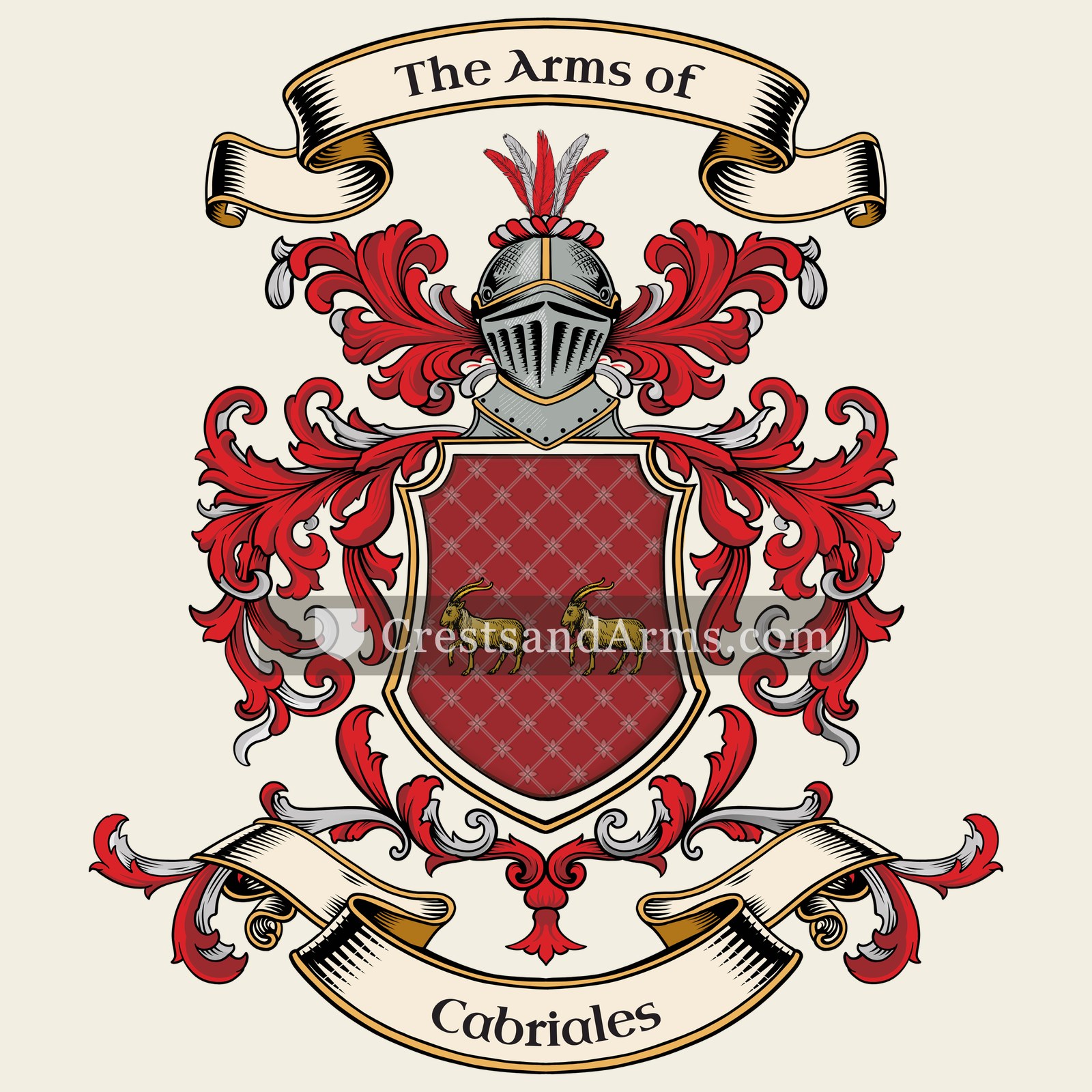
 goatOne who wins by diplomacy rather than force
 goatOne who wins by diplomacy rather than force