Map of Spain showing where the Cachero arms are recorded
The Cachero arms were recorded in Asturies, c. 1722.
This is where the arms were entered in the register. Families often moved to other parts of the country, so the same name can turn up in more than one region.
The body that granted and recorded arms in Spain in this period.
Philip V of Spain
Sovereign of the period
Philip V of Spain
1714–1724
Reigning in Spain when the Cachero arms are first recorded.
How Arms Worked in Spain
In Spain, a coat of arms was considered a form of property that belonged to the entire family line. These arms were passed down from a father to all his children equally. Younger branches of the family usually kept the original design without needing to add any special marks to distinguish their specific line.
Granting authority
The Cronista Rey de Armas was the official body that regulated and granted coats of arms throughout Spain.
How they got arms
Families often obtained their arms through royal grants or by proving their noble status to the official heraldic authority.
Where arms were recorded
Coats of arms were officially recorded in the registers of the Cronista Rey de Armas starting in 1496.
The family's standing
Recorded among the armigerous families of Spain.
Origin & History of the Cachero Family in Spain
The surname Cachero is deeply rooted in the mountainous landscape of Asturias, Spain, where records confirm the family was established by at least 1722. The name is considered a topographic or occupational descriptor, likely originating from the local Asturian dialect to identify people who lived near or worked with specific types of rocky terrain or wood-clearing sites. During the early 18th century, families in this region were often tied to small agricultural holdings and communal land management in the foothills of the Cantabrian Mountains. As the family grew, members became integrated into the local parish systems, which served as the primary record keepers for births, marriages, and deaths in rural Asturian villages. This transition from a localized group to a recorded lineage reflects the broader social patterns of northern Spain, where families maintained strong connections to their ancestral lands for generations.
Cachero Meaning & Related Branches
Root word
Cacho
A piece, fragment, or chunk of something.
This name
CacheroA topographic or occupational surname referring to someone living near a specific plot of land.
also spelled
Cacherro
Kachero
Cashero
Documented Sources
J. B. Rietstap, Armorial Général, Gouda: G. B. van Goor Zonen, 1884–87
Archivo Histórico Diocesano de Oviedo, Libros Sacramentales de la Parroquia de San Juan de Priorio, 1722
Canella Secades, Fermín, Estudios asturianos, 1890
Madoz, Pascual, Diccionario geográfico-estadístico-histórico de España y sus posesiones de Ultramar, 1845
Digital archive packCoat of arms PNG, gold border print PDF, vector SVG and the certificate of authenticity. Sent to your email in minutes.


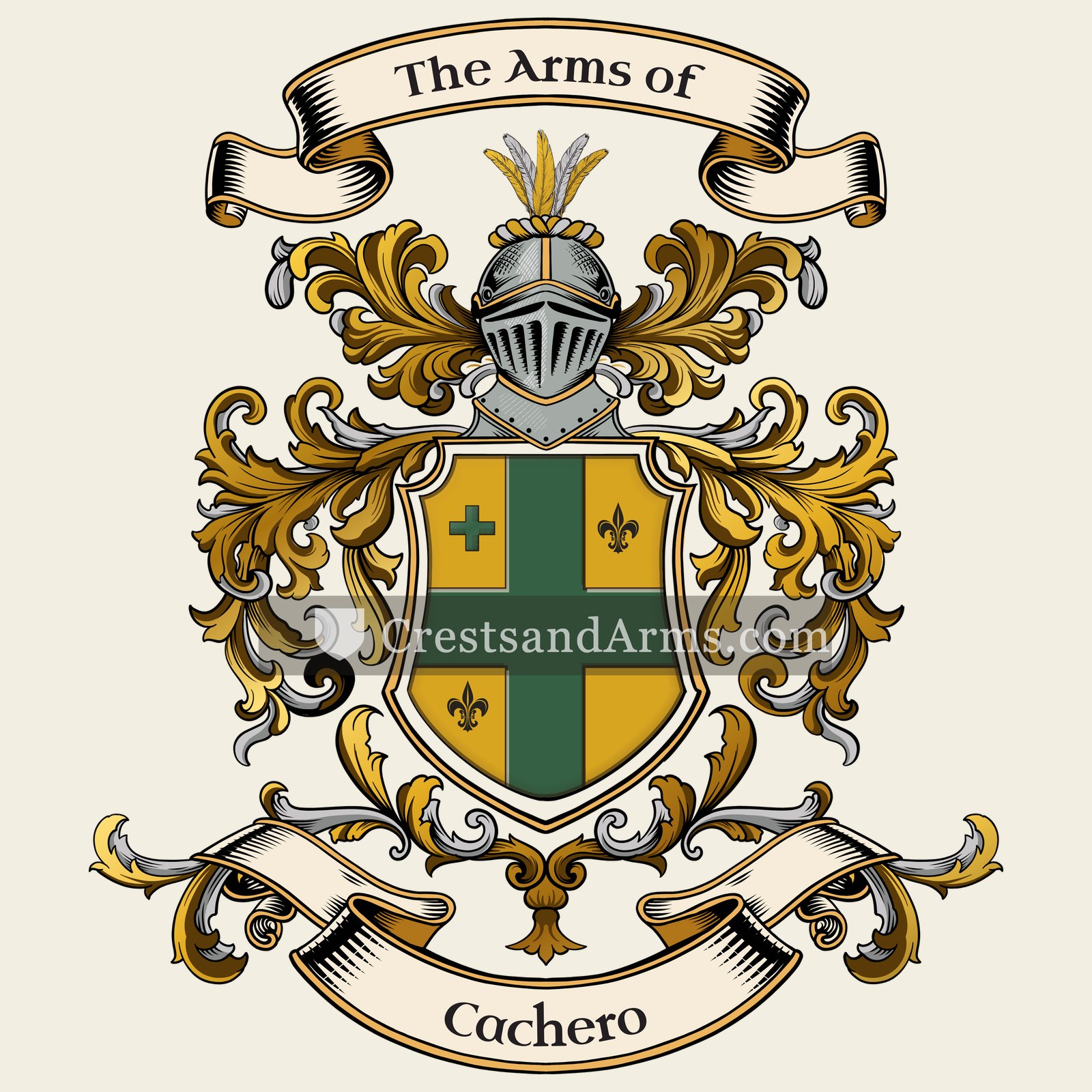
 cross symbolChristian faith and service
 fleur de lisPurity, light, and the sixth son
 cross symbolChristian faith and service
 fleur de lisPurity, light, and the sixth son