Map of England showing where the Caddick arms are recorded
The Caddick arms were recorded in Stafford, c. 1620.
Staffordshire was mixed country of moorland, farmland and early ironworking. Its landed families were spread widely rather than concentrated, and each holding brought its own claim to arms.
This is where the arms were entered in the register. Families often moved to other parts of the country, so the same name can turn up in more than one region.
The body that granted and recorded arms in England in this period.
James VI and I
Sovereign of the period
James VI and I
1603–1625
Reigning in England when the Caddick arms are first recorded.
How Arms Worked in England
English heraldry allowed arms to be shared by all legitimate descendants of the original owner. These symbols were treated as personal property that moved through the generations to all children. While the eldest son kept the original design, other family members could use the same shield without needing to change it or register their own unique versions.
Granting authority
The College of Arms in London has regulated the use of coats of arms throughout England and Wales since 1484.
How they got arms
Families typically obtained their coats of arms through a formal grant from the Crown or by proving their ancient right to them.
Where arms were recorded
All official coats of arms are recorded in the registers kept at the College of Arms, which date back to the fifteenth century.
The family's standing
Recorded among the armigerous families of Stafford.
Origin & History of the Caddick Family in England
The surname Caddick is rooted in the West Midlands region of England, where it first appeared as a distinct family name during the early seventeenth century. Historical records confirm that members of the Caddick family were established in the town of Stafford by 1620, living as part of a growing community in the heart of Staffordshire. The name likely evolved from local nicknames or occupational descriptions common in the medieval period, eventually becoming a fixed surname as families settled into specific parishes. During this era, the people bearing the name were often involved in the local trade and agricultural life that defined the English countryside. By settling in Stafford, the early Caddicks became part of the social fabric of a historic market town, contributing to the local economy and community life long before the industrial changes of later centuries.
Coat of Arms & Family Crest Details
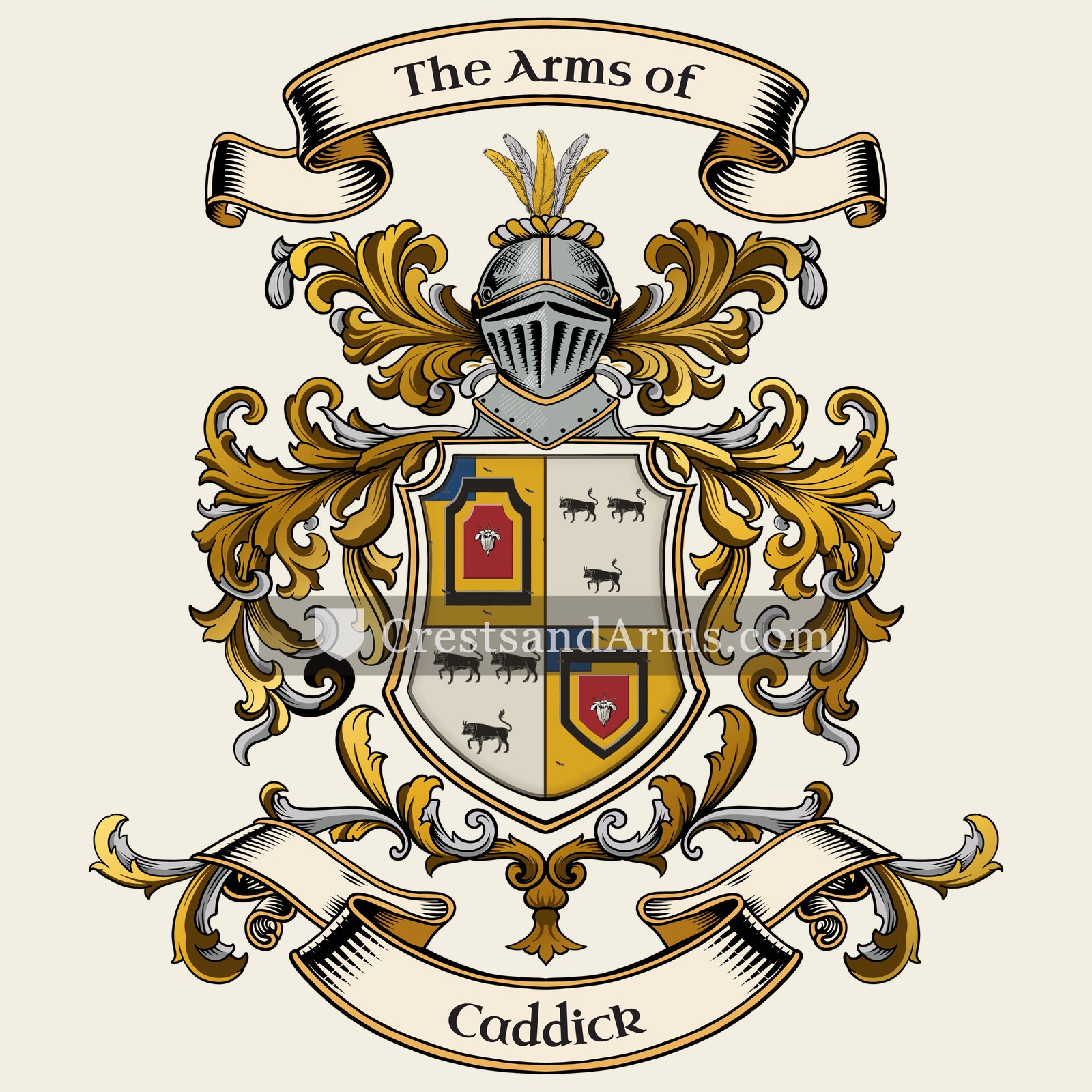
Symbols on this shield
orlePreservation, and protection in battle
paleMilitary strength, and a fortified defence
cantonA mark of honour granted by the sovereign
lilyPurity and the promise of resurrection
martletA younger son, who must win his own land
bullValour and generosity
Colours
Gold (Or)Means: Generosity
Silver (Argent)Means: Peace and sincerity
Red (Gules)Means: Military strength
Blue (Azure)Means: Loyalty and truth
Black (Sable)Means: Constancy
Historical info
Source
Sir Bernard Burke, The General Armory of England, Scotland, Ireland and Wales, London: Harrison & Sons, 1884
Blazon (the actual original written record)
“Quarterly, 1st and 4th, CHADWICK, or, an inescutcheon gu. charged with a lily leaved and slipped ppr. within an orle of martlets sa.; 2nd and 3rd, COOPER, per pale indented ar. and sa. three bulls pass. counterchanged, a canton az”
TipperaryTipperary, c. 1855
Digital archive packCoat of arms PNG, gold border print PDF, vector SVG and the certificate of authenticity. Sent to your email in minutes.
Map of Ireland showing where the Caddick arms are recorded
The Caddick arms were recorded in Tipperary, c. 1855.
Tipperary was the best grazing land in Ireland, held by a small number of powerful families. Land of that value stayed in the same hands, and unbroken holding is what puts a name in the records.
This is where the arms were entered in the register. Families often moved to other parts of the country, so the same name can turn up in more than one region.
The body that granted and recorded arms in Ireland in this period.
Victoria
Sovereign of the period
Victoria
1837–1901
Reigning in England when the Caddick arms are first recorded.
How Arms Worked in Ireland
The Ulster King of Arms granted coats of arms to individuals who proved their social standing and good character. These symbols were typically inherited by all legitimate descendants of the original holder. If a family branch wanted a unique look, they could apply for a specific change to their design through the office to ensure their identity remained distinct.
Granting authority
The Ulster King of Arms acted as the official body that regulated and issued all coats of arms throughout Ireland.
How they got arms
Families obtained their arms through formal grants issued by the office after proving their eligibility and paying the required fees.
Where arms were recorded
All official grants were recorded in the registers held by the Ulster King of Arms starting from the year 1552.
The family's standing
Recorded among the armigerous families of Tipperary.
Origin & History of the Caddick Family in Ireland
The family name Caddick is relatively rare in Ireland, with its historical presence primarily concentrated in County Tipperary during the mid-nineteenth century. While the name likely originated in England, those who settled in Ireland became deeply integrated into the local agricultural landscape. By 1855, records confirm that members of the family were established in Tipperary, a region known for its fertile land and complex history of land ownership. During this period, families like the Caddicks often lived as tenant farmers or laborers, navigating the difficult economic conditions that followed the Great Famine. Their presence in the area suggests they were part of the local community structure, contributing to the rural life of the county during a time of significant social change. Because the name is not traditionally Gaelic, it is probable that the family arrived in Ireland through migration patterns linked to trade or administrative roles, eventually putting down roots in the Irish Midlands.
Related Branches & Arms
Root word
Cadoc
A Welsh personal name derived from the word for battle.
This name
CaddickA patronymic surname meaning son of Cadoc, originating from the Welsh border regions.
also spelled
Chadwyck
Documented Sources
Sir Bernard Burke, The General Armory of England, Scotland, Ireland and Wales, London: Harrison & Sons, 1884
Staffordshire Record Office, Stafford St Mary Parish Registers, 1620
Reaney, P. H. and Wilson, R. M., A Dictionary of English Surnames, 1991
Digital archive packCoat of arms PNG, gold border print PDF, vector SVG and the certificate of authenticity. Sent to your email in minutes.


 bordureA difference between branches of one family
 martletA younger son, who must win his own land
 bordureA difference between branches of one family
 martletA younger son, who must win his own land


 orlePreservation, and protection in battle
 paleMilitary strength, and a fortified defence
 cantonA mark of honour granted by the sovereign
 lilyPurity and the promise of resurrection
 bullValour and generosity