Map of Spain showing where the Cadell arms are recorded
The Cadell arms were recorded in Catalonia, c. 1722.
Catalonia lived by sea trade, and its merchant houses were as powerful as its landowners. Both sorts of family took arms, and Barcelona kept records of the houses entitled to bear them.
This is where the arms were entered in the register. Families often moved to other parts of the country, so the same name can turn up in more than one region.
The body that granted and recorded arms in Spain in this period.
Philip V of Spain
Sovereign of the period
Philip V of Spain
1714–1724
Reigning in Spain when the Cadell arms are first recorded.
How Arms Worked in Spain
In Spain, a coat of arms was considered a form of property that belonged to the entire family line. These arms were passed down from a father to all his children equally. Younger branches of the family usually kept the original design without needing to add any special marks to distinguish their specific line.
Granting authority
The Cronista Rey de Armas was the official body that regulated and granted coats of arms throughout Spain.
How they got arms
Families often obtained their arms through royal grants or by proving their noble status to the official heraldic authority.
Where arms were recorded
Coats of arms were officially recorded in the registers of the Cronista Rey de Armas starting in 1496.
The family's standing
Recorded among the armigerous families of Catalonia.
Origin & History of the Cadell Family in Spain
The history of the Cadell name in Spain is deeply rooted in the rugged landscape of Catalonia, where the family established a notable presence by the early eighteenth century. Historical records confirm that members of the family were active in the region by 1722, likely integrated into the local social and economic structures that defined the Catalan countryside during that era. The name itself reflects the linguistic shifts common in the Mediterranean, where families often adapted their surnames to fit the phonetic patterns of their new homes. As the family settled into their community, they participated in the daily life of the province, contributing to the local traditions and agricultural development that characterized the period. By establishing themselves in Catalonia, the Cadell family became part of the long and complex history of migration and settlement that shaped the identity of the region.
Coat of Arms & Family Crest Details
Symbols on this shield
bordureA difference between branches of one family
stagPeace and harmony, and one who will not fight unprovoked
buckleFidelity, and a bond firmly held
Colours
Silver (Argent)Means: Peace and sincerity
Red (Gules)Means: Military strength
Blue (Azure)Means: Loyalty and truth
Historical info
Source
Sir Bernard Burke, The General Armory of England, Scotland, Ireland and Wales, London: Harrison & Sons, 1884
Blazon (the actual original written record)
“Ar. a stag's head couped in chief gu. in base three oval buckles tongues in fesse az. within a bordure of the second”
Scotlandc. 1748
Digital archive packCoat of arms PNG, gold border print PDF, vector SVG and the certificate of authenticity. Sent to your email in minutes.
Map of Scotland showing where the Cadell arms are recorded
The Cadell arms were recorded in Scotland, c. 1748.
Arms such as these were typically recorded in Edinburgh.
Edinburgh was the seat of Scotland's government, its courts and its heralds. Families with business there settled nearby, and being close to where arms were recorded is exactly why so many of them appear.
This is where the arms were entered in the register. Families often moved to other parts of the country, so the same name can turn up in more than one region.
The body that granted and recorded arms in Scotland in this period.
George II of Great Britain
Sovereign of the period
George II of Great Britain
1727–1760
Reigning in Spain when the Cadell arms are first recorded.
How Arms Worked in Scotland
Scottish heraldry is unique because it treats a coat of arms as a piece of personal property protected by law. Only one person can own a specific design at any given time. When a family grows, the head keeps the original shield while other relatives must apply for their own distinct version with slight changes to prove their specific identity.
Granting authority
The Court of the Lord Lyon acts as the official body that regulates and controls all heraldic matters throughout Scotland.
How they got arms
Individuals obtain a legal right to their arms through a formal petition process that confirms their identity and family connection.
Where arms were recorded
All valid coats of arms are officially entered into the Public Register of All Arms and Bearings starting from 1672.
The family's standing
Recorded among the armigerous families of Scotland.
Origin & History of the Cadell Family in Scotland
The surname Cadell has deep roots in the history of Scotland, appearing in official records as early as the mid-eighteenth century. By 1748, members of the family were well-established in Edinburgh, a city that served as the bustling center of Scottish commerce and law during the Enlightenment. The name itself is thought to be of ancient Celtic origin, potentially derived from words meaning battle or spirit. As the family grew in prominence, they became closely linked to the industrial and social development of the region. Many individuals bearing the name played active roles in the professional life of the capital, contributing to the growth of trade and the intellectual culture that defined Edinburgh at the time. Through these early residents, the Cadell name became a fixture in the historical narrative of the Scottish Lowlands.
Coat of Arms & Family Crest Details
Symbols on this shield
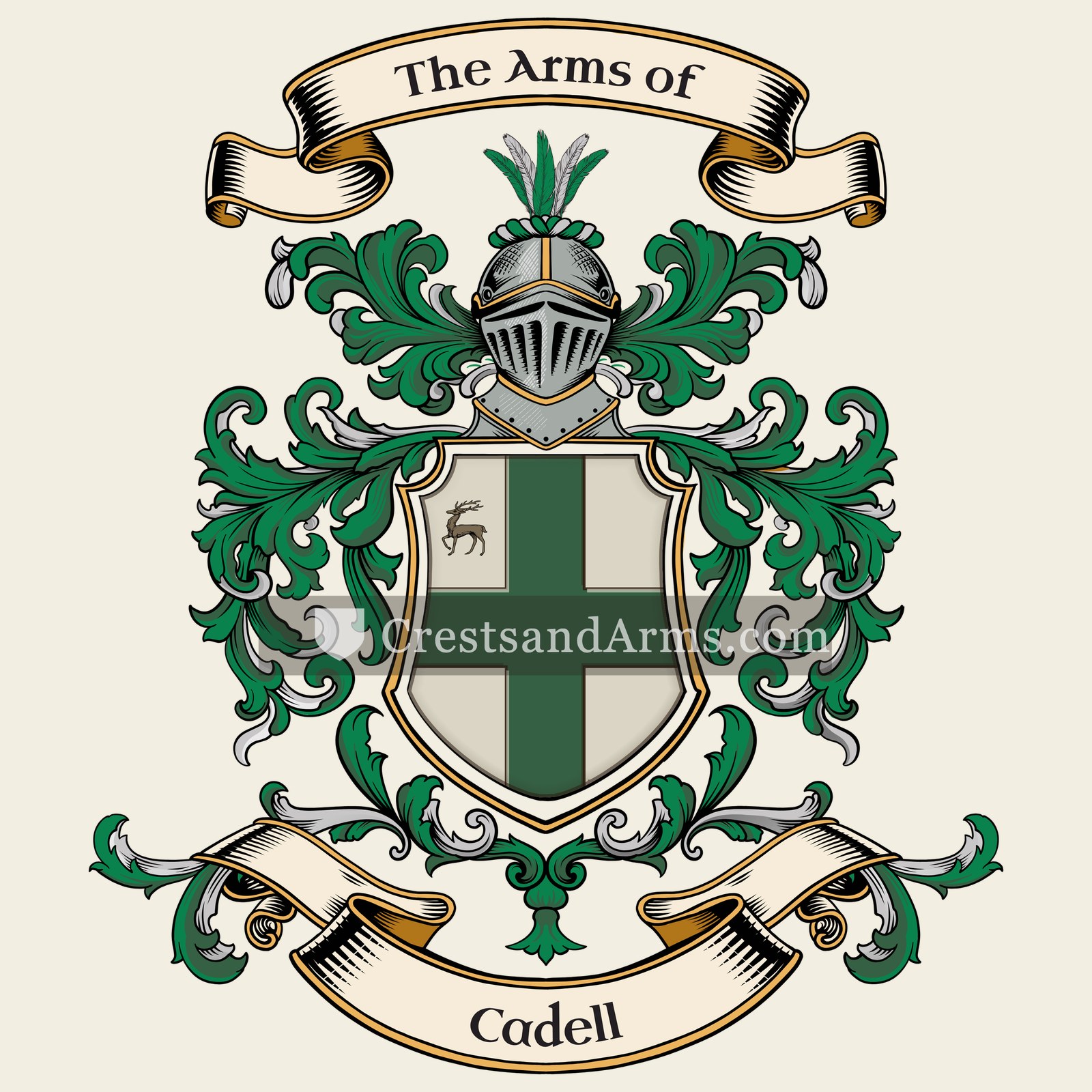
cross symbolChristian faith and service
stagPeace and harmony, and one who will not fight unprovoked
Colours
Silver (Argent)Means: Peace and sincerity
Green (Vert)Means: Hope
Historical info
Source
Sir Bernard Burke, The General Armory of England, Scotland, Ireland and Wales, London: Harrison & Sons, 1884
Blazon (the actual original written record)
“Ar. a cross engr. vert, in the first quarter a stag's head cabossed”
EnglandThomas Caddell, c. 1801
Digital archive packCoat of arms PNG, gold border print PDF, vector SVG and the certificate of authenticity. Sent to your email in minutes.
Map of England showing where the Cadell arms are recorded
The Cadell arms were recorded in Thomas Caddell, c. 1801.
Arms such as these were typically recorded in York.
Yorkshire is the largest of the English counties, and it held more gentry families than any other. Land there was split among a great many households rather than a few, so a great many of them carried arms.
This is where the arms were entered in the register. Families often moved to other parts of the country, so the same name can turn up in more than one region.
The body that granted and recorded arms in England in this period.
George III of Great Britain
Sovereign of the period
George III of Great Britain
1760–1801
Reigning in Spain when the Cadell arms are first recorded.
How Arms Worked in England
English heraldry allowed arms to be shared by all legitimate descendants of the original owner. These symbols were treated as personal property that moved through the generations to all children. While the eldest son kept the original design, other family members could use the same shield without needing to change it or register their own unique versions.
Granting authority
The College of Arms in London has regulated the use of coats of arms throughout England and Wales since 1484.
How they got arms
Families typically obtained their coats of arms through a formal grant from the Crown or by proving their ancient right to them.
Where arms were recorded
All official coats of arms are recorded in the registers kept at the College of Arms, which date back to the fifteenth century.
The family's standing
Recorded among the armigerous families of England.
Origin & History of the Cadell Family in England
The name Cadell has deep roots that stretch back through centuries of British history, often appearing in records as a variant of older names derived from the Welsh word for battle. While the family name is frequently associated with early settlements in the northern regions, the presence of the Cadell family in York by 1801 highlights their integration into the urban life of Northern England during the Industrial Revolution. During this period, families with this surname were often involved in the growing trade and professional sectors that defined the city. As the family established itself in York, they became part of the broader social fabric of the region, moving away from their ancient origins to participate in the rapid modernization of 19th-century England. This transition reflects how many families with long-standing names adapted to new environments while maintaining a connection to their historical identity.
Cadell Meaning & Related Branches
Root word
Catulus
Latin word meaning a young animal or a puppy.
This name
CadellA surname of Spanish origin derived from a nickname for a young or spirited person.
also spelled
Cadel
Kadell
Kadel
Related arms
Caddellsimilar arms
Documented Sources
J. B. Rietstap, Armorial Général, Gouda: G. B. van Goor Zonen, 1884–87
Arxiu de la Corona d'Aragó, Reial Audiència. Registres de la governació de Catalunya, 1722
Arxiu Històric de Protocols de Barcelona, Lligalls de notaris de Barcelona, 1722
Pérez Samper, Maria de los Ángeles, La vida cotidiana en la Cataluña del siglo XVIII, 1996
Digital archive packCoat of arms PNG, gold border print PDF, vector SVG and the certificate of authenticity. Sent to your email in minutes.


 mountThe ground held, and steadfastness upon it
 greyhoundCourage, vigilance and loyalty
 mountThe ground held, and steadfastness upon it
 greyhoundCourage, vigilance and loyalty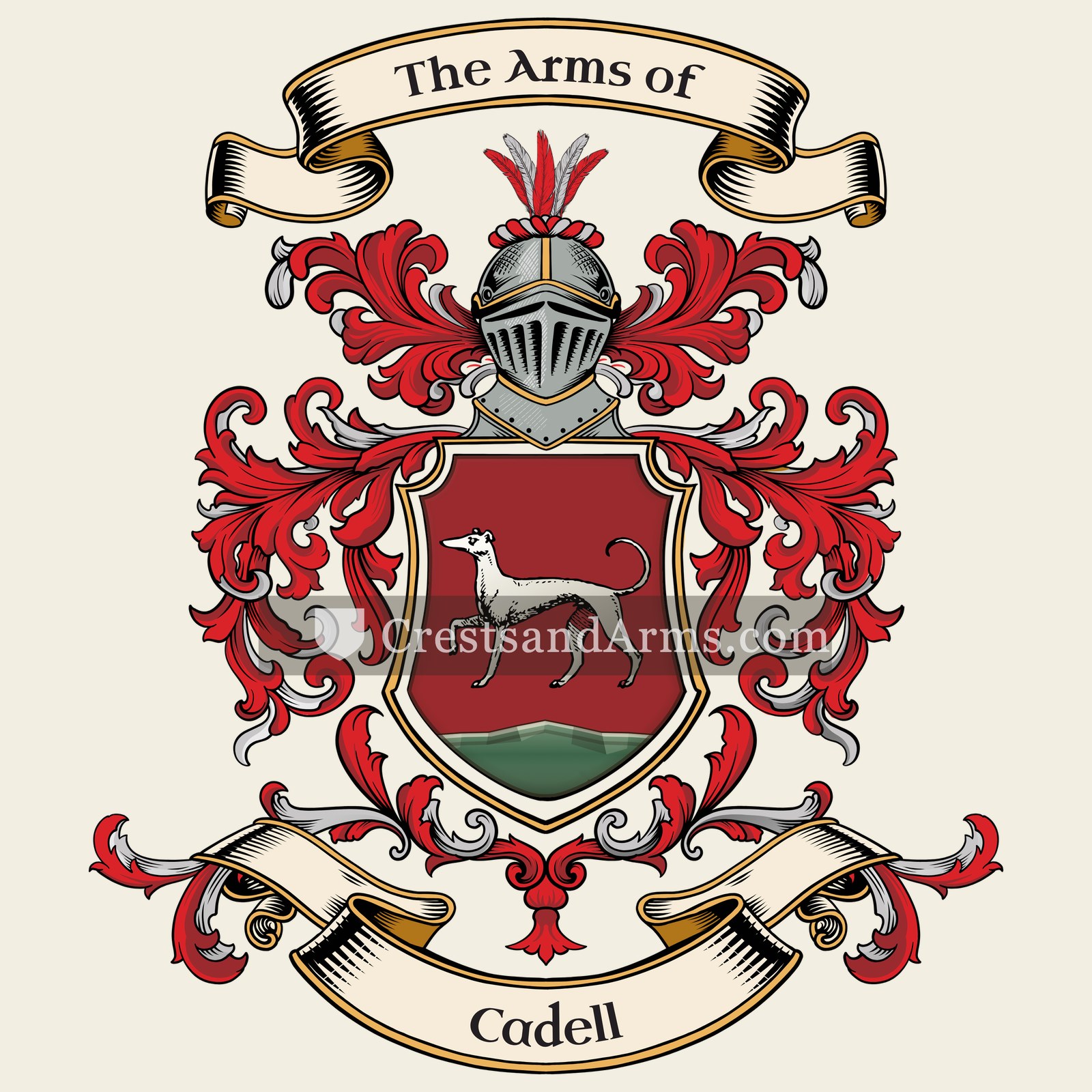


 bordureA difference between branches of one family
 stagPeace and harmony, and one who will not fight unprovoked
 buckleFidelity, and a bond firmly held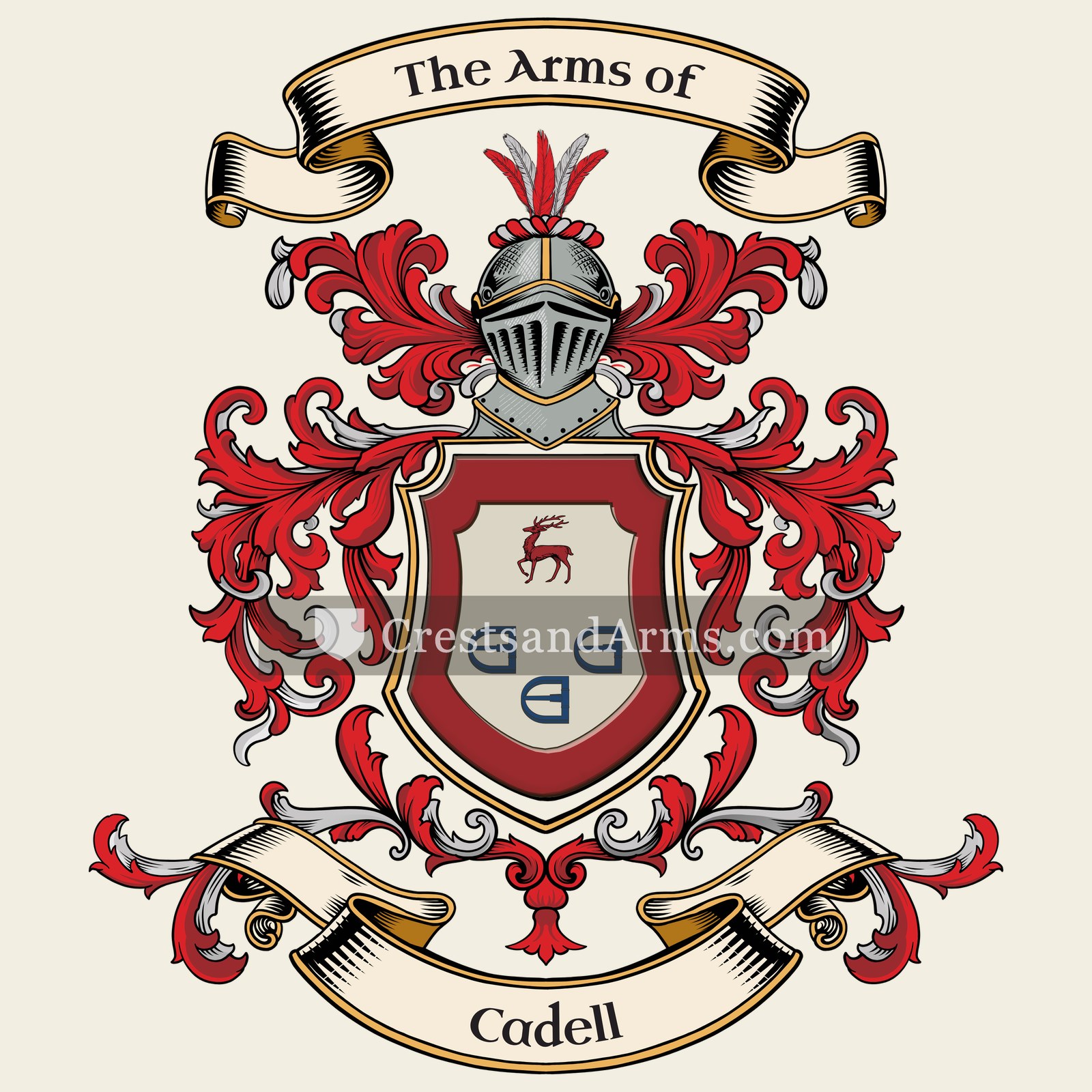


 cross symbolChristian faith and service