Map of France showing where the Cahors arms are recorded
The Cahors arms were recorded in Guyenne, c. 1663.
Guyenne was the great wine country of south-western France, shipping claret to England for centuries. The trade made merchant families rich, they bought vineyards and estates with the money, and land of that kind brought arms with it.
This is where the arms were entered in the register. Families often moved to other parts of the country, so the same name can turn up in more than one region.
The body that granted and recorded arms in France in this period.
Louis XIV of France
Sovereign of the period
Louis XIV of France
1643–1715
Reigning in France when the Cahors arms are first recorded.
How Arms Worked in France
In France, a coat of arms was a mark of honor that passed down through the male line to all legitimate descendants. Families often used the same shield without changes to show their shared heritage. If a branch wanted to stand out, they could add a small mark to their shield to show their specific place in the family tree.
Granting authority
The Juge d'armes de France acted as the official authority that regulated and verified coats of arms across the country.
How they got arms
Families typically inherited their arms from ancestors, though they could also receive them through royal grants or by proving their noble status.
Where arms were recorded
Coats of arms were officially recorded in the Armorial Général de France, which began its main collection in the year 1696.
The family's standing
Recorded among the armigerous families of Guyenne.
Origin & History of the Cahors Family in France
The family name Cahors is a locative surname, meaning it was originally derived from the city of Cahors located in the Quercy region of southwestern France. During the seventeenth century, members of the family established a notable presence in the province of Guyenne, a historic area that encompassed much of the Aquitaine region. Life in Guyenne during the 1660s was defined by a transition toward stronger royal control under King Louis XIV, which often required families to maintain clear records of their residence and local standing. As the family settled into this fertile landscape, they became part of the social fabric of a region famous for its trade and agricultural production. By anchoring themselves in Guyenne by 1663, the family participated in the complex history of a territory that had long served as a crossroads for merchants and landholders moving through the French southwest.
Cahors Meaning & Related Branches
Root word
Cadurci
An ancient Celtic tribe inhabiting the region of modern-day Quercy.
This name
CahorsRefers to a person originating from the city of Cahors in southwestern France.
also spelled
Kahors
Kahor
Documented Sources
J. B. Rietstap, Armorial Général, Gouda: G. B. van Goor Zonen, 1884–87
Boutruche, Robert. Une société provinciale en lutte contre le régime féodal: L'alleu en Bordelais et en Bazadais du XIe au XVIIIe siècle. 1963
Archives Départementales de la Gironde. Série E: Familles, seigneuries et terres
Higounet, Charles. Histoire de l'Aquitaine. 1971
Digital archive packCoat of arms PNG, gold border print PDF, vector SVG and the certificate of authenticity. Sent to your email in minutes.


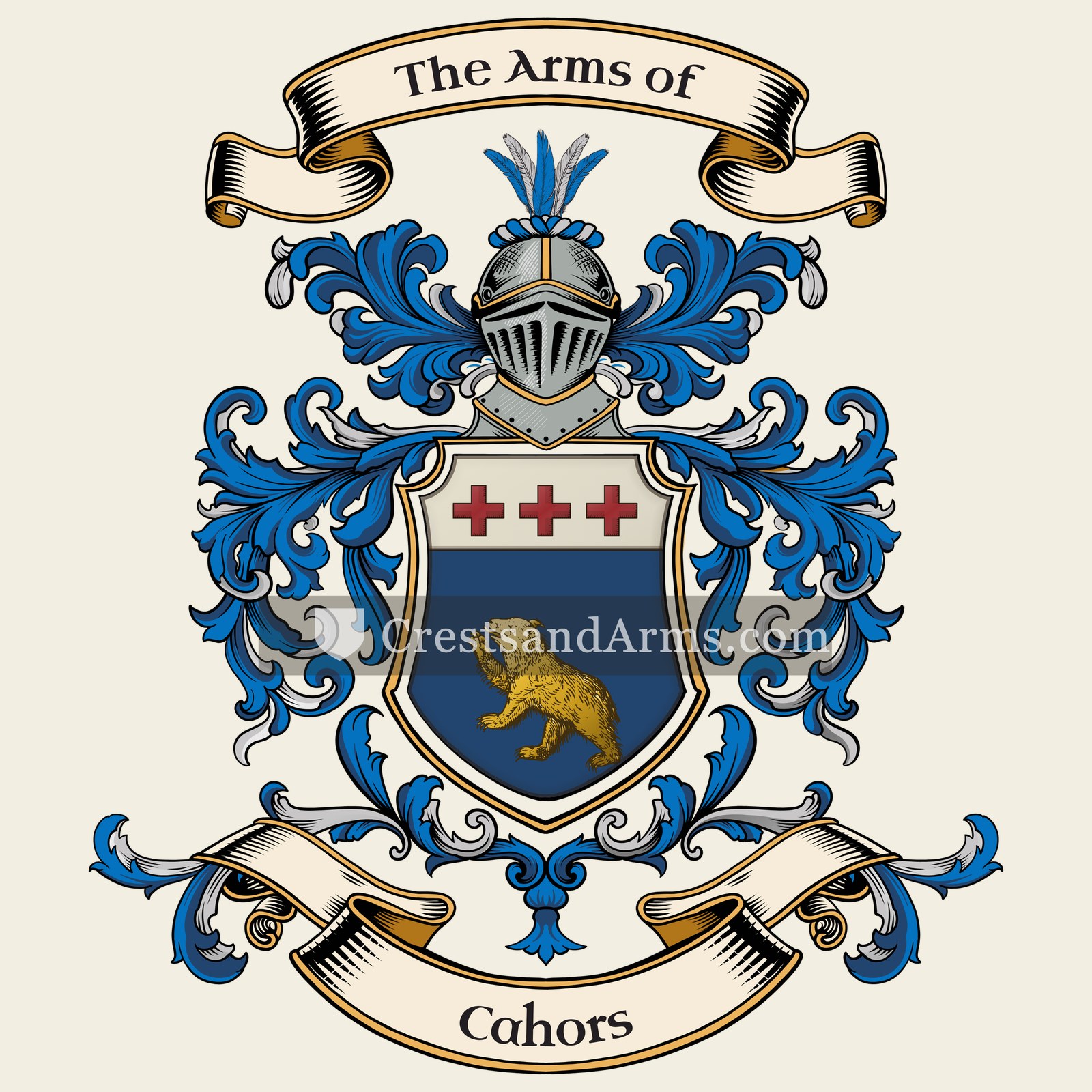
 chiefAuthority, wisdom and dominion
 cross symbolChristian faith and service
 bearStrength, cunning and protection of kin
 chiefAuthority, wisdom and dominion
 cross symbolChristian faith and service
 bearStrength, cunning and protection of kin