Map of England showing where the Caines arms are recorded
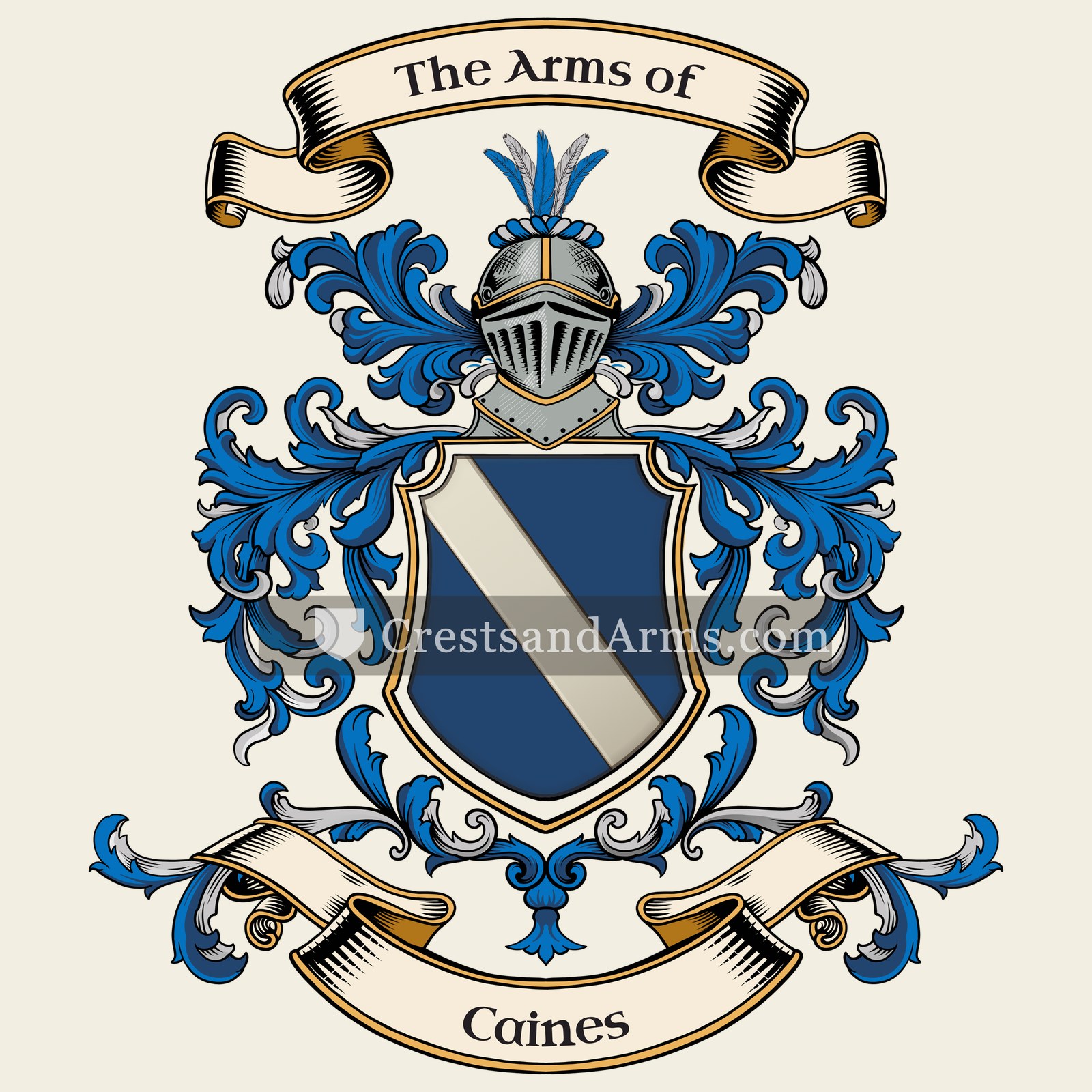
The Caines arms were recorded in Tarent Kaynston, c. 1620.
Arms such as these were typically recorded in York.
Yorkshire is the largest of the English counties, and it held more gentry families than any other. Land there was split among a great many households rather than a few, so a great many of them carried arms.
This is where the arms were entered in the register. Families often moved to other parts of the country, so the same name can turn up in more than one region.
The body that granted and recorded arms in England in this period.
James VI and I
Sovereign of the period
James VI and I
1603–1625
Reigning in England when the Caines arms are first recorded.
How Arms Worked in England
English heraldry allowed arms to be shared by all legitimate descendants of the original owner. These symbols were treated as personal property that moved through the generations to all children. While the eldest son kept the original design, other family members could use the same shield without needing to change it or register their own unique versions.
Granting authority
The College of Arms in London has regulated the use of coats of arms throughout England and Wales since 1484.
How they got arms
Families typically obtained their coats of arms through a formal grant from the Crown or by proving their ancient right to them.
Where arms were recorded
All official coats of arms are recorded in the registers kept at the College of Arms, which date back to the fifteenth century.
The family's standing
Recorded among the armigerous families of England.
Origin & History of the Caines Family in England
The family name Caines is rooted in the history of Northern England, with records confirming the family’s presence in the city of York as early as 1620. During the seventeenth century, York was a bustling center of trade and religious life, and families like the Caines were often integrated into the local merchant or artisan classes. The name itself is thought to be a variation of older occupational or locational surnames that evolved as families moved through the English countryside. By settling in a major urban hub like York, the early members of this family likely participated in the city’s vibrant guild system, which governed the crafts and trades of the era. This period was a time of significant social change in England, and the Caines family would have navigated the challenges of a growing city while establishing their roots in the region. Their early presence in such a historic location suggests that they were part of the foundational community that helped shape the city’s development during the early modern period.
Caines Meaning & Related Branches
Root word
Cain
Derived from the Hebrew name Qayin meaning acquired or possessed.
This name
CainesA patronymic surname indicating a descendant or son of Cain.
also spelled
Cains
Kaines
Cayne
Caynes
Related arms
Caignesvariant spelling
Canesvariant spelling
Caynevariant spelling
Caynesvariant spelling
Documented Sources
Sir Bernard Burke, The General Armory of England, Scotland, Ireland and Wales, London: Harrison & Sons, 1884
Baines, Edward, History, Directory and Gazetteer of the County of York, 1822
The National Archives, State Papers Domestic: James I, 1620
York City Archives, York House Books, 1620
Digital archive packCoat of arms PNG, gold border print PDF, vector SVG and the certificate of authenticity. Sent to your email in minutes.


 bendDefence, and the scarf of a commander
 bendDefence, and the scarf of a commander