A record of documented arms, meaning and origin, researched for the Cairns family lines. Documented in 2 countries.
Reg. 8738 · French, A–C
Coat of Arms & Family Crest Details
Symbols on this shield
martletA younger son, who must win his own land
trefoilPerpetuity, and the Trinity
Colours
Red (Gules)Means: Military strength
Silver (Argent)Means: Peace and sincerity
Green (Vert)Means: Hope
Historical info
Source
J. B. Rietstap, Armorial Général, Gouda: G. B. van Goor Zonen, 1884–87
Blazon (the actual original written record)
“De gu. à trois martinets d'arg.; à la bord. du même, ch. de trois trèfles de sin., 2 dans les angles du chef et 1 en p. C.: un martinet d'arg., ch. sur sa poitrine d'un trèfle de sin. S.: deux faucons, au nat., coll., enchaînés et grilletés d'or, tenant chacun en son bec un trèfle de sin. D.: EFFLORESCO.”
Francec. 1867
Digital archive packCoat of arms PNG, gold border print PDF, vector SVG and the certificate of authenticity. Sent to your email in minutes.
Map of France showing where the Cairns arms are recorded
The Cairns arms were recorded in France, c. 1867.
Arms such as these were typically recorded in Bretagne.
More families held coats of arms in Bretagne than anywhere else in France. The land was divided into many small estates rather than a few large ones, so far more households counted as gentry, and each needed a shield of its own to be told apart.
This is where the arms were entered in the register. Families often moved to other parts of the country, so the same name can turn up in more than one region.
The body that granted and recorded arms in France in this period.
Napoleon III
Sovereign of the period
Napoleon III
1852–1870
Reigning in France when the Cairns arms are first recorded.
How Arms Worked in France
In France, a coat of arms was a mark of honor that passed down through the male line to all legitimate descendants. Families often used the same shield without changes to show their shared heritage. If a branch wanted to stand out, they could add a small mark to their shield to show their specific place in the family tree.
Granting authority
The Juge d'armes de France acted as the official authority that regulated and verified coats of arms across the country.
How they got arms
Families typically inherited their arms from ancestors, though they could also receive them through royal grants or by proving their noble status.
Where arms were recorded
Coats of arms were officially recorded in the Armorial Général de France, which began its main collection in the year 1696.
The family's standing
Recorded among the armigerous families of France.
Origin & History of the Cairns Family in France
The history of the Cairns name in France is deeply tied to the unique cultural landscape of the Brittany region. While the name is often associated with Scottish origins, records confirm that members of the family were firmly established in Brittany by 1867. During this period, the region was undergoing significant social changes as it transitioned into a more modern industrial era. Families living in Brittany at this time often navigated a blend of traditional Celtic heritage and the growing influence of the French state. The presence of the Cairns name in local records suggests that these early family members were likely integrated into the professional or agricultural life of the province. By settling in this coastal area, the family became part of the long history of migration and cultural exchange that has defined Brittany for centuries.
Coat of Arms & Family Crest Details
Symbols on this shield
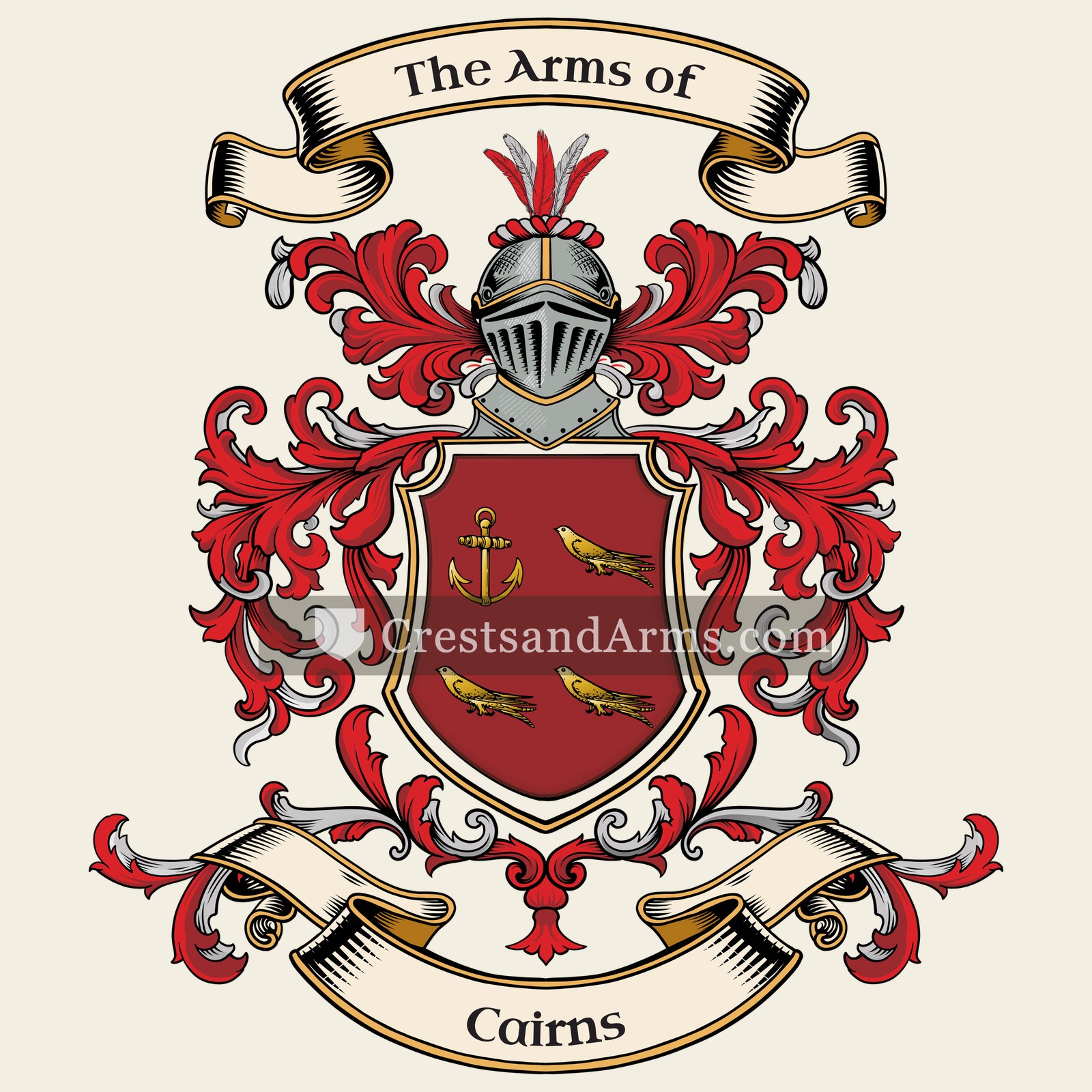
anchorHope, and steadfastness in trouble
martletA younger son, who must win his own land
Colours
Red (Gules)Means: Military strength
Gold (Or)Means: Generosity
Historical info
Source
Sir Bernard Burke, The General Armory of England, Scotland, Ireland and Wales, London: Harrison & Sons, 1884
Blazon (the actual original written record)
“Gu. an anchor betw. three martlets or”
Scotlandc. 1748
Digital archive packCoat of arms PNG, gold border print PDF, vector SVG and the certificate of authenticity. Sent to your email in minutes.
Map of Scotland showing where the Cairns arms are recorded
The Cairns arms were recorded in Scotland, c. 1748.
Arms such as these were typically recorded in Edinburgh.
Edinburgh was the seat of Scotland's government, its courts and its heralds. Families with business there settled nearby, and being close to where arms were recorded is exactly why so many of them appear.
This is where the arms were entered in the register. Families often moved to other parts of the country, so the same name can turn up in more than one region.
The body that granted and recorded arms in Scotland in this period.
George II of Great Britain
Sovereign of the period
George II of Great Britain
1727–1760
Reigning in France when the Cairns arms are first recorded.
How Arms Worked in Scotland
Scottish heraldry is unique because it treats a coat of arms as a piece of personal property protected by law. Only one person can own a specific design at any given time. When a family grows, the head keeps the original shield while other relatives must apply for their own distinct version with slight changes to prove their specific identity.
Granting authority
The Court of the Lord Lyon acts as the official body that regulates and controls all heraldic matters throughout Scotland.
How they got arms
Individuals obtain a legal right to their arms through a formal petition process that confirms their identity and family connection.
Where arms were recorded
All valid coats of arms are officially entered into the Public Register of All Arms and Bearings starting from 1672.
The family's standing
Recorded among the armigerous families of Scotland.
Origin & History of the Cairns Family in Scotland
The surname Cairns is rooted in the landscape of Scotland, deriving its name from the Gaelic word *carn*, which refers to a mound of stones or a burial cairn. Historically, the name is linked to families who lived near these prominent landmarks in the southern regions of the country. By the mid-eighteenth century, the family established a notable presence in Edinburgh, a city that served as the bustling center of Scottish intellectual and social life during the Enlightenment. Members of the family living in the capital in 1748 were part of a period defined by rapid urban growth and the expansion of professional classes. These early ancestors helped shape the identity of the name as it transitioned from its rural origins into the heart of Scotland’s most significant city.
Cairns Meaning & Related Branches
Root word
Carn
A Celtic term referring to a heap of stones or cairn.
This name
CairnsA topographic name for someone who lived near a prominent pile of stones or a burial mound.
also spelled
Kairns
Kairnz
Cairnes
Cairne
Related arms
Cairnesvariant spelling
Carnesvariant spelling
Documented Sources
J. B. Rietstap, Armorial Général, Gouda: G. B. van Goor Zonen, 1884–87
Archives départementales du Finistère, État civil, 1867
Archives départementales du Morbihan, Recensement de la population, 1867
Le Gallo, Yves, Le Finistère de la Préhistoire à nos jours, 1978
Digital archive packCoat of arms PNG, gold border print PDF, vector SVG and the certificate of authenticity. Sent to your email in minutes.


 martletA younger son, who must win his own land
 trefoilPerpetuity, and the Trinity
 martletA younger son, who must win his own land
 trefoilPerpetuity, and the Trinity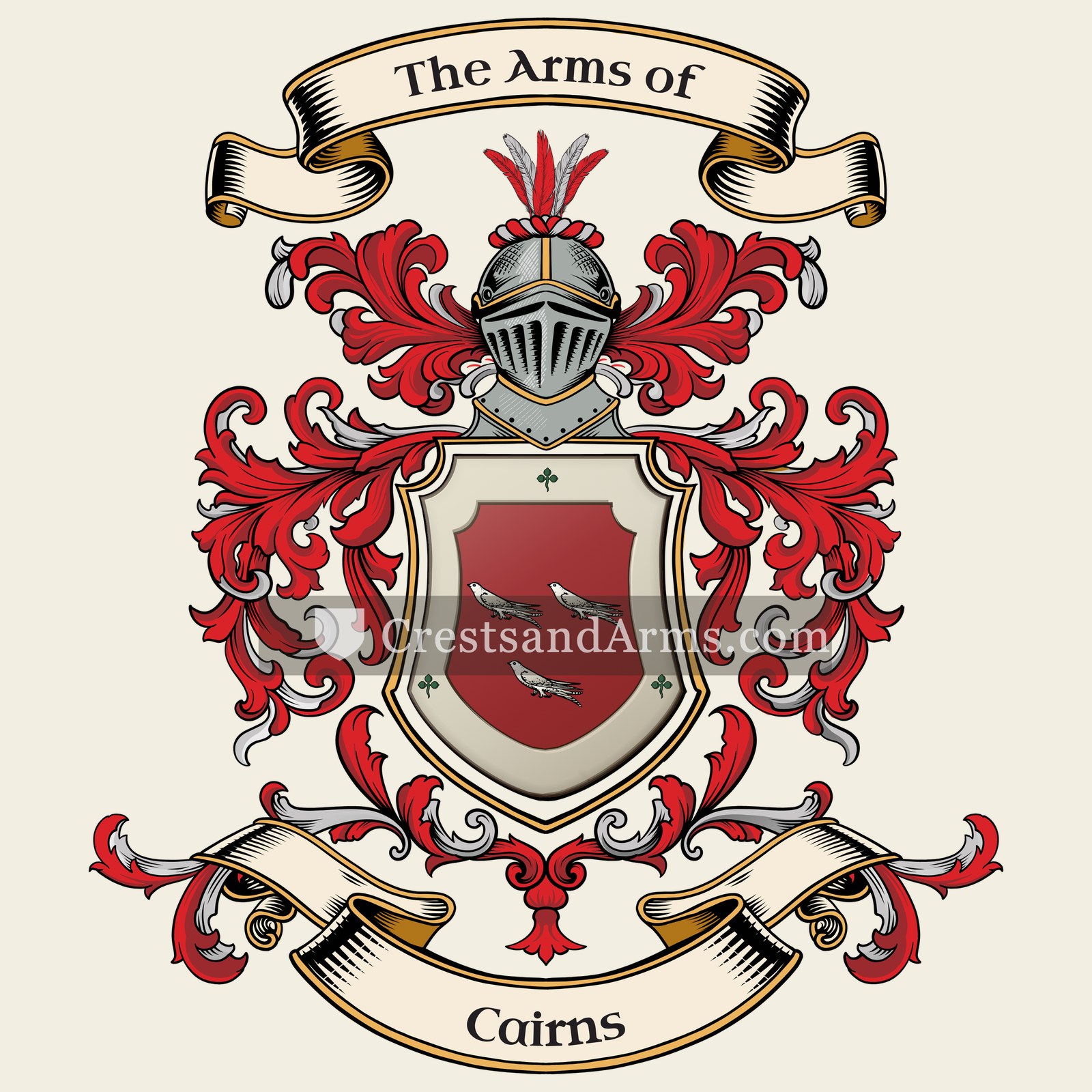


 anchorHope, and steadfastness in trouble