Map of Ireland showing where the Calfee arms are recorded
The Calfee arms were recorded in Ireland, c. 1645.
Arms such as these were typically recorded in Dublin.
Dublin was the seat of government in Ireland and the place where grants were sought and recorded. Families with business at the castle or the courts settled nearby, and settling there put their arms on record.
This is where the arms were entered in the register. Families often moved to other parts of the country, so the same name can turn up in more than one region.
The body that granted and recorded arms in Ireland in this period.
Charles I of England
Sovereign of the period
Charles I of England
1625–1649
Reigning in Ireland when the Calfee arms are first recorded.
How Arms Worked in Ireland
The Ulster King of Arms granted coats of arms to individuals who proved their social standing and good character. These symbols were typically inherited by all legitimate descendants of the original holder. If a family branch wanted a unique look, they could apply for a specific change to their design through the office to ensure their identity remained distinct.
Granting authority
The Ulster King of Arms acted as the official body that regulated and issued all coats of arms throughout Ireland.
How they got arms
Families obtained their arms through formal grants issued by the office after proving their eligibility and paying the required fees.
Where arms were recorded
All official grants were recorded in the registers held by the Ulster King of Arms starting from the year 1552.
The family's standing
Recorded among the armigerous families of Ireland.
Origin & History of the Calfee Family in Ireland
The history of the Calfee family name is deeply connected to the turbulent landscape of seventeenth-century Ireland. Records confirm that members of the family were established in Dublin by 1645, a time when the city served as a central hub for political and social change. The name is believed to have roots in the linguistic shifts occurring across the British Isles, likely evolving from older occupational or topographical descriptions. As the family settled into the urban environment of Dublin, they became part of the growing merchant and professional classes that defined the city during this era. Over the following decades, the family expanded their influence, eventually seeing members migrate across the Atlantic to the American colonies. This movement was common for families of that period who sought new economic opportunities and land ownership in the developing territories.
Calfee Meaning & Related Branches
Root word
Calf
A young bovine animal
This name
CalfeeA nickname for a person with a gentle or youthful nature
also spelled
Calff
Calphe
Kalf
Documented Sources
Sir Bernard Burke, The General Armory of England, Scotland, Ireland and Wales, London: Harrison & Sons, 1884
MacLysaght, Edward. The Surnames of Ireland. 1985
National Archives of Ireland. Civil Survey, 1654–1656
Registry of Deeds, Dublin. Memorials of Deeds, Conveyances and Wills
Digital archive packCoat of arms PNG, gold border print PDF, vector SVG and the certificate of authenticity. Sent to your email in minutes.


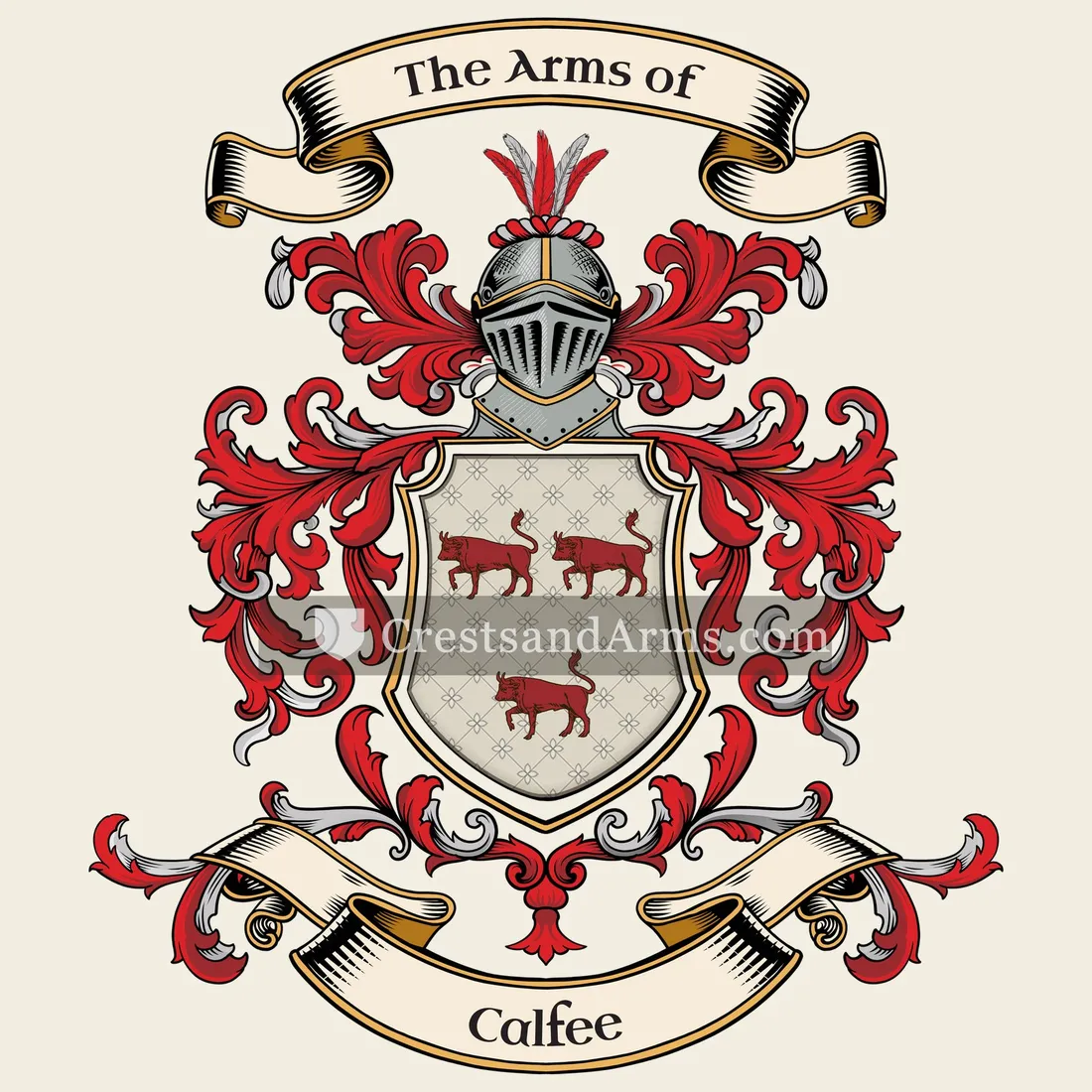
 bullValour and generosity
 bullValour and generosity