Map of Scotland showing where the Callison arms are recorded
The Callison arms were recorded in Kincardine, c. 1748.
Kincardineshire was a narrow strip of farmland between the hills and the North Sea. Its landed families were few but very long-settled, and long settlement brought arms.
This is where the arms were entered in the register. Families often moved to other parts of the country, so the same name can turn up in more than one region.
The body that granted and recorded arms in Scotland in this period.
George II of Great Britain
Sovereign of the period
George II of Great Britain
1727–1760
Reigning in Scotland when the Callison arms are first recorded.
How Arms Worked in Scotland
Scottish heraldry is unique because it treats a coat of arms as a piece of personal property protected by law. Only one person can own a specific design at any given time. When a family grows, the head keeps the original shield while other relatives must apply for their own distinct version with slight changes to prove their specific identity.
Granting authority
The Court of the Lord Lyon acts as the official body that regulates and controls all heraldic matters throughout Scotland.
How they got arms
Individuals obtain a legal right to their arms through a formal petition process that confirms their identity and family connection.
Where arms were recorded
All valid coats of arms are officially entered into the Public Register of All Arms and Bearings starting from 1672.
The family's standing
Recorded among the armigerous families of Kincardine.
Origin & History of the Callison Family in Scotland
The Callison family name has deep roots in the coastal region of Kincardine, Scotland, where historical records confirm their presence by the mid-eighteenth century. During this era, Kincardine was a bustling center for maritime trade and shipbuilding along the Firth of Forth. Families living in this area often relied on the sea for their livelihoods, working as merchants, sailors, or skilled craftsmen in the local dockyards. The name likely evolved as a localized variation of earlier Scottish surnames, reflecting the way families were identified within their specific parish communities. By 1748, the Callisons were well-established members of this society, participating in the daily life and religious traditions of the local kirk. Their history is tied to the growth of Scottish port towns, where the movement of goods and people shaped the identity of families living along the coast.
Coat of Arms & Family Crest Details
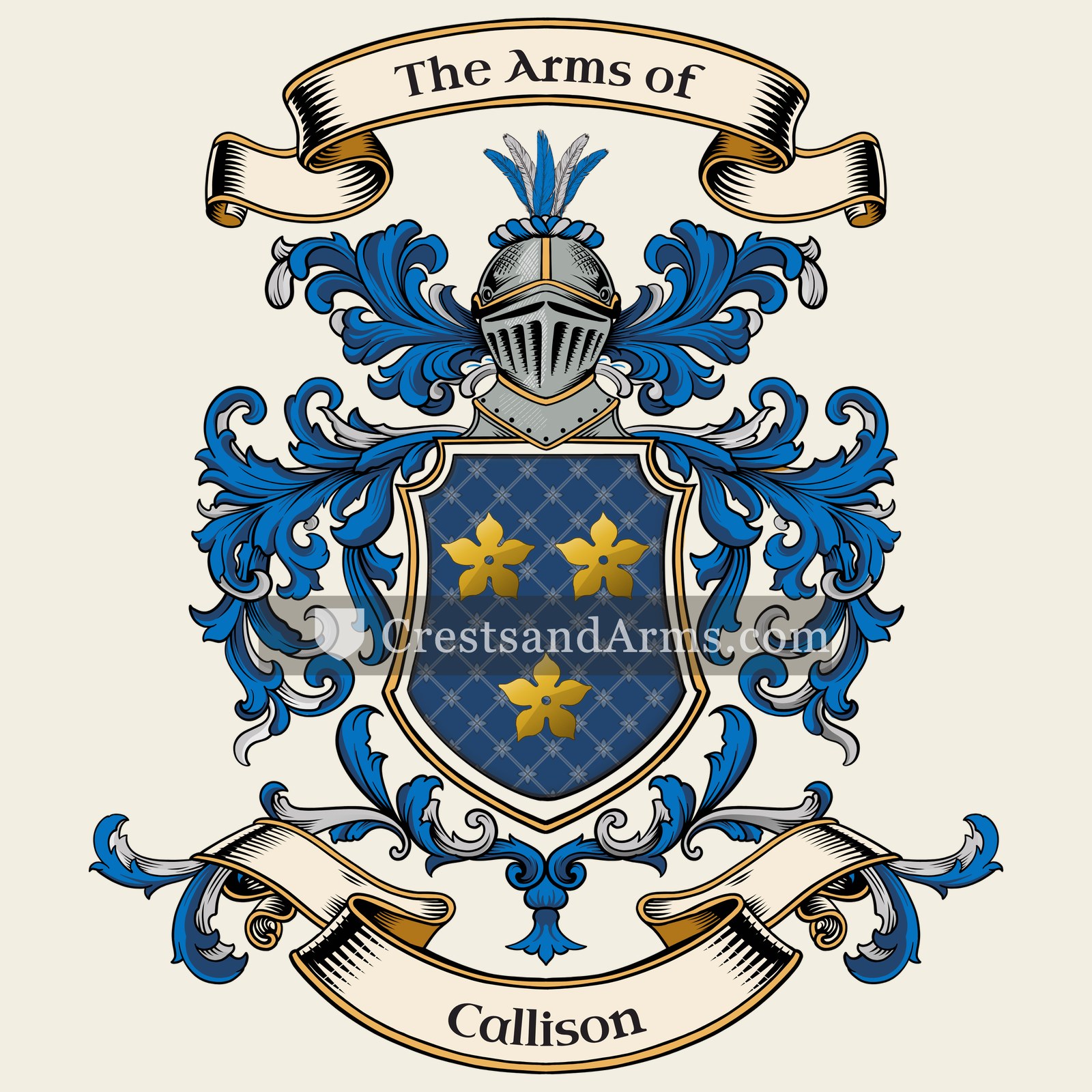
Symbols on this shield
cinquefoilHope and joy
Colours
Blue (Azure)Means: Loyalty and truth
Gold (Or)Means: Generosity
Historical info
Source
Sir Bernard Burke, The General Armory of England, Scotland, Ireland and Wales, London: Harrison & Sons, 1884
Blazon (the actual original written record)
“Az. three cinquefoils or, the middle leaf gu”
NorfolkNorfolk, c. 1620
Digital archive packCoat of arms PNG, gold border print PDF, vector SVG and the certificate of authenticity. Sent to your email in minutes.
Map of England showing where the Callison arms are recorded
The Callison arms were recorded in Norfolk, c. 1620.
Norfolk grew rich on wool and grain, and its wealth was spread among many middling families rather than a few great ones. Households of that kind bought land and took arms, and the county holds a large share of English names.
This is where the arms were entered in the register. Families often moved to other parts of the country, so the same name can turn up in more than one region.
The body that granted and recorded arms in England in this period.
James VI and I
Sovereign of the period
James VI and I
1603–1625
Reigning in Scotland when the Callison arms are first recorded.
How Arms Worked in England
English heraldry allowed arms to be shared by all legitimate descendants of the original owner. These symbols were treated as personal property that moved through the generations to all children. While the eldest son kept the original design, other family members could use the same shield without needing to change it or register their own unique versions.
Granting authority
The College of Arms in London has regulated the use of coats of arms throughout England and Wales since 1484.
How they got arms
Families typically obtained their coats of arms through a formal grant from the Crown or by proving their ancient right to them.
Where arms were recorded
All official coats of arms are recorded in the registers kept at the College of Arms, which date back to the fifteenth century.
The family's standing
Recorded among the armigerous families of Norfolk.
Origin & History of the Callison Family in England
The history of the Callison family in England is rooted in the coastal landscape of Norfolk, where records confirm their presence by the year 1620. During the early seventeenth century, Norfolk was a bustling region defined by its connections to the North Sea and a growing textile industry. Families like the Callisons often settled in these areas to take advantage of trade opportunities and the fertile agricultural land of East Anglia. While the name likely evolved from local dialects or occupational descriptions common to the region, the family became part of the social fabric of Norfolk during a time of significant economic change. By establishing themselves in this part of England, the early Callisons participated in the daily life of parish communities, contributing to the local workforce and the development of the county before many families began to look toward the wider world.
Related Branches & Arms
Root word
MacAlasdair
Son of Alexander, derived from the Greek name meaning defender of men.
This name
CallisonA Scottish patronymic surname indicating descent from a person named Alexander.
also spelled
Collyson
Collisonne
Documented Sources
Sir Bernard Burke, The General Armory of England, Scotland, Ireland and Wales, London: Harrison & Sons, 1884
National Records of Scotland, Kirk Session Records of Kincardine, 1748
National Records of Scotland, Old Parish Registers of Births and Marriages, 1748
Digital archive packCoat of arms PNG, gold border print PDF, vector SVG and the certificate of authenticity. Sent to your email in minutes.


 roseThe seventh son, and beauty with grace
 swordJustice, and military honour
 roseThe seventh son, and beauty with grace
 swordJustice, and military honour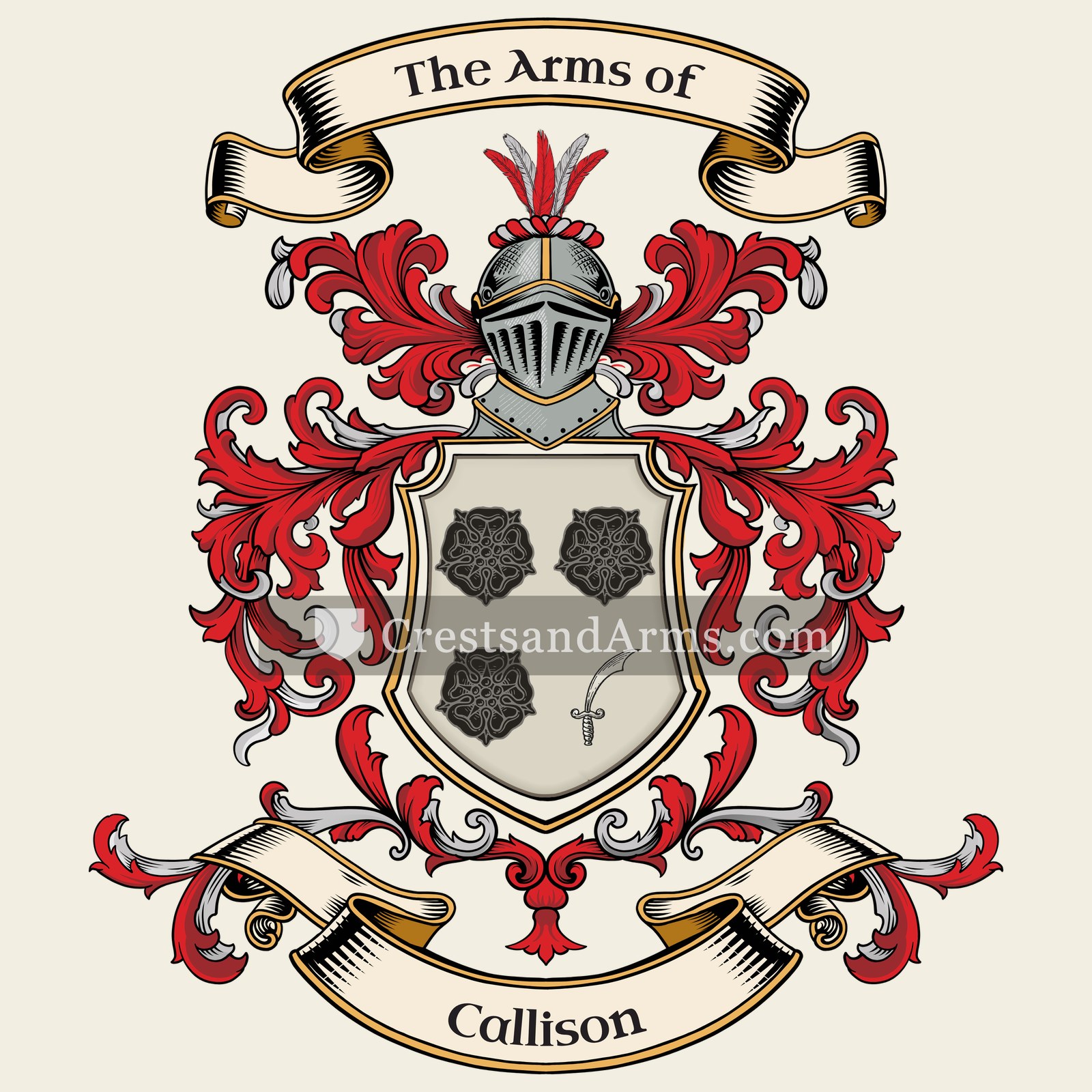


 cinquefoilHope and joy