Map of Italy showing where the Calvi arms are recorded
The Calvi arms were recorded in Milan, c. 1775.
This is where the arms were entered in the register. Families often moved to other parts of the country, so the same name can turn up in more than one region.
The body that granted and recorded arms in Italy in this period.
Alvise Giovanni Mocenigo
Sovereign of the period
Alvise Giovanni Mocenigo
1763–1778
Reigning in Italy when the Calvi arms are first recorded.
How Arms Worked in Italy
In the Italian states, coats of arms were often used by noble families to show their status and history. These symbols were passed down through the generations to all legitimate male descendants. Younger branches of a family usually kept the original design but sometimes added small changes to distinguish their specific line from the main branch.
Granting authority
Various local rulers and city governments controlled the use of coats of arms across the different Italian states.
How they got arms
Families often assumed their own arms or received them as official grants from local lords, popes, or city councils.
Where arms were recorded
Arms were recorded in local city archives or private family books rather than in one single national register.
The family's standing
Recorded among the armigerous families of Italy.
Origin & History of the Calvi Family in Italy
The surname Calvi traces its roots to the Latin word calvus, which translates to bald or hairless. In the context of medieval Italy, this name likely began as a descriptive nickname used to identify an individual by their physical appearance. By the time the family established a documented presence in Milan in 1775, they were already part of the complex social fabric of Northern Italy. During this period, Milan was a center of trade and intellectual growth under the influence of the Habsburg monarchy. Families like the Calvi often integrated into the local urban economy through commerce or administrative roles within the city. Their history reflects the broader movement of families who settled in major Italian hubs to take advantage of the shifting political and economic opportunities of the eighteenth century.
Coat of Arms & Family Crest Details
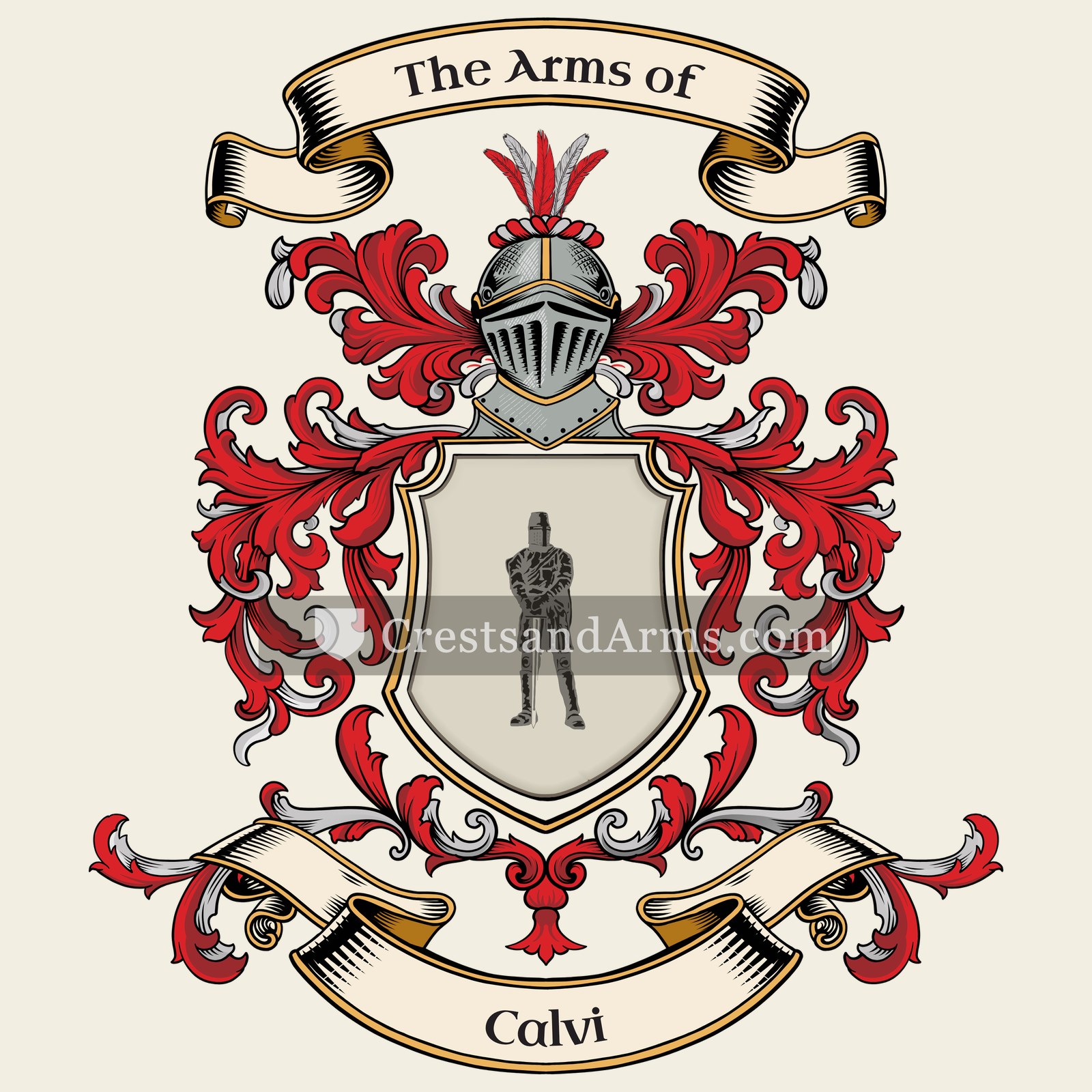
Symbols on this shield
knightChivalry and service in arms
Colours
Silver (Argent)Means: Peace and sincerity
Black (Sable)Means: Constancy
Historical info
Source
J. B. Rietstap, Armorial Général, Gouda: G. B. van Goor Zonen, 1884–87
Blazon (the actual original written record)
“Coupé: au 1 d'arg. à l'aigle ép. de sa., bq. et m. d'or; au 2 de sin. à un homme chauve iss., mouv. de la base de l'écu, hab. de sa., au rabat d'arg. Deux cq. cour. C.: 1º une aigle à une seule tête de sa., bq. et m. d'or; l. d'arg. et de sa.; 2º l'homme iss.; l. d'arg. et de sin.”
Austriac. 1879
Digital archive packCoat of arms PNG, gold border print PDF, vector SVG and the certificate of authenticity. Sent to your email in minutes.
Map of Austria showing where the Calvi arms are recorded
The Calvi arms were recorded in Austria, c. 1879.
Arms such as these were typically recorded in Tyrol.
Tyrol was mountain country in western Austria, where the valleys were held by families who had been there a very long time. Old tenure counted for more than money, and old families carried arms.
This is where the arms were entered in the register. Families often moved to other parts of the country, so the same name can turn up in more than one region.
Region
Tyrol
First recorded
1879
Granting Authority for the Calvi Arms
Imperial and Royal chancery
Sodacan · CC BY-SA 3.0
The body that granted and recorded arms in Austria in this period.
Franz Joseph I of Austria
Sovereign of the period
Franz Joseph I of Austria
1848–1916
Reigning in Italy when the Calvi arms are first recorded.
How Arms Worked in Austria
Austrian coats of arms were often linked directly to noble titles granted by the Emperor. These symbols belonged to the entire family line rather than just one individual. When a family grew, new branches kept the original design without needing to change it. This system allowed all members of a noble house to share the same identity across many generations.
Granting authority
The Imperial and Royal chancery managed all heraldic matters and controlled the official granting of arms throughout the Austrian lands.
How they got arms
Families typically received their arms through a formal imperial decree that often accompanied the elevation of a person to noble status.
Where arms were recorded
Official records of these grants were kept in the Imperial Register of Nobility which began its formal documentation process in 1453.
The family's standing
Recorded among the armigerous families of Austria.
Origin & History of the Calvi Family in Austria
The family name Calvi has deep roots in the Alpine regions of Europe, with a notable presence established in the Tyrol area of Austria by at least 1879. The name itself is thought to be of Latin origin, likely derived from the word calvus, which means bald or bare. This term was often used as a descriptive nickname for individuals living near a treeless mountain peak or a barren hillside. As families moved through the rugged landscapes of the Tyrol, they integrated into the local culture while maintaining their distinct identity. By the late nineteenth century, members of the Calvi family were active participants in the social and economic life of the region. Their history reflects the broader movement of families across the borders of the Austro-Hungarian Empire, where they adapted to the unique traditions and linguistic shifts of the Alpine territory.
Calvi Meaning & Related Branches
Root word
Calvus
Latin term meaning bald or hairless.
This name
CalviA topographic or descriptive surname referring to a bald person or someone living on a bare hill.
also spelled
Calve
Kalvi
Related arms
Riva-Finolisimilar arms
Calvévariant spelling
Documented Sources
J. B. Rietstap, Armorial Général, Gouda: G. B. van Goor Zonen, 1884–87
De Felice, Emidio. Dizionario dei cognomi italiani. 1978
State Archives of Milan (Archivio di Stato di Milano), Stato Civile della Restaurazione
Digital archive packCoat of arms PNG, gold border print PDF, vector SVG and the certificate of authenticity. Sent to your email in minutes.


 bendDefence, and the scarf of a commander
 bendDefence, and the scarf of a commander


 knightChivalry and service in arms