A record of documented arms, meaning and origin, researched for the Camas family lines. Documented in 2 countries.
Reg. 4137 · German, A–C
Coat of Arms & Family Crest Details
Symbols on this shield
bendDefence, and the scarf of a commander
martletA younger son, who must win his own land
crescentHonour by the sovereign, and the second son
stagPeace and harmony, and one who will not fight unprovoked
Colours
Silver (Argent)Means: Peace and sincerity
Red (Gules)Means: Military strength
Black (Sable)Means: Constancy
Blue (Azure)Means: Loyalty and truth
Historical info
Source
J. B. Rietstap, Armorial Général, Gouda: G. B. van Goor Zonen, 1884–87
Blazon (the actual original written record)
“Parti: au 1 d'arg. à la bande de gu., soutenant un choucas de sa. et acc. en chef d'un croiss. d'azur (Camas); au 2 d'arg. à une tête et col de cerf au nat. (Brandt). Deux cq. cour. C.: 1° une aigle de Prusse, tenant le sceptre et le globe; 1. d'arg. et de sa.; 2° une ramure de cerf; 1. d'arg. et de gu. [Comp. Filhiol de Camas.]”
Germanyc. 1742
Digital archive packCoat of arms PNG, gold border print PDF, vector SVG and the certificate of authenticity. Sent to your email in minutes.
Map of Germany showing where the Camas arms are recorded
The Camas arms were recorded in Germany, c. 1742.
Arms such as these were typically recorded in Bavaria.
Bavaria was a country of old landed families and walled market towns. Estates passed down the same line for centuries, and both the landowners and the leading townsmen kept arms, which is why so many Bavarian names sit in the registers.
This is where the arms were entered in the register. Families often moved to other parts of the country, so the same name can turn up in more than one region.
The body that granted and recorded arms in Germany in this period.
Charles VII, Holy Roman Emperor
Sovereign of the period
Charles VII, Holy Roman Emperor
1742–1745
Reigning in Germany when the Camas arms are first recorded.
How Arms Worked in Germany
In the Holy Roman Empire, coats of arms were often granted to individuals by the Emperor or his representatives. These arms were then passed down through the generations to all legitimate descendants of the original holder. Younger branches of a family usually kept the same shield design without needing to change it, as the arms belonged to the entire lineage.
Granting authority
The Holy Roman Emperor held the sole power to grant new coats of arms throughout his vast imperial territories.
How they got arms
Families typically obtained their coats of arms through a formal imperial grant or by proving their noble status to the authorities.
Where arms were recorded
These grants were officially recorded in the Imperial Chancery registers, which began keeping formal records of such honors during the Middle Ages.
The family's standing
Recorded among the armigerous families of Germany.
Origin & History of the Camas Family in Germany
The family name Camas has roots that trace back to the complex social landscape of eighteenth-century Bavaria. By 1742, members of the family were established within this region during a time of significant political upheaval caused by the War of the Austrian Succession. During this era, Bavaria was a central player in European power struggles, and families like the Camas often lived in communities shaped by the influence of the Holy Roman Empire. The name likely evolved as a localized identifier for individuals living in or near specific geographic landmarks or settlements within the Bavarian countryside. As the family navigated the rigid social structures of the time, they contributed to the local economy and community life that defined the southern German states. Their presence in 1742 suggests that the family was well-integrated into the regional culture long before the modern borders of Germany were fully formed.
Coat of Arms & Family Crest Details
Symbols on this shield
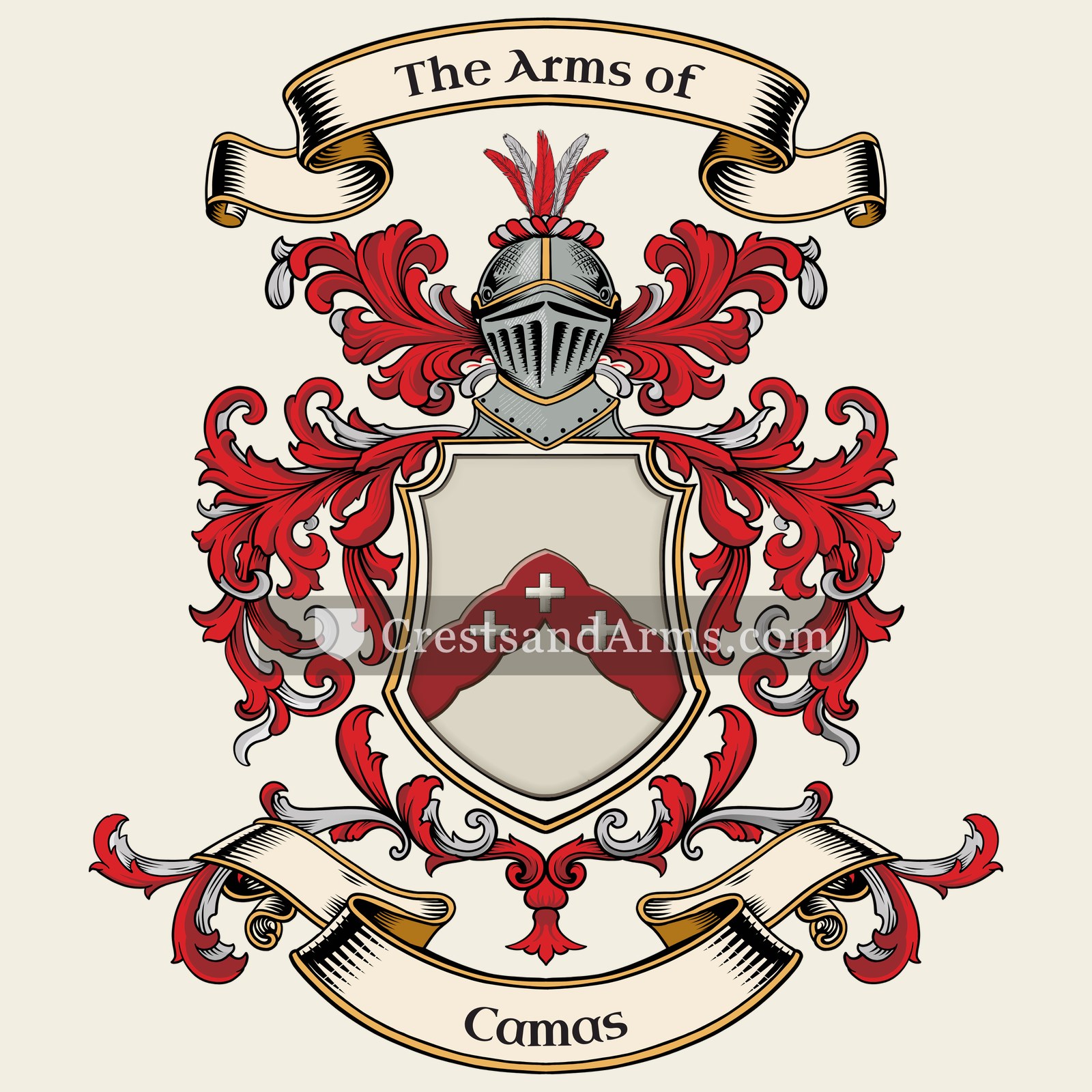
chevronProtection, and faithful service completed
cross symbolChristian faith and service
Colours
Silver (Argent)Means: Peace and sincerity
Red (Gules)Means: Military strength
Historical info
Source
Sir Bernard Burke, The General Armory of England, Scotland, Ireland and Wales, London: Harrison & Sons, 1884
Blazon (the actual original written record)
“Ar. on a chev. engr. gu. three crosses crosslet, couped of the first”
Irelandc. 1645
Digital archive packCoat of arms PNG, gold border print PDF, vector SVG and the certificate of authenticity. Sent to your email in minutes.
Map of Ireland showing where the Camas arms are recorded
The Camas arms were recorded in Ireland, c. 1645.
Arms such as these were typically recorded in Dublin.
Dublin was the seat of government in Ireland and the place where grants were sought and recorded. Families with business at the castle or the courts settled nearby, and settling there put their arms on record.
This is where the arms were entered in the register. Families often moved to other parts of the country, so the same name can turn up in more than one region.
The body that granted and recorded arms in Ireland in this period.
Charles I of England
Sovereign of the period
Charles I of England
1625–1649
Reigning in Germany when the Camas arms are first recorded.
How Arms Worked in Ireland
The Ulster King of Arms granted coats of arms to individuals who proved their social standing and good character. These symbols were typically inherited by all legitimate descendants of the original holder. If a family branch wanted a unique look, they could apply for a specific change to their design through the office to ensure their identity remained distinct.
Granting authority
The Ulster King of Arms acted as the official body that regulated and issued all coats of arms throughout Ireland.
How they got arms
Families obtained their arms through formal grants issued by the office after proving their eligibility and paying the required fees.
Where arms were recorded
All official grants were recorded in the registers held by the Ulster King of Arms starting from the year 1552.
The family's standing
Recorded among the armigerous families of Ireland.
Origin & History of the Camas Family in Ireland
The history of the Camas family in Ireland is firmly rooted in the mid-seventeenth century, with records confirming their presence in Dublin by 1645. During this era, Dublin was a bustling center of trade and political transition, making it a significant location for families to establish themselves. The name likely emerged within the urban environment of the city, where residents were often identified by their occupations or their specific neighborhoods. As the family settled into the social fabric of the capital, they became part of the diverse population that navigated the complex religious and economic changes of the time. While the name remains rare, its early appearance in official city records suggests that the family was integrated into the local community during a period of great historical upheaval in Ireland.
Camas Meaning & Related Branches
Root word
Kamm
A comb or a ridge of a mountain.
This name
CamasA topographic name for someone who lived near a mountain ridge or a crest.
also spelled
Kamas
Kammas
Camus
Related arms
Camusvariant spelling
Documented Sources
J. B. Rietstap, Armorial Général, Gouda: G. B. van Goor Zonen, 1884–87


 bendDefence, and the scarf of a commander
 martletA younger son, who must win his own land
 crescentHonour by the sovereign, and the second son
 stagPeace and harmony, and one who will not fight unprovoked
 bendDefence, and the scarf of a commander
 martletA younger son, who must win his own land
 crescentHonour by the sovereign, and the second son
 stagPeace and harmony, and one who will not fight unprovoked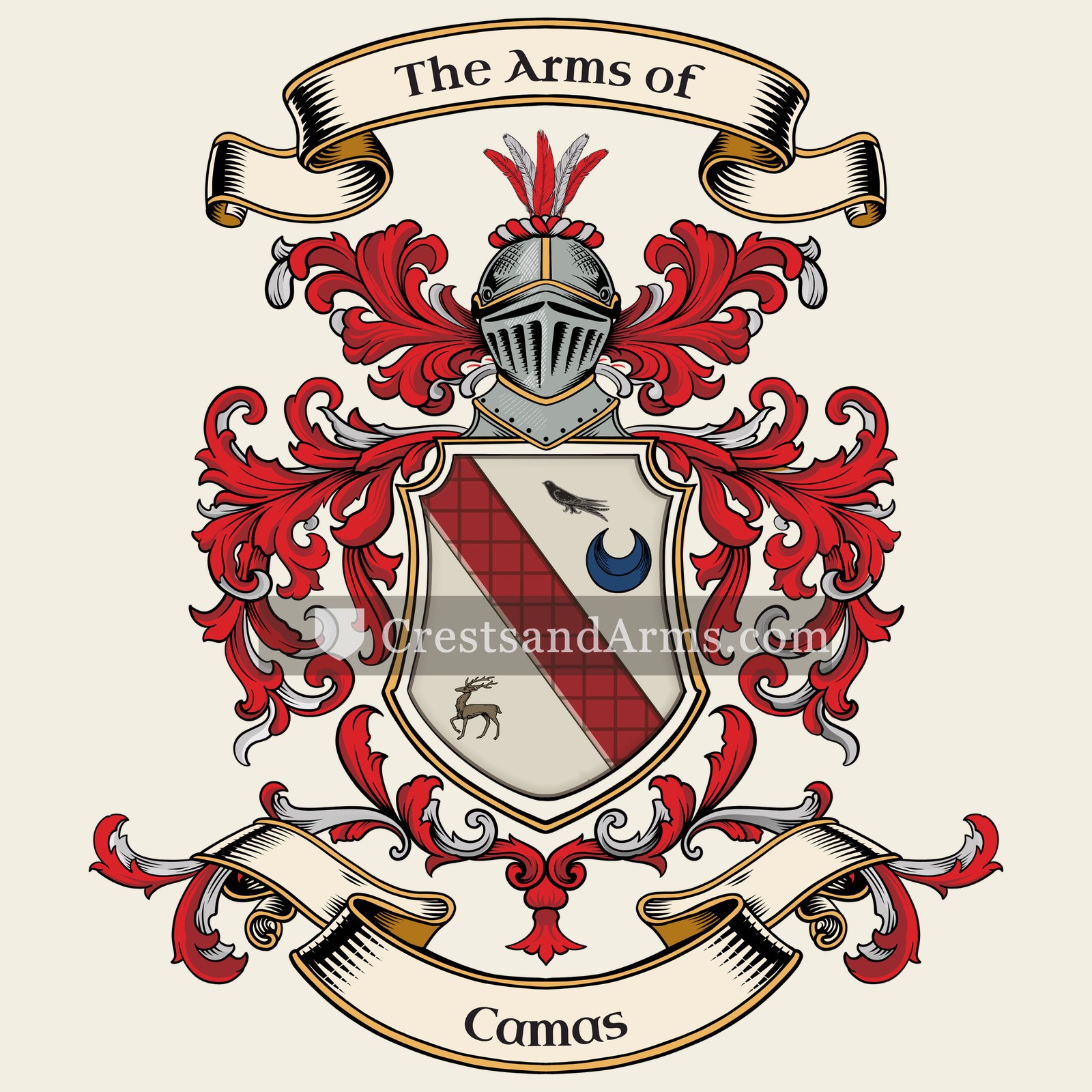


 chevronProtection, and faithful service completed
 cross symbolChristian faith and service