Map of France showing where the Camon arms are recorded
The Camon arms were recorded in Navarre, c. 1663.
Navarre was mountain country straddling the Pyrenees, with a strong class of small independent landholders. A great many households counted as gentry there, and each needed a shield to be told apart.
This is where the arms were entered in the register. Families often moved to other parts of the country, so the same name can turn up in more than one region.
The body that granted and recorded arms in France in this period.
Louis XIV of France
Sovereign of the period
Louis XIV of France
1643–1715
Reigning in France when the Camon arms are first recorded.
How Arms Worked in France
In France, a coat of arms was a mark of honor that passed down through the male line to all legitimate descendants. Families often used the same shield without changes to show their shared heritage. If a branch wanted to stand out, they could add a small mark to their shield to show their specific place in the family tree.
Granting authority
The Juge d'armes de France acted as the official authority that regulated and verified coats of arms across the country.
How they got arms
Families typically inherited their arms from ancestors, though they could also receive them through royal grants or by proving their noble status.
Where arms were recorded
Coats of arms were officially recorded in the Armorial Général de France, which began its main collection in the year 1696.
The family's standing
Recorded among the armigerous families of Navarre.
Origin & History of the Camon Family in France
The family name Camon has deep roots in the northern region of Navarre, where records confirm members of the family were established by 1663. During this period, Navarre was a unique territory with a complex social structure that blended local traditions with the influence of the Spanish crown. Families like the Camons often lived in rural villages or small towns where they were deeply connected to the land and local agricultural life. Because the region served as a crossroads between the Iberian Peninsula and the rest of Europe, the family likely navigated a society shaped by the movement of travelers, merchants, and soldiers. Their presence in official documents from the mid-seventeenth century suggests that they were recognized members of their community who participated in the legal and social systems of the time. Over the following generations, the family name became a lasting part of the regional history of Navarre as they continued to build their lives within the mountain valleys and plains of the area.
Camon Meaning & Related Branches
Root word
Camus
Derived from the Old French word meaning snub-nosed or flat-nosed.
This name
CamonA topographic or descriptive surname referring to a person with a flat or snub nose.
also spelled
Kamon
Documented Sources
J. B. Rietstap, Armorial Général, Gouda: G. B. van Goor Zonen, 1884–87
Archivo Real y General de Navarra, Sección de Procesos Judiciales
Caro Baroja, Julio, La casa en Navarra, 1982
Jimeno Jurío, José María, Navarra: Historia y destino, 1990
Digital archive packCoat of arms PNG, gold border print PDF, vector SVG and the certificate of authenticity. Sent to your email in minutes.


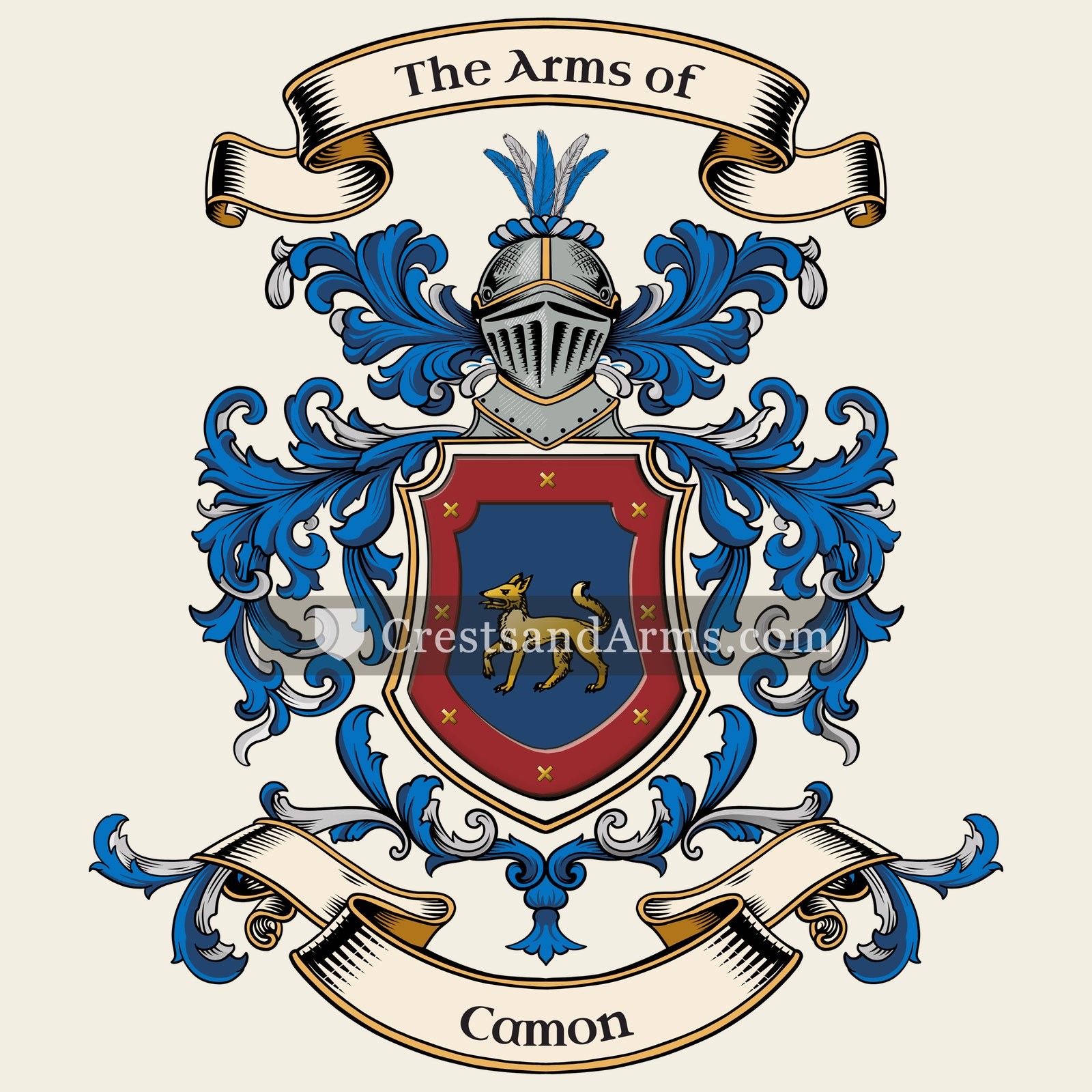
 wolfReward from long service and hard work
 saltire coupedResolution, and the cross of St Andrew
 wolfReward from long service and hard work
 saltire coupedResolution, and the cross of St Andrew