Map of Belgium showing where the Campano arms are recorded
The Campano arms were recorded in Tournai, c. 1737.
This is where the arms were entered in the register. Families often moved to other parts of the country, so the same name can turn up in more than one region.
The body that granted and recorded arms in Belgium in this period.
Charles VI, Holy Roman Emperor
Sovereign of the period
Charles VI, Holy Roman Emperor
1711–1740
Reigning in Belgium when the Campano arms are first recorded.
How Arms Worked in Belgium
In Belgium, a coat of arms is considered personal property that is passed down through the male line to legitimate descendants. Families often use the same shield design across generations to show their shared heritage. If a branch of the family wants to change the design, they must apply for an official update to their specific version of the arms.
Granting authority
The Conseil héraldique is the official body that regulates and approves all coats of arms in Belgium.
How they got arms
Families obtain their coats of arms through formal royal grants or by confirming their historical right to use existing designs.
Where arms were recorded
All approved coats of arms are officially recorded in the public registers of the Conseil héraldique since 1844.
The family's standing
Recorded among the armigerous families of Belgium.
Origin & History of the Campano Family in Belgium
The family name Campano carries a rich history that is deeply rooted in the cultural landscape of Western Europe. By the year 1737, records confirm that members of the family were well-established in the historic city of Tournai, which is located in modern-day Belgium. During this period, Tournai served as a vital hub for trade and craftsmanship, placing the family in a region known for its complex political shifts and vibrant urban life. The name itself is often associated with regional origins, as it likely functioned as a geographic identifier for individuals who moved from rural areas to growing cities. As the family integrated into the society of Tournai, they contributed to the local economy and participated in the daily life of a city that had long been a center for textile production and religious history. This early presence in such a prominent city suggests that the family was part of the steady movement of people who shaped the social fabric of the eighteenth century.
Campano Meaning & Related Branches
Root word
Campania
Latin term for a flat, open field or countryside region.
This name
CampanoRefers to a person who originated from the Campania region or lived in the countryside.
also spelled
Campen
Kampeno
Documented Sources
J. B. Rietstap, Armorial Général, Gouda: G. B. van Goor Zonen, 1884–87
Archives de l'État à Tournai, État civil et registres paroissiaux
Rolland, Paul, Histoire de Tournai, 1956
Digital archive packCoat of arms PNG, gold border print PDF, vector SVG and the certificate of authenticity. Sent to your email in minutes.


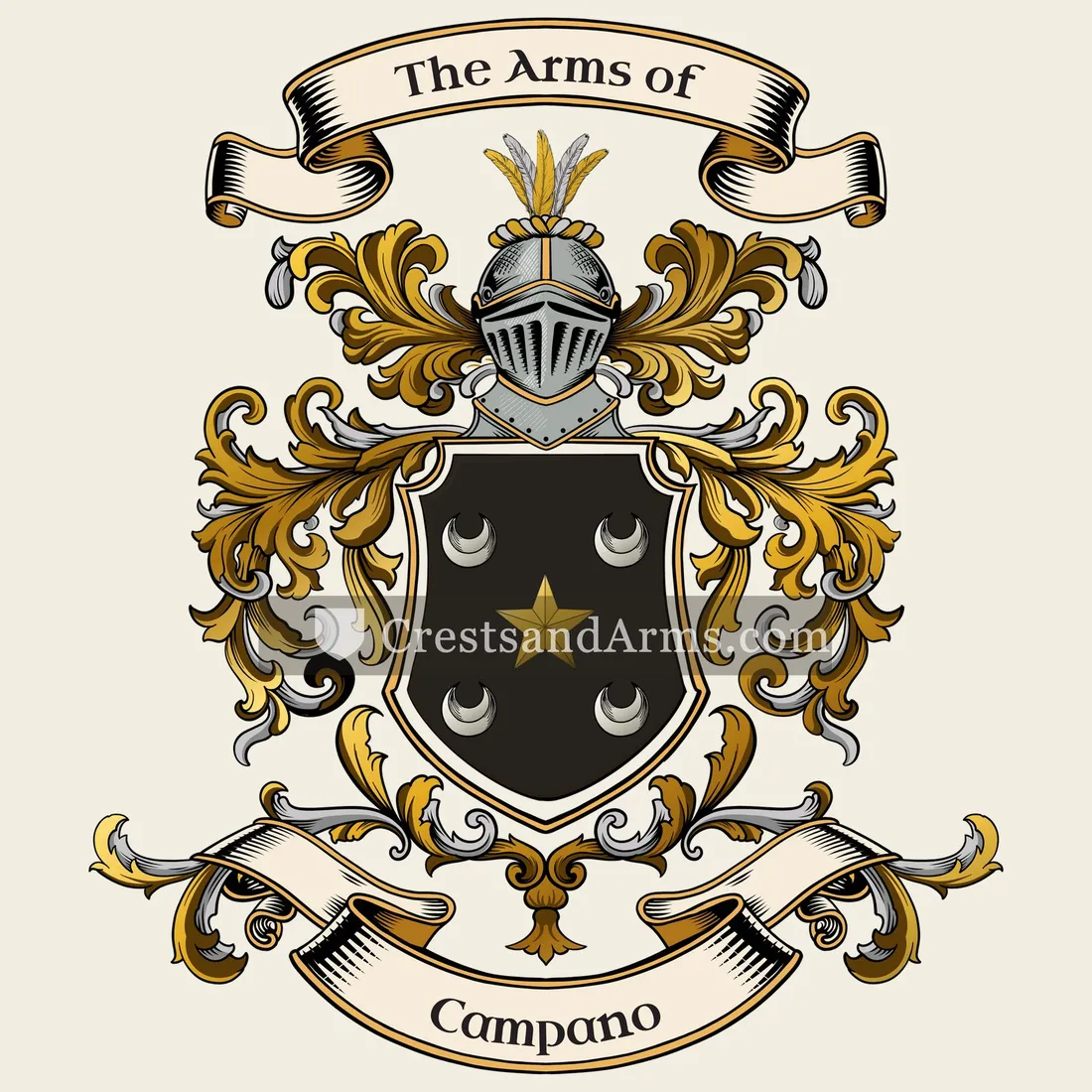
 mulletThe third son, and a divine quality from above
 crescentHonour by the sovereign, and the second son
 mulletThe third son, and a divine quality from above
 crescentHonour by the sovereign, and the second son