Map of France showing where the Canaday arms are recorded
The Canaday arms were recorded in Roussillon, c. 1663.
Roussillon was Pyrenean country that belonged to Spain before it belonged to France. Its families held small estates under both crowns, and serving either one brought a shield.
This is where the arms were entered in the register. Families often moved to other parts of the country, so the same name can turn up in more than one region.
The body that granted and recorded arms in France in this period.
Louis XIV of France
Sovereign of the period
Louis XIV of France
1643–1715
Reigning in France when the Canaday arms are first recorded.
How Arms Worked in France
In France, a coat of arms was a mark of honor that passed down through the male line to all legitimate descendants. Families often used the same shield without changes to show their shared heritage. If a branch wanted to stand out, they could add a small mark to their shield to show their specific place in the family tree.
Granting authority
The Juge d'armes de France acted as the official authority that regulated and verified coats of arms across the country.
How they got arms
Families typically inherited their arms from ancestors, though they could also receive them through royal grants or by proving their noble status.
Where arms were recorded
Coats of arms were officially recorded in the Armorial Général de France, which began its main collection in the year 1696.
The family's standing
Recorded among the armigerous families of Roussillon.
Origin & History of the Canaday Family in France
The family name Canaday originates from a complex history of migration and linguistic evolution within the region of Roussillon. By 1663, records confirm that members of the family were firmly established in this area, which sits along the border of modern France and Spain. During this period, the region was undergoing significant political shifts as it transitioned from Spanish to French control following the Treaty of the Pyrenees. The name likely developed as a localized variation of older surnames found in the Catalan-speaking territories of the eastern Pyrenees. As families moved through these changing borders, the spelling of their names often adapted to fit the phonetic preferences of the local administration. These early ancestors were likely involved in the agricultural or artisanal life of the Roussillon countryside, contributing to the distinct cultural identity of a region caught between two powerful kingdoms.
Canaday Meaning & Related Branches
Root word
Cana
A Celtic or Old French term referring to a reed or cane.
This name
CanadayDerived from a topographic descriptor for someone who lived near a patch of reeds.
also spelled
Candi
Kandy
Documented Sources
J. B. Rietstap, Armorial Général, Gouda: G. B. van Goor Zonen, 1884–87
Sahlins, Peter, Boundaries: The Making of France and Spain in the Pyrenees, 1989
Archives départementales des Pyrénées-Orientales, Collection de l'Intendance de Roussillon, Série C
Digital archive packCoat of arms PNG, gold border print PDF, vector SVG and the certificate of authenticity. Sent to your email in minutes.


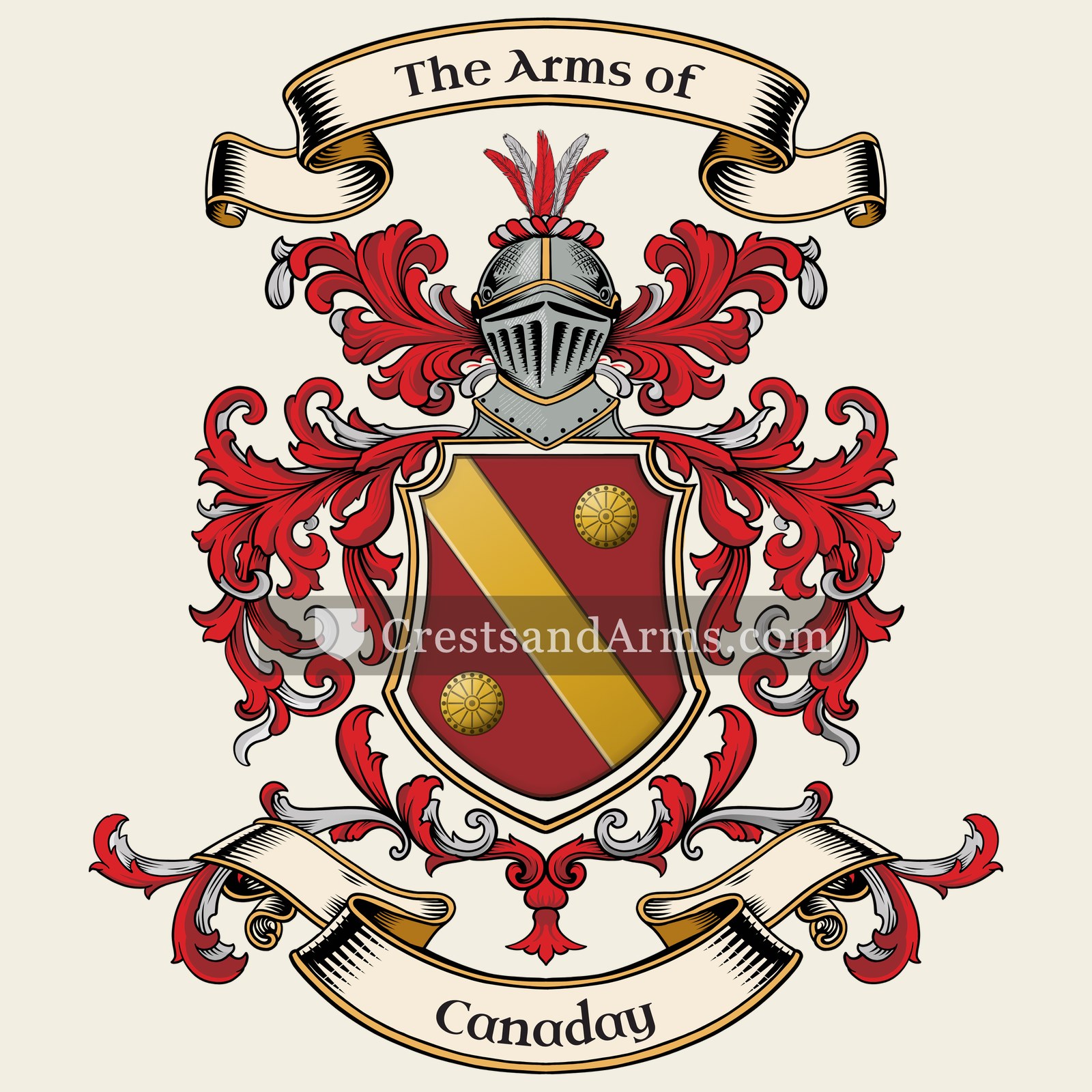
 bendDefence, and the scarf of a commander
 roundelA coin, and one who has been to the crusades
 bendDefence, and the scarf of a commander
 roundelA coin, and one who has been to the crusades