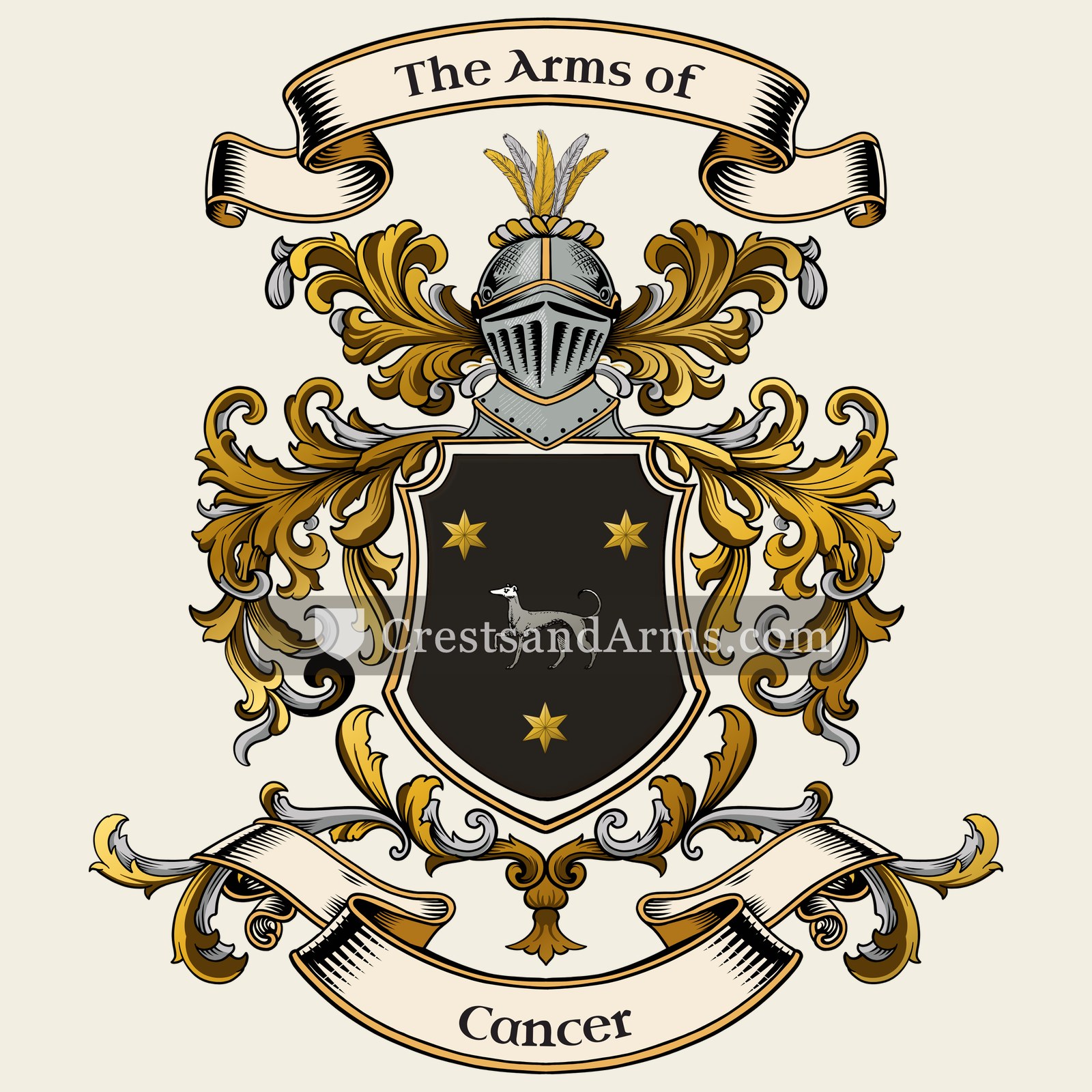
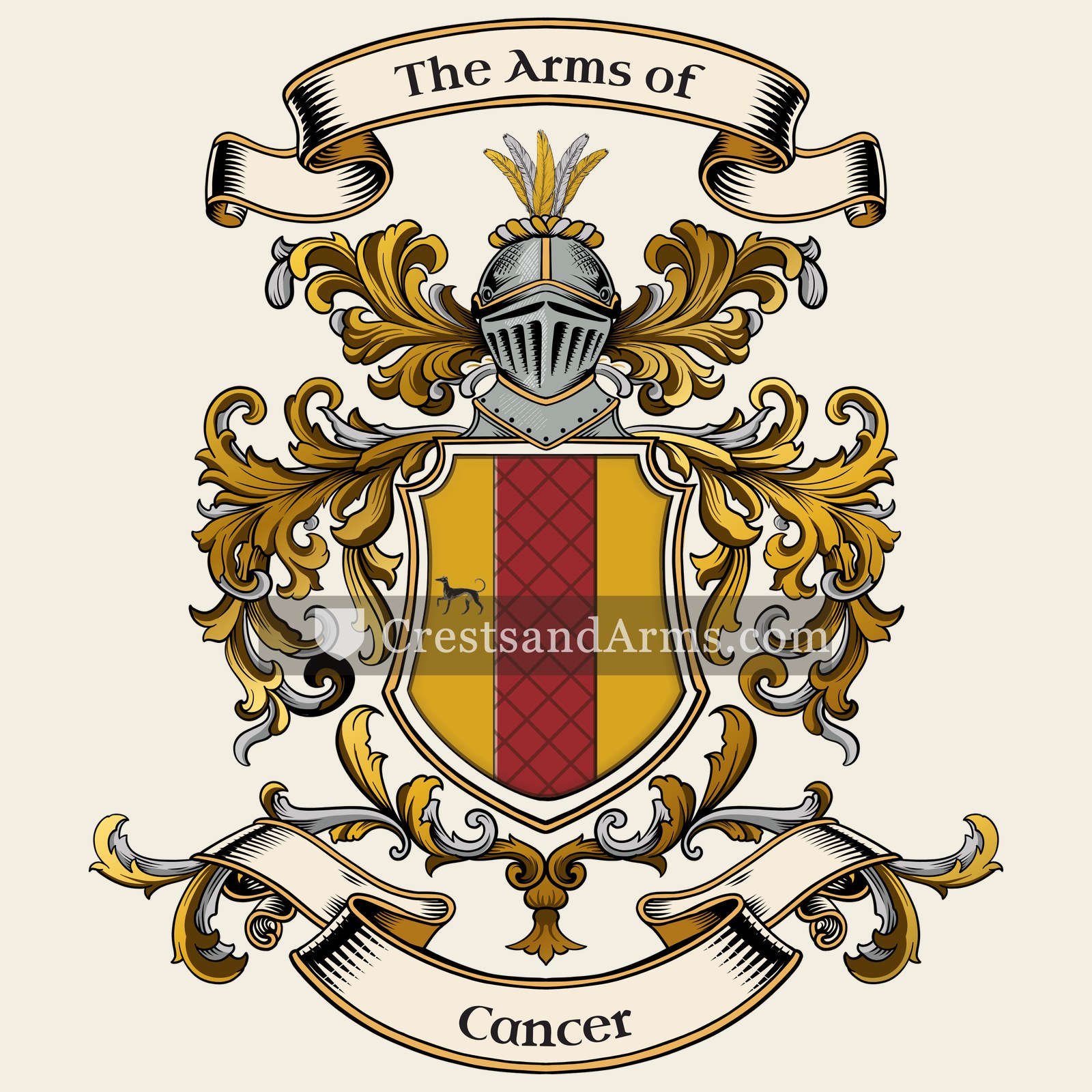
A record of documented arms, meaning and origin, researched for the Cancer family lines. Documented in 2 countries.
Reg. 8061 · French, A–C
Coat of Arms & Family Crest Details
Symbols on this shield
greyhoundCourage, vigilance and loyalty
starThe celestial goddess, and nobility
Colours
Black (Sable)Means: Constancy
Silver (Argent)Means: Peace and sincerity
Gold (Or)Means: Generosity
Historical info
Source
J. B. Rietstap, Armorial Général, Gouda: G. B. van Goor Zonen, 1884–87
Blazon (the actual original written record)
“De sa. à un lévrier d'arg., acc. de trois étoiles (6) d'or.”
LanguedocLanguedoc, c. 1663
Where the Cancer Arms Were Recorded
Languedoc
Map of France showing where the Cancer arms are recorded
The Cancer arms were recorded in Languedoc, c. 1663.
Languedoc stretched across the south of France, a country of small towns, vineyards and old local families. Its gentry were numerous rather than grand, and a great many of them held arms even where their estates were modest.
This is where the arms were entered in the register. Families often moved to other parts of the country, so the same name can turn up in more than one region.
The body that granted and recorded arms in France in this period.
Louis XIV of France
Sovereign of the period
Louis XIV of France
1643–1715
Reigning in France when the Cancer arms are first recorded.
How Arms Worked in France
In France, a coat of arms was a mark of honor that passed down through the male line to all legitimate descendants. Families often used the same shield without changes to show their shared heritage. If a branch wanted to stand out, they could add a small mark to their shield to show their specific place in the family tree.
Granting authority
The Juge d'armes de France acted as the official authority that regulated and verified coats of arms across the country.
How they got arms
Families typically inherited their arms from ancestors, though they could also receive them through royal grants or by proving their noble status.
Where arms were recorded
Coats of arms were officially recorded in the Armorial Général de France, which began its main collection in the year 1696.
The family's standing
Recorded among the armigerous families of Languedoc.
Origin & History of the Cancer Family in France
The family name Cancer traces its historical roots to the Languedoc region of southern France, where records confirm members of the family were established by 1663. During the seventeenth century, this area was a center of agricultural production and religious transition, which likely influenced the daily lives and social standing of the family. The name itself is thought to have evolved from local linguistic traditions or descriptive nicknames common in the Occitan-speaking territories of the time. As the family navigated the complex social structures of the French provinces, they were likely involved in the regional trade networks or land management practices that defined the Languedoc economy. By maintaining a presence in this specific geographic corridor, the early generations of the Cancer family participated in the long-term development of a region known for its unique cultural identity and historical resilience.
Coat of Arms & Family Crest Details
Symbols on this shield
paleMilitary strength, and a fortified defence
greyhoundCourage, vigilance and loyalty
Colours
Gold (Or)Means: Generosity
Red (Gules)Means: Military strength
Black (Sable)Means: Constancy
Historical info
Source
J. B. Rietstap, Armorial Général, Gouda: G. B. van Goor Zonen, 1884–87
Blazon (the actual original written record)
“D'or à un lévrier ramp. de sa., enchaîné à un pal de gu. à sen.”
AragonAragon, c. 1722
Where the Cancer Arms Were Recorded
Aragon
Map of Spain showing where the Cancer arms are recorded
The Cancer arms were recorded in Aragon, c. 1722.
Aragon was mountain and river country in north-eastern Spain, with a strong tradition of small independent landholders. A great many families counted as gentry there, and each one needed a shield to be told apart.
This is where the arms were entered in the register. Families often moved to other parts of the country, so the same name can turn up in more than one region.
The body that granted and recorded arms in Spain in this period.
Philip V of Spain
Sovereign of the period
Philip V of Spain
1714–1724
Reigning in France when the Cancer arms are first recorded.
How Arms Worked in Spain
In Spain, a coat of arms was considered a form of property that belonged to the entire family line. These arms were passed down from a father to all his children equally. Younger branches of the family usually kept the original design without needing to add any special marks to distinguish their specific line.
Granting authority
The Cronista Rey de Armas was the official body that regulated and granted coats of arms throughout Spain.
How they got arms
Families often obtained their arms through royal grants or by proving their noble status to the official heraldic authority.
Where arms were recorded
Coats of arms were officially recorded in the registers of the Cronista Rey de Armas starting in 1496.
The family's standing
Recorded among the armigerous families of Aragon.
Origin & History of the Cancer Family in Spain
The family name Cancer has deep roots in the historical region of Aragon, Spain, where records confirm the family’s presence by the early eighteenth century. The name is linguistically linked to the Latin word *cancer*, which historically referred to a crab, but in a medieval Spanish context, it often functioned as a descriptive nickname or a topographic identifier. Families bearing this name were integrated into the social fabric of the Ebro River valley, a region known for its complex mix of agricultural traditions and administrative roles. By 1722, the Cancer family was established within the local Aragonese community, participating in the regional life that defined the transition from the late Hapsburg era to the new Bourbon administration. Their history reflects the broader movement of families who settled in the northern provinces, contributing to the local economy and the evolving identity of the Spanish interior during a time of significant political change.
Related Branches & Arms
Root word
Cancer
Latin word meaning crab or a spreading ulcerous growth.
This name
CancerA topographic or occupational surname likely referring to someone living near a crab-filled area or a crab fisherman.
also spelled
Kanser
Documented Sources
J. B. Rietstap, Armorial Général, Gouda: G. B. van Goor Zonen, 1884–87
Archives départementales de l'Hérault, Registres paroissiaux et d'état civil de la commune de Montpellier, 1663
Le Roy Ladurie, Emmanuel, Les Paysans de Languedoc, 1966
Digital archive packCoat of arms PNG, gold border print PDF, vector SVG and the certificate of authenticity. Sent to your email in minutes.


 greyhoundCourage, vigilance and loyalty
 starThe celestial goddess, and nobility
 greyhoundCourage, vigilance and loyalty
 starThe celestial goddess, and nobility

 paleMilitary strength, and a fortified defence