Map of Spain showing where the Cano arms are recorded
The Cano arms were recorded in Castile, c. 1722.
Castile was the heart of Spain and the source of most of its noble families. Land won in the long wars against the Moors was granted out to fighting men, and a man granted land was granted arms along with it.
This is where the arms were entered in the register. Families often moved to other parts of the country, so the same name can turn up in more than one region.
The body that granted and recorded arms in Spain in this period.
Philip V of Spain
Sovereign of the period
Philip V of Spain
1714–1724
Reigning in Spain when the Cano arms are first recorded.
How Arms Worked in Spain
In Spain, a coat of arms was considered a form of property that belonged to the entire family line. These arms were passed down from a father to all his children equally. Younger branches of the family usually kept the original design without needing to add any special marks to distinguish their specific line.
Granting authority
The Cronista Rey de Armas was the official body that regulated and granted coats of arms throughout Spain.
How they got arms
Families often obtained their arms through royal grants or by proving their noble status to the official heraldic authority.
Where arms were recorded
Coats of arms were officially recorded in the registers of the Cronista Rey de Armas starting in 1496.
The family's standing
Recorded among the armigerous families of Castile.
Origin & History of the Cano Family in Spain
The surname Cano has deep roots in the Iberian Peninsula, emerging as a descriptive name that likely identified an ancestor based on their physical appearance or personal traits. In the Spanish language, the word "cano" refers to someone with gray or white hair, suggesting that the name was originally a nickname given to an elder or a person who turned gray at a young age. By the early 18th century, the family was well-established in the region of Castile, a central area of Spain known for its historical influence and distinct cultural identity. Families living in Castile during this period often participated in the agricultural and administrative life of the kingdom, helping to shape the local communities where they resided. As the name spread through different provinces, it became a permanent identifier for generations of families who maintained their ties to the Castilian landscape.
Cano Meaning & Related Branches
Root word
canis
Latin word meaning dog or hound.
This name
CanoA topographic name for someone living near a reed bed or a nickname for a dog-like person.
also spelled
Kano
Canoe
Canos
Documented Sources
J. B. Rietstap, Armorial Général, Gouda: G. B. van Goor Zonen, 1884–87
Moll, Francesc de B., Els llinatges catalans: Catalunya, País Valencià, Illes Balears, 1959
Pescador del Hoyo, María del Carmen, Apellidos en España, 1996
Archivo de la Real Chancillería de Valladolid, Registro de Ejecutorias
Digital archive packCoat of arms PNG, gold border print PDF, vector SVG and the certificate of authenticity. Sent to your email in minutes.


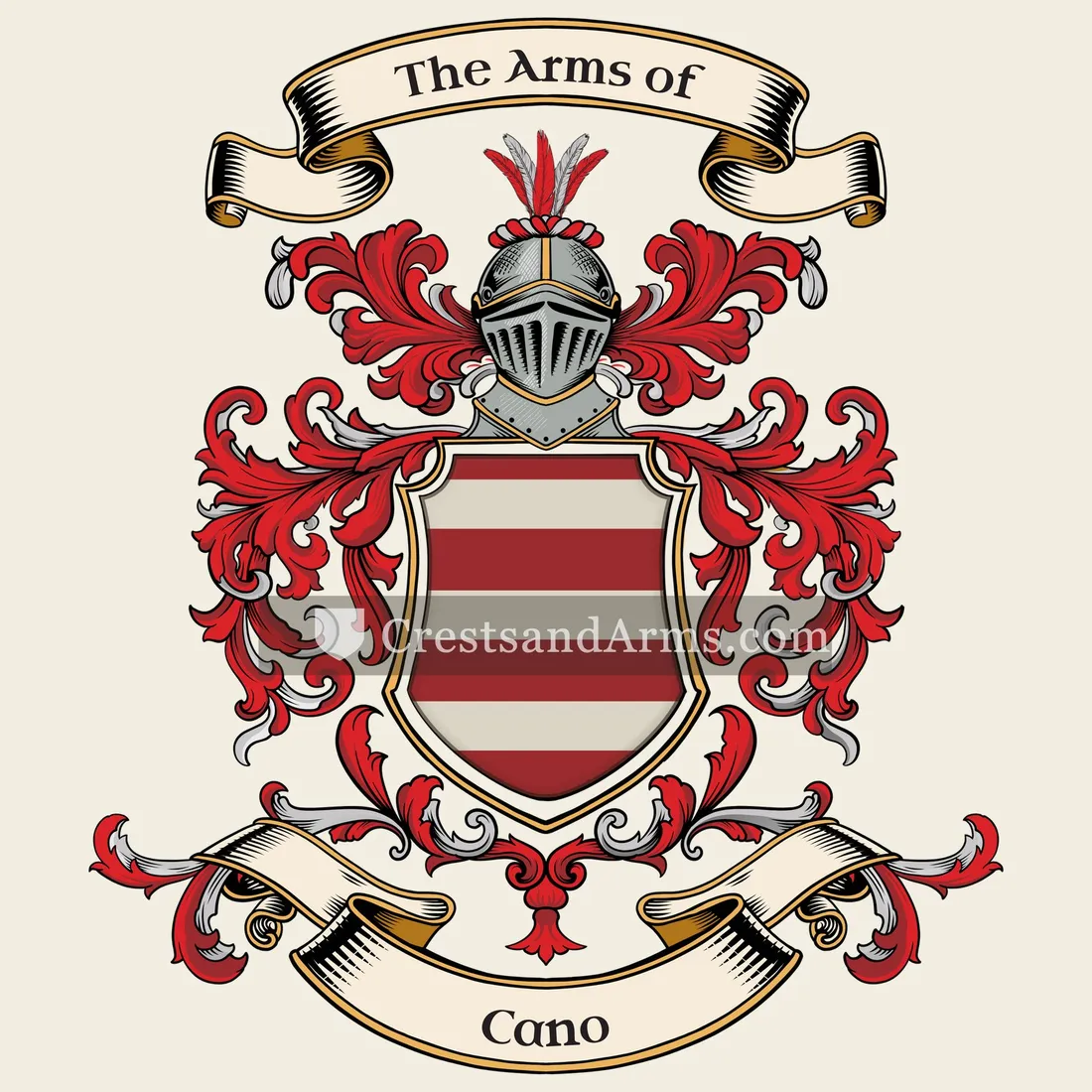
 fessThe military belt, and readiness to serve
 fessThe military belt, and readiness to serve