Map of Spain showing where the Canton arms are recorded
The Canton arms were recorded in Castile, c. 1722.
Castile was the heart of Spain and the source of most of its noble families. Land won in the long wars against the Moors was granted out to fighting men, and a man granted land was granted arms along with it.
This is where the arms were entered in the register. Families often moved to other parts of the country, so the same name can turn up in more than one region.
The body that granted and recorded arms in Spain in this period.
Philip V of Spain
Sovereign of the period
Philip V of Spain
1714–1724
Reigning in Spain when the Canton arms are first recorded.
How Arms Worked in Spain
In Spain, a coat of arms was considered a form of property that belonged to the entire family line. These arms were passed down from a father to all his children equally. Younger branches of the family usually kept the original design without needing to add any special marks to distinguish their specific line.
Granting authority
The Cronista Rey de Armas was the official body that regulated and granted coats of arms throughout Spain.
How they got arms
Families often obtained their arms through royal grants or by proving their noble status to the official heraldic authority.
Where arms were recorded
Coats of arms were officially recorded in the registers of the Cronista Rey de Armas starting in 1496.
The family's standing
Recorded among the armigerous families of Castile.
Origin & History of the Canton Family in Spain
The history of the Canton family in Spain is deeply rooted in the rugged landscapes of the Castile region. By the year 1722, records confirm that members of the family were established residents within this central Spanish territory. During this era, the name was closely associated with the social and economic shifts occurring in rural Castilian communities. Families like the Cantons often played a vital role in local agriculture and the development of village life as Spain transitioned through the eighteenth century. Because the name appears in official documentation from this period, it suggests that the family held a recognized status within their parish or town. This early presence in Castile serves as a foundational chapter for the family, marking their long-standing connection to the history and culture of the region.
Coat of Arms & Family Crest Details
Symbols on this shield
chiefAuthority, wisdom and dominion
lionCourage, strength and royalty
Colours
Gold (Or)Means: Generosity
Historical info
Source
Sir Bernard Burke, The General Armory of England, Scotland, Ireland and Wales, London: Harrison & Sons, 1884
Blazon (the actual original written record)
“Or (another, sa.) on a chief az. a lion pass. of the field, armed gu”
Irelandc. 1645
Digital archive packCoat of arms PNG, gold border print PDF, vector SVG and the certificate of authenticity. Sent to your email in minutes.
Map of Ireland showing where the Canton arms are recorded
The Canton arms were recorded in Ireland, c. 1645.
Arms such as these were typically recorded in Dublin.
Dublin was the seat of government in Ireland and the place where grants were sought and recorded. Families with business at the castle or the courts settled nearby, and settling there put their arms on record.
This is where the arms were entered in the register. Families often moved to other parts of the country, so the same name can turn up in more than one region.
The body that granted and recorded arms in Ireland in this period.
Charles I of England
Sovereign of the period
Charles I of England
1625–1649
Reigning in Spain when the Canton arms are first recorded.
How Arms Worked in Ireland
The Ulster King of Arms granted coats of arms to individuals who proved their social standing and good character. These symbols were typically inherited by all legitimate descendants of the original holder. If a family branch wanted a unique look, they could apply for a specific change to their design through the office to ensure their identity remained distinct.
Granting authority
The Ulster King of Arms acted as the official body that regulated and issued all coats of arms throughout Ireland.
How they got arms
Families obtained their arms through formal grants issued by the office after proving their eligibility and paying the required fees.
Where arms were recorded
All official grants were recorded in the registers held by the Ulster King of Arms starting from the year 1552.
The family's standing
Recorded among the armigerous families of Ireland.
Origin & History of the Canton Family in Ireland
The history of the Canton family in Ireland is deeply connected to the social and political shifts of the seventeenth century. While the name has roots in various parts of Europe, records confirm that members of the family were firmly established in Dublin by 1645. During this period, Dublin was a bustling center of trade and administration, making it a likely place for families to settle and integrate into the local economy. The presence of the Cantons in the city during the mid-1600s suggests that they were part of the urban middle class, likely involved in commerce or professional life as the city expanded. Over the following generations, the family became a part of the fabric of Irish society, adapting to the changing laws and cultural environment of the time. By tracing their residence in the capital, we gain a clearer picture of how the family navigated the complexities of life in a rapidly evolving Irish city.
Coat of Arms & Family Crest Details
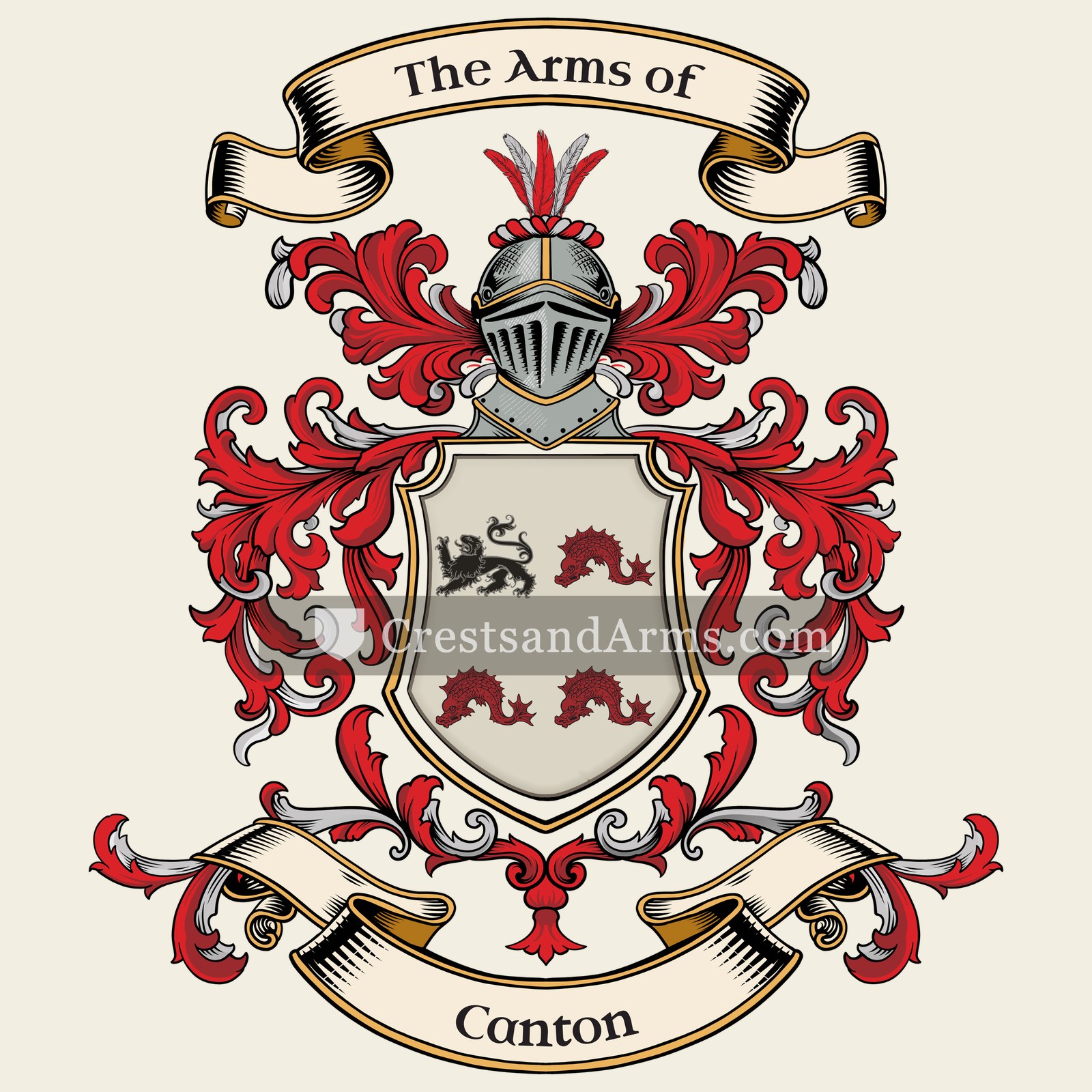
Symbols on this shield
lionCourage, strength and royalty
dolphinSwiftness, charity and love
Colours
Silver (Argent)Means: Peace and sincerity
Black (Sable)Means: Constancy
Red (Gules)Means: Military strength
Historical info
Source
Sir Bernard Burke, The General Armory of England, Scotland, Ireland and Wales, London: Harrison & Sons, 1884
Blazon (the actual original written record)
“Ar. a lion pass. in fesse sa. betw. three dolphins gu”
KentKent, c. 1620
Digital archive packCoat of arms PNG, gold border print PDF, vector SVG and the certificate of authenticity. Sent to your email in minutes.
Map of England showing where the Canton arms are recorded
The Canton arms were recorded in Kent, c. 1620.
Kent sits between London and the short crossing to Europe, and the trade passing through made it wealthy. Merchant families bought land with that money, and it was landowners who took coats of arms.
This is where the arms were entered in the register. Families often moved to other parts of the country, so the same name can turn up in more than one region.
The body that granted and recorded arms in England in this period.
James VI and I
Sovereign of the period
James VI and I
1603–1625
Reigning in Spain when the Canton arms are first recorded.
How Arms Worked in England
English heraldry allowed arms to be shared by all legitimate descendants of the original owner. These symbols were treated as personal property that moved through the generations to all children. While the eldest son kept the original design, other family members could use the same shield without needing to change it or register their own unique versions.
Granting authority
The College of Arms in London has regulated the use of coats of arms throughout England and Wales since 1484.
How they got arms
Families typically obtained their coats of arms through a formal grant from the Crown or by proving their ancient right to them.
Where arms were recorded
All official coats of arms are recorded in the registers kept at the College of Arms, which date back to the fifteenth century.
The family's standing
Recorded among the armigerous families of Kent.
Origin & History of the Canton Family in England
The family name Canton has deep roots in the English county of Kent, where records confirm members of the family were living as early as 1620. The name itself likely originated as a locative surname, which means it was used to describe people who came from a specific place or a particular district. In the medieval period, the word canton referred to a small division of land or a corner of a larger territory. Families often adopted these names to identify their home region or a specific plot of land they managed. By the time the name appeared in Kent during the early seventeenth century, it had become a stable family identifier passed down through generations. These early settlers were likely part of the local agricultural or trade communities that defined the landscape of southeastern England during the reign of King James I.
Canton Meaning & Related Branches
Root word
cantus
Latin term meaning a corner, edge, or rim.
This name
CantonRefers to a person who lived near a corner, edge, or a specific boundary marker.
also spelled
Kanton
Cantone
Cantons
Related arms
Kayntonvariant spelling
Documented Sources
J. B. Rietstap, Armorial Général, Gouda: G. B. van Goor Zonen, 1884–87
Archivo Histórico Nacional, Consejo de Castilla, Expedientes de pruebas de nobleza
Archivo de la Real Chancillería de Valladolid, Registro de Ejecutorias
Digital archive packCoat of arms PNG, gold border print PDF, vector SVG and the certificate of authenticity. Sent to your email in minutes.


 greyhoundCourage, vigilance and loyalty
 greyhoundCourage, vigilance and loyalty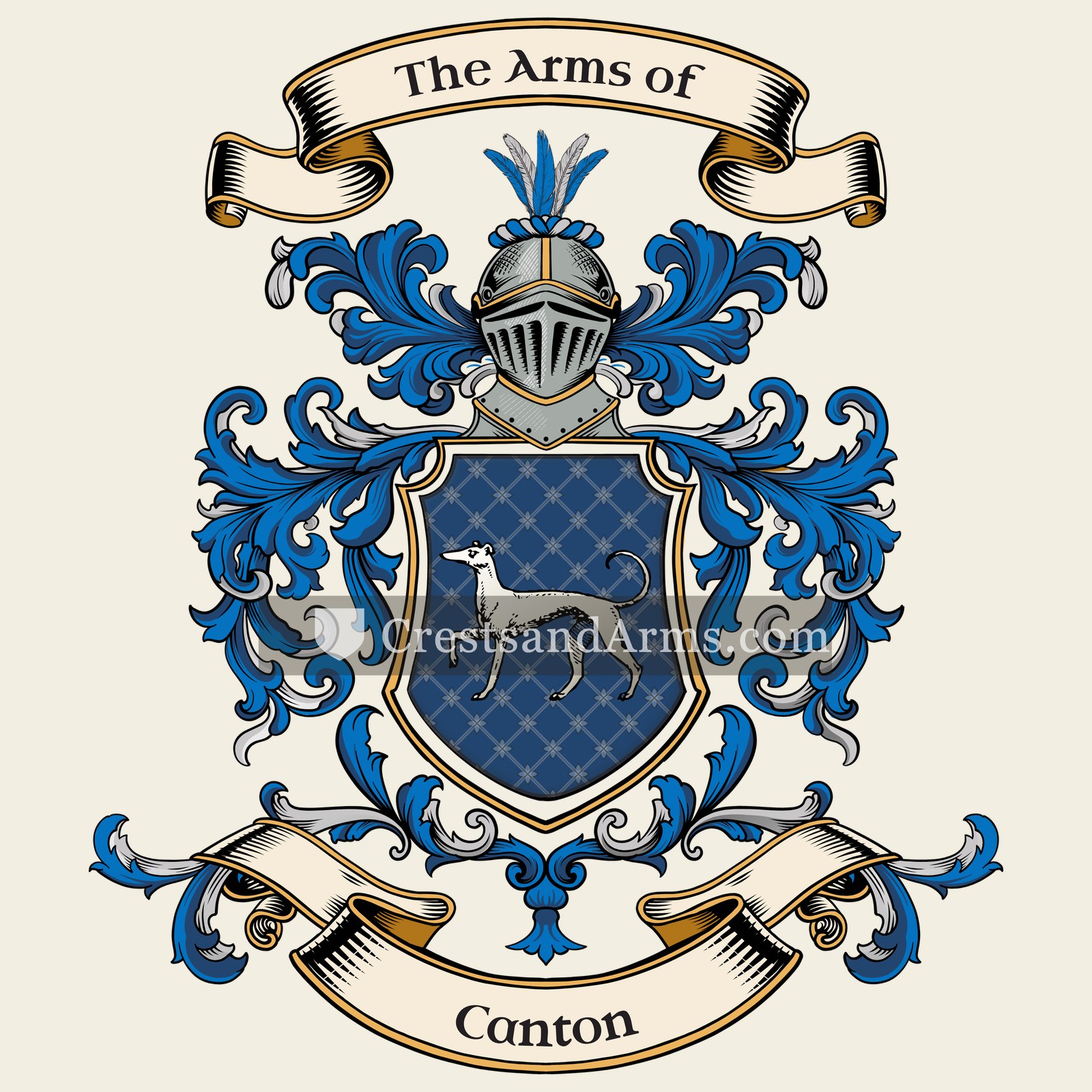


 chiefAuthority, wisdom and dominion
 lionCourage, strength and royalty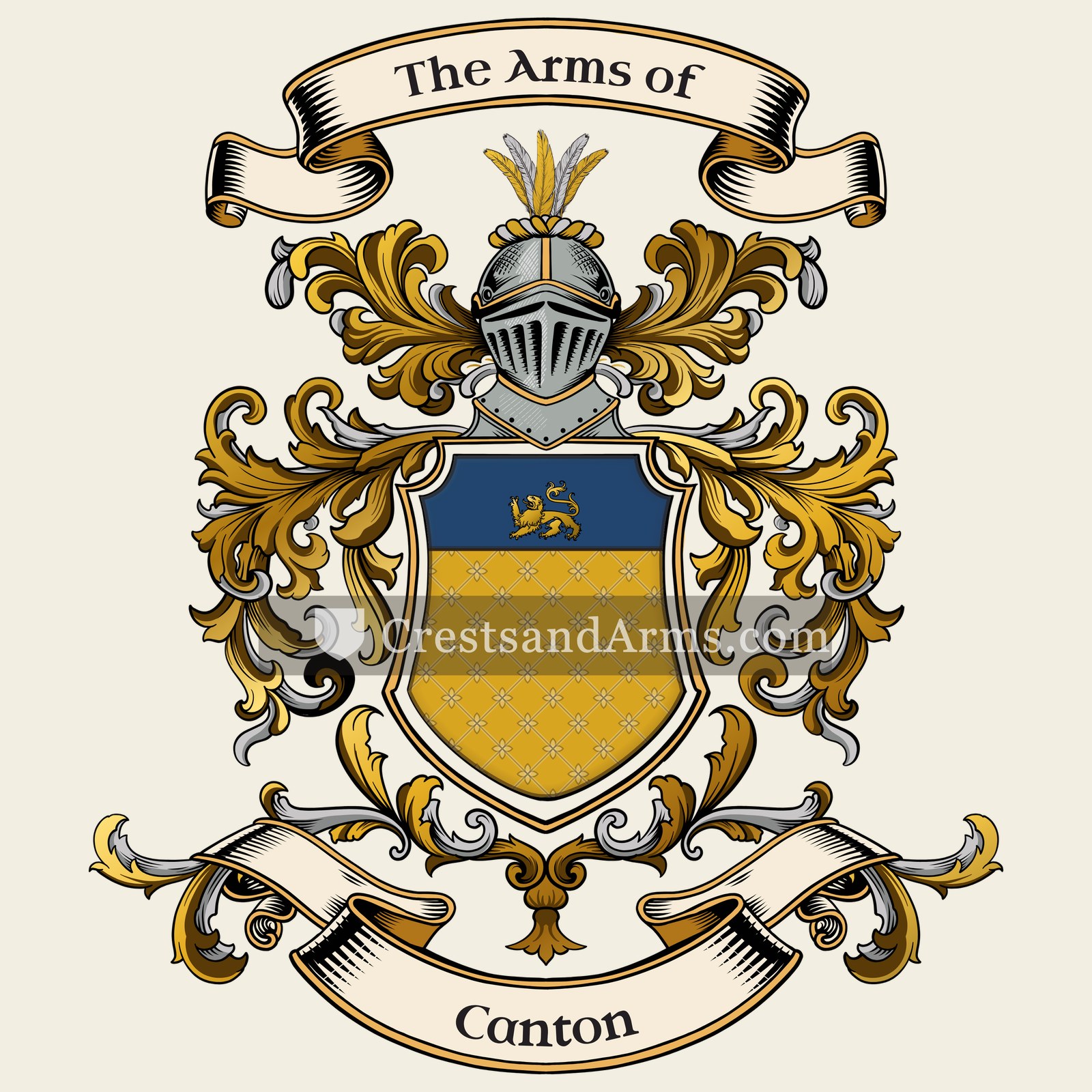


 dolphinSwiftness, charity and love