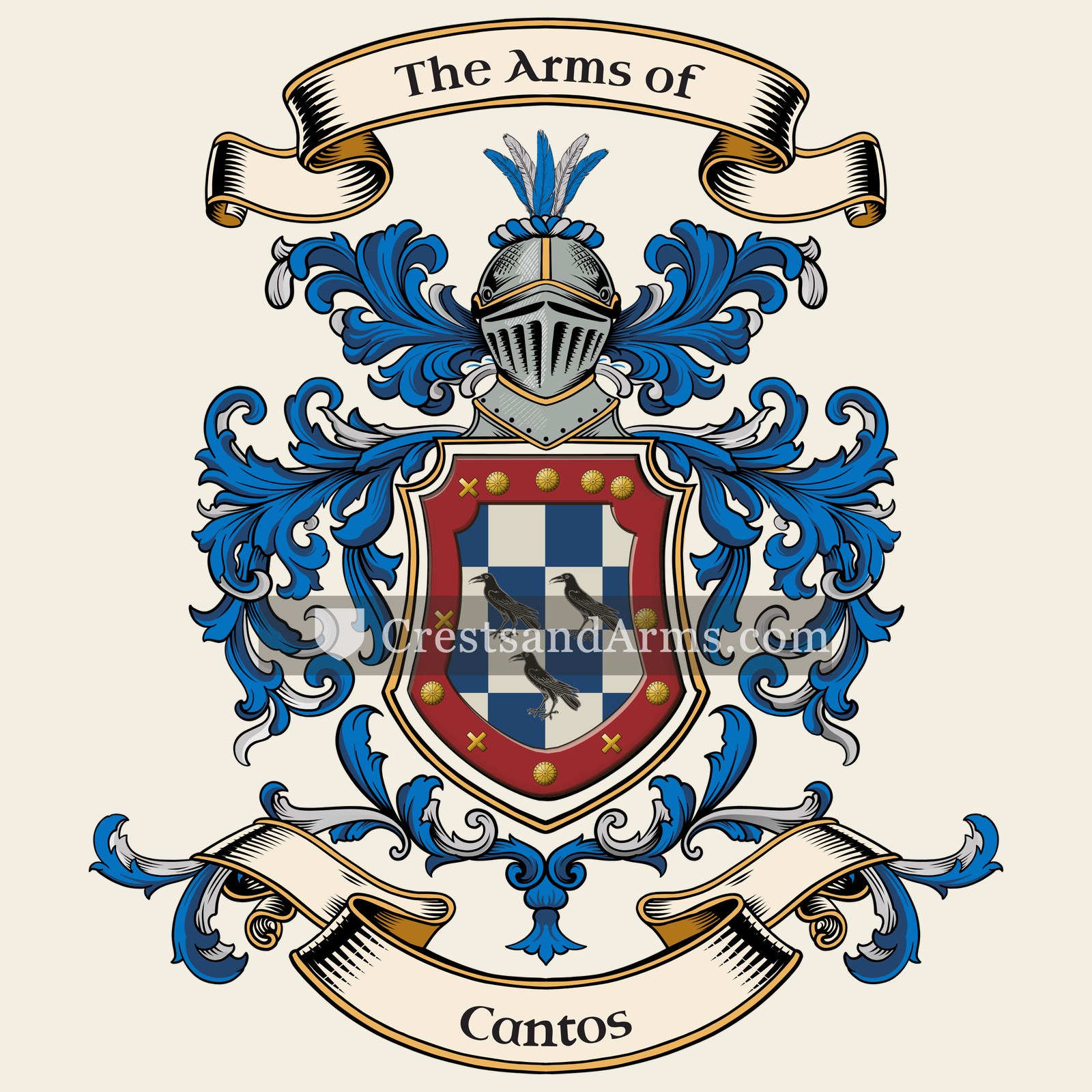
A record of documented arms, meaning and origin, researched for the Cantos family of Spain.
Reg. 3909 · Spanish, A–C
Coat of Arms & Family Crest Details
Symbols on this shield
chequyConstancy, and the counting-board
roundelA coin, and one who has been to the crusades
saltire coupedResolution, and the cross of St Andrew
ravenConstancy and divine providence
Colours
Silver (Argent)Means: Peace and sincerity
Red (Gules)Means: Military strength
Gold (Or)Means: Generosity
Black (Sable)Means: Constancy
Blue (Azure)Means: Loyalty and truth
Historical info
Source
J. B. Rietstap, Armorial Général, Gouda: G. B. van Goor Zonen, 1884–87
Blazon (the actual original written record)
“Parti: au 1 échiq. d'arg. et d'azur de cinq tires, chacune de trois points; au 2 d'arg. à trois corbeaux de sa., le vol ouv. et abaissé, 2 et 1. L'écu entouré d'une bord. de gu., ch. de huit bes. d'or, alternant avec huit flanchis du même.”
SpainAsturies, c. 1722
Digital archive packCoat of arms PNG, gold border print PDF, vector SVG and the certificate of authenticity. Sent to your email in minutes.
Map of Spain showing where the Cantos arms are recorded
The Cantos arms were recorded in Asturies, c. 1722.
This is where the arms were entered in the register. Families often moved to other parts of the country, so the same name can turn up in more than one region.
The body that granted and recorded arms in Spain in this period.
Philip V of Spain
Sovereign of the period
Philip V of Spain
1714–1724
Reigning in Spain when the Cantos arms are first recorded.
How Arms Worked in Spain
In Spain, a coat of arms was considered a form of property that belonged to the entire family line. These arms were passed down from a father to all his children equally. Younger branches of the family usually kept the original design without needing to add any special marks to distinguish their specific line.
Granting authority
The Cronista Rey de Armas was the official body that regulated and granted coats of arms throughout Spain.
How they got arms
Families often obtained their arms through royal grants or by proving their noble status to the official heraldic authority.
Where arms were recorded
Coats of arms were officially recorded in the registers of the Cronista Rey de Armas starting in 1496.
The family's standing
Recorded among the armigerous families of Spain.
Origin & History of the Cantos Family in Spain
The family name Cantos has deep roots in the northern region of Spain known as Asturias. By the year 1722, records confirm that members of the family were already established in this rugged, mountainous landscape. The name itself is derived from the Spanish word "canto," which refers to a stone, a corner, or the edge of a cliff. It is likely that the name was first used to describe people who lived near a prominent rocky outcrop or a specific boundary marker in their local village. Over time, families living in these distinct geographical spots became known by the name of the land they occupied. This practice of naming people after their surroundings was a common way to identify individuals in rural communities during the eighteenth century. As the family grew, they remained connected to the traditions and the unique culture of the Asturian region.
Cantos Meaning & Related Branches
Root word
Cantus
Latin term meaning a song, melody, or singing.
This name
CantosRefers to a person who lived near a singing stream or a musical location.
also spelled
Canto
Kantos
Cantose
Documented Sources
J. B. Rietstap, Armorial Général, Gouda: G. B. van Goor Zonen, 1884–87
Archivo Histórico Diocesano de Oviedo, Libros Sacramentales de la Parroquia de San Pedro de Grado
Archivo General de Simancas, Catastro de Ensenada
Moll, Francesc de Borja, Els llinatges catalans: Catalunya, País Valencià, Illes Balears, 1959
Faure, Roberto, Diccionario de apellidos españoles, 2001
Digital archive packCoat of arms PNG, gold border print PDF, vector SVG and the certificate of authenticity. Sent to your email in minutes.


 chequyConstancy, and the counting-board
 roundelA coin, and one who has been to the crusades
 saltire coupedResolution, and the cross of St Andrew
 ravenConstancy and divine providence
 chequyConstancy, and the counting-board
 roundelA coin, and one who has been to the crusades
 saltire coupedResolution, and the cross of St Andrew
 ravenConstancy and divine providence