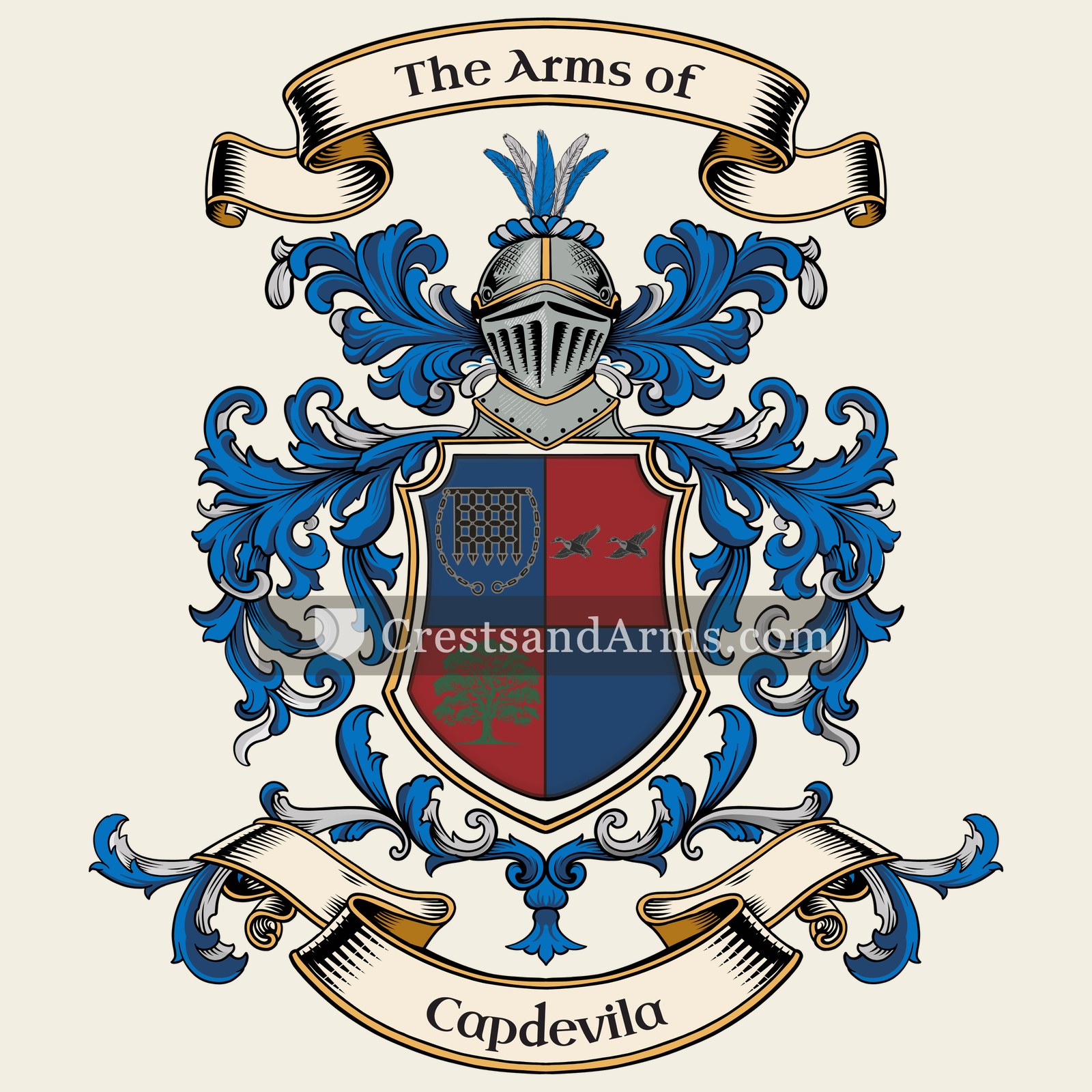
A record of documented arms, meaning and origin, researched for the Capdevila family of Spain.
Reg. 8237 · Spanish, A–C
Coat of Arms & Family Crest Details
Symbols on this shield
portcullisProtection of the household, and the guarded gate
duckResourcefulness on land and water
treeLife, endurance and deep roots
Colours
Blue (Azure)Means: Loyalty and truth
Red (Gules)Means: Military strength
Black (Sable)Means: Constancy
Historical info
Source
J. B. Rietstap, Armorial Général, Gouda: G. B. van Goor Zonen, 1884–87
Blazon (the actual original written record)
“Ec.: au 1 d'azur à une église composée de deux maisonnettes accostées, le clocher à sen., sur une terrasse, le tout au nat.; au 2 de gu. à un gril carré de sa., le manche en haut; au 3 d'arg. à deux canettes nageantes au nat. dans une eau d'azur agitée d'arg.; au 4 d'arg. à un arbre terrassé de sin.”
Spainc. 1722
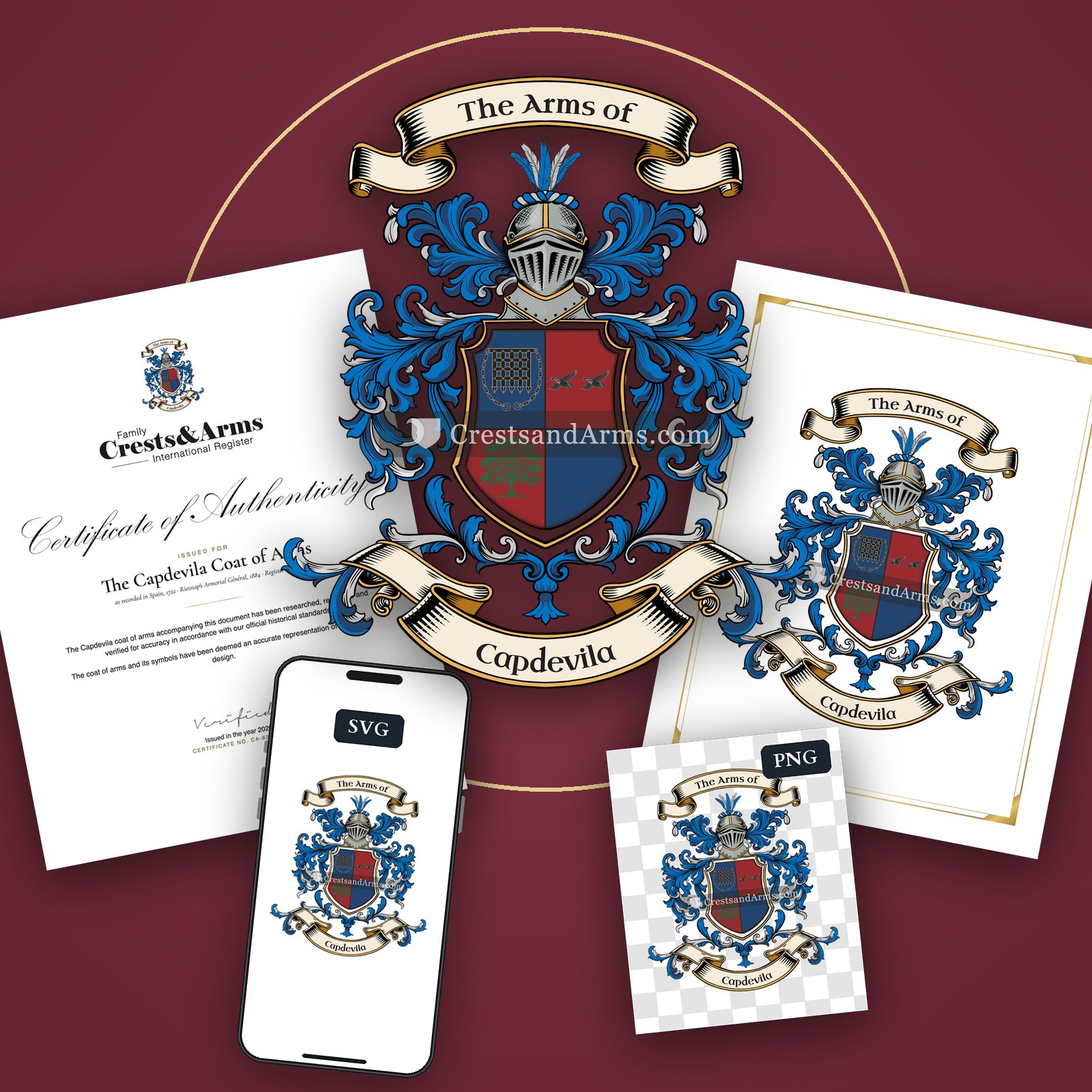
Digital archive packCoat of arms PNG, gold border print PDF, vector SVG and the certificate of authenticity. Sent to your email in minutes.
Map of Spain showing where the Capdevila arms are recorded
The Capdevila arms were recorded in Spain, c. 1722.
Arms such as these were typically recorded in Castile.
Castile was the heart of Spain and the source of most of its noble families. Land won in the long wars against the Moors was granted out to fighting men, and a man granted land was granted arms along with it.
This is where the arms were entered in the register. Families often moved to other parts of the country, so the same name can turn up in more than one region.
The body that granted and recorded arms in Spain in this period.
Philip V of Spain
Sovereign of the period
Philip V of Spain
1714–1724
Reigning in Spain when the Capdevila arms are first recorded.
How Arms Worked in Spain
In Spain, a coat of arms was considered a form of property that belonged to the entire family line. These arms were passed down from a father to all his children equally. Younger branches of the family usually kept the original design without needing to add any special marks to distinguish their specific line.
Granting authority
The Cronista Rey de Armas was the official body that regulated and granted coats of arms throughout Spain.
How they got arms
Families often obtained their arms through royal grants or by proving their noble status to the official heraldic authority.
Where arms were recorded
Coats of arms were officially recorded in the registers of the Cronista Rey de Armas starting in 1496.
The family's standing
Recorded among the armigerous families of Spain.
Origin & History of the Capdevila Family in Spain
The surname Capdevila is rooted in the linguistic traditions of the Iberian Peninsula, specifically emerging from the Catalan regions before spreading into other parts of Spain. The name is a topographic descriptor, derived from the combination of the words "cap," meaning head or top, and "vila," meaning town or village. This suggests that the earliest families bearing this name likely lived at the highest point of a settlement or at the entrance of a town. By the early 18th century, members of the family had established a presence in the region of Castile. This migration reflects the broader movement of families across Spanish territories during the Bourbon reforms, as individuals sought new opportunities in administration, agriculture, and trade within the changing landscape of the Spanish Empire.
Capdevila Meaning & Related Branches
Root word
Cap de villa
Head or top of the town or estate.
This name
CapdevilaRefers to someone who lived at the head or the highest point of a village.
also spelled
Kapdevila
Capdevilla
Capdevilah
Documented Sources
J. B. Rietstap, Armorial Général, Gouda: G. B. van Goor Zonen, 1884–87
Alcover, Antoni M. and Moll, Francesc de B., Diccionari català-valencià-balear, 1930
Moll, Francesc de B., Els llinatges catalans, 1959
Archivo General de Simancas, Registro del Sello de Corte, 1722
Digital archive packCoat of arms PNG, gold border print PDF, vector SVG and the certificate of authenticity. Sent to your email in minutes.


 portcullisProtection of the household, and the guarded gate
 duckResourcefulness on land and water
 treeLife, endurance and deep roots
 portcullisProtection of the household, and the guarded gate
 duckResourcefulness on land and water
 treeLife, endurance and deep roots