Map of Spain showing where the Capet arms are recorded
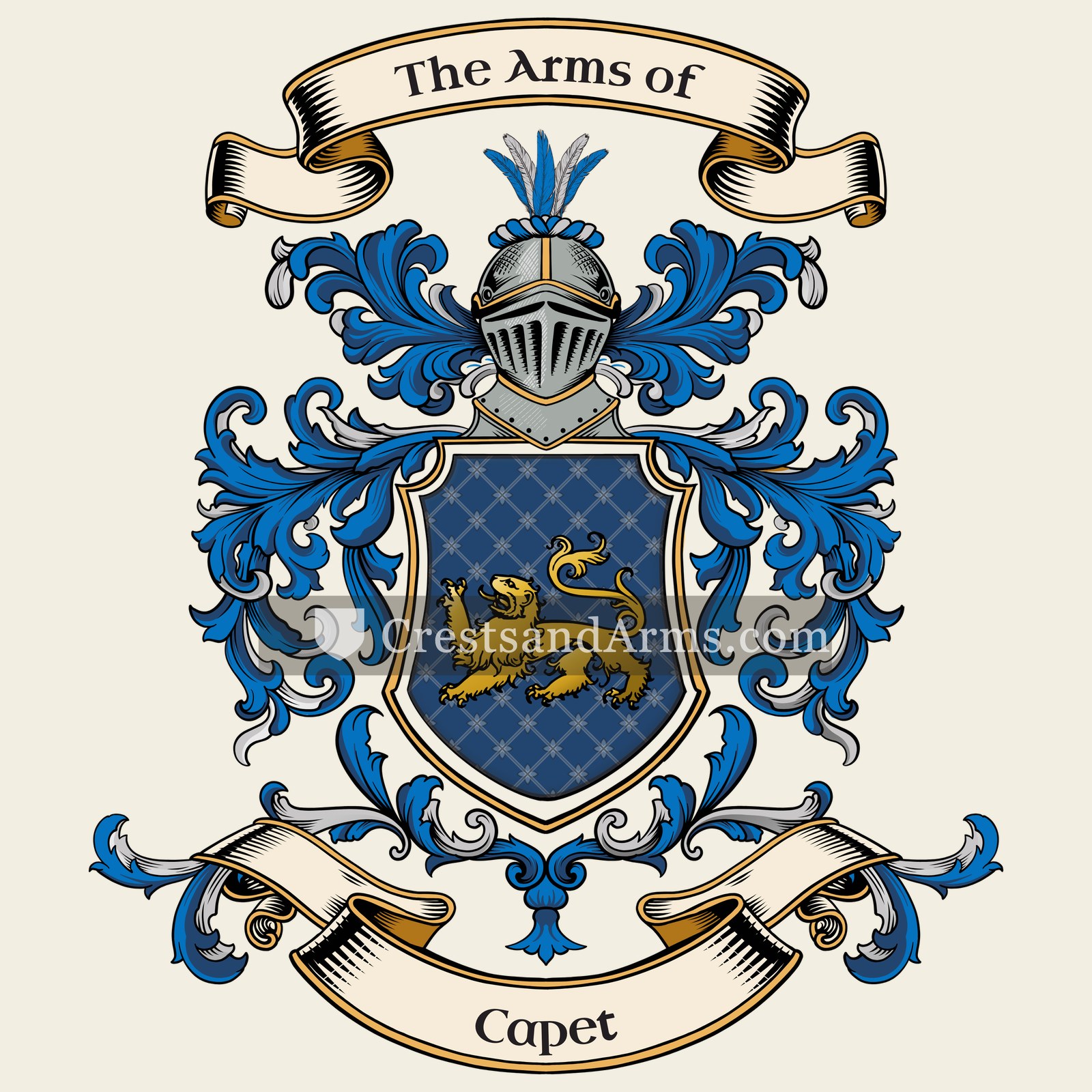
The Capet arms were recorded in Catalonia, c. 1722.
Catalonia lived by sea trade, and its merchant houses were as powerful as its landowners. Both sorts of family took arms, and Barcelona kept records of the houses entitled to bear them.
This is where the arms were entered in the register. Families often moved to other parts of the country, so the same name can turn up in more than one region.
The body that granted and recorded arms in Spain in this period.
Philip V of Spain
Sovereign of the period
Philip V of Spain
1714–1724
Reigning in Spain when the Capet arms are first recorded.
How Arms Worked in Spain
In Spain, a coat of arms was considered a form of property that belonged to the entire family line. These arms were passed down from a father to all his children equally. Younger branches of the family usually kept the original design without needing to add any special marks to distinguish their specific line.
Granting authority
The Cronista Rey de Armas was the official body that regulated and granted coats of arms throughout Spain.
How they got arms
Families often obtained their arms through royal grants or by proving their noble status to the official heraldic authority.
Where arms were recorded
Coats of arms were officially recorded in the registers of the Cronista Rey de Armas starting in 1496.
The family's standing
Recorded among the armigerous families of Catalonia.
Origin & History of the Capet Family in Spain
The origins of the Capet name are deeply rooted in the history of medieval France, where it first emerged as a nickname for Hugh Capet, the founder of the Capetian dynasty who became King of France in 987. Historians believe the name likely derived from the Latin word "cappa," which referred to a short cloak or cape worn by the clergy or nobility of that era. While the royal line held great power in northern France, the name eventually spread across various regions through migration and social mobility. By the early 18th century, records confirm that families bearing this name were established in Catalonia. This presence in northeastern Spain suggests that the name had moved far beyond its royal origins, becoming a distinct family identifier for people living in the borderlands between France and the Iberian Peninsula by 1722.
Capet Meaning & Related Branches
Root word
cappa
A Latin term referring to a hooded cloak or cape.
This name
CapetA nickname for someone who habitually wore a distinctive hooded cloak or cape.
also spelled
Kapet
Capett
Capeth
Capay
Documented Sources
J. B. Rietstap, Armorial Général, Gouda: G. B. van Goor Zonen, 1884–87
Fawtier, Robert. Les Capétiens et la France. 1942
Settipani, Christian. La préhistoire des Capétiens. 1993
Arxiu de la Corona d'Aragó, Generalitat de Catalunya, Registres de la Reial Audiència. 1722
Digital archive packCoat of arms PNG, gold border print PDF, vector SVG and the certificate of authenticity. Sent to your email in minutes.


 lionCourage, strength and royalty
 lionCourage, strength and royalty