Map of Italy showing where the Caporicci arms are recorded
The Caporicci arms were recorded in Udine, c. 1775.
This is where the arms were entered in the register. Families often moved to other parts of the country, so the same name can turn up in more than one region.
The body that granted and recorded arms in Italy in this period.
Alvise Giovanni Mocenigo
Sovereign of the period
Alvise Giovanni Mocenigo
1763–1778
Reigning in Italy when the Caporicci arms are first recorded.
How Arms Worked in Italy
In the Italian states, coats of arms were often used by noble families to show their status and history. These symbols were passed down through the generations to all legitimate male descendants. Younger branches of a family usually kept the original design but sometimes added small changes to distinguish their specific line from the main branch.
Granting authority
Various local rulers and city governments controlled the use of coats of arms across the different Italian states.
How they got arms
Families often assumed their own arms or received them as official grants from local lords, popes, or city councils.
Where arms were recorded
Arms were recorded in local city archives or private family books rather than in one single national register.
The family's standing
Recorded among the armigerous families of Italy.
Origin & History of the Caporicci Family in Italy
The surname Caporicci finds its historical roots in the northeastern regions of Italy, with documented evidence placing the family in the city of Udine by 1775. The name likely originated as a descriptive nickname, as the structure suggests a combination of terms related to the head or a specific physical trait. During the late 18th century, Udine served as a vital crossroads for trade and culture within the Venetian territories, which allowed families like the Caporiccis to establish themselves as part of the local urban fabric. By settling in this region, early family members became part of a society shaped by both Italian and Central European influences. While the exact origins of the name remain tied to local linguistic traditions, the presence of the family in Udine during this period indicates they were well-integrated into the administrative and social life of the city.
Caporicci Meaning & Related Branches
Root word
Capra
Latin term for a female goat.
This name
CaporicciA locative or occupational surname likely referring to a goat herder or someone living near a goat farm.
also spelled
Caporyaco
Documented Sources
J. B. Rietstap, Armorial Général, Gouda: G. B. van Goor Zonen, 1884–87
Archivio di Stato di Udine, Stato civile della città di Udine (1775)


 fessThe military belt, and readiness to serve
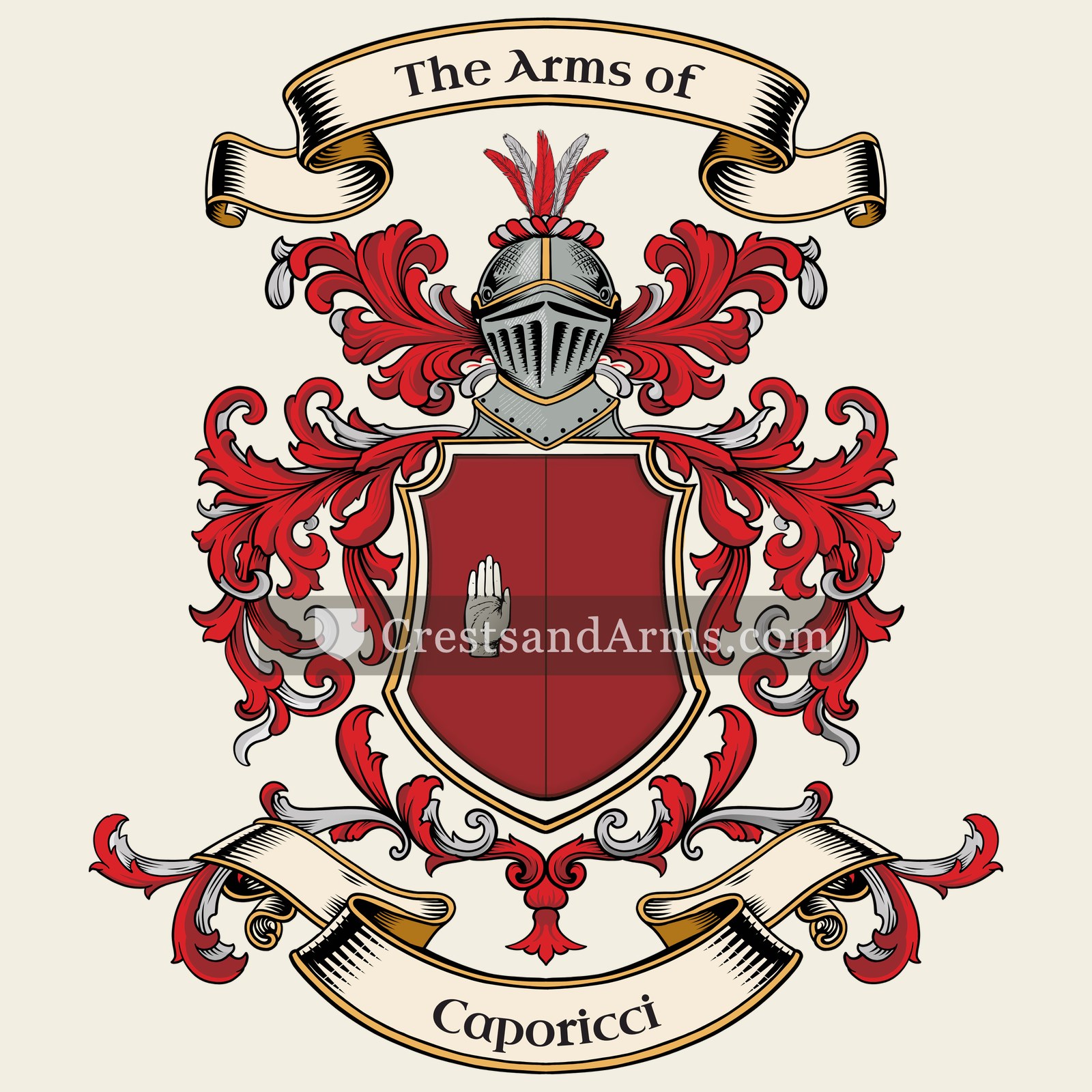
 handFaith, sincerity and justice
 fessThe military belt, and readiness to serve
 handFaith, sincerity and justice