Map of Belgium showing where the Cappello arms are recorded
The Cappello arms were recorded in Brabant, c. 1737.
Brabant lay at the heart of the Low Countries, where the trade routes met. Its towns were wealthy and its landowners many, and both kinds of family kept arms, which is why the region is so heavily represented.
This is where the arms were entered in the register. Families often moved to other parts of the country, so the same name can turn up in more than one region.
The body that granted and recorded arms in Belgium in this period.
Charles VI, Holy Roman Emperor
Sovereign of the period
Charles VI, Holy Roman Emperor
1711–1740
Reigning in Belgium when the Cappello arms are first recorded.
How Arms Worked in Belgium
In Belgium, a coat of arms is considered personal property that is passed down through the male line to legitimate descendants. Families often use the same shield design across generations to show their shared heritage. If a branch of the family wants to change the design, they must apply for an official update to their specific version of the arms.
Granting authority
The Conseil héraldique is the official body that regulates and approves all coats of arms in Belgium.
How they got arms
Families obtain their coats of arms through formal royal grants or by confirming their historical right to use existing designs.
Where arms were recorded
All approved coats of arms are officially recorded in the public registers of the Conseil héraldique since 1844.
The family's standing
Recorded among the armigerous families of Brabant.
Origin & History of the Cappello Family in Belgium
The family name Cappello has deep roots in the region of Brabant, where records confirm members of the family were living as early as 1737. The name itself is derived from the Italian word for hat, which suggests that the earliest ancestors likely worked as hatters or clothing merchants. During the eighteenth century, Brabant was a bustling center for trade and craftsmanship under the rule of the Austrian Netherlands. Families like the Cappellos often moved across European borders to follow economic opportunities in textile production and urban commerce. By settling in this region, the family became part of the local social fabric during a time of significant transition for the Belgian provinces. Their presence in the historical records of the era reflects the broader movement of skilled workers who helped shape the identity of the Brabant region through their specialized trades.
Coat of Arms & Family Crest Details
Symbols on this shield
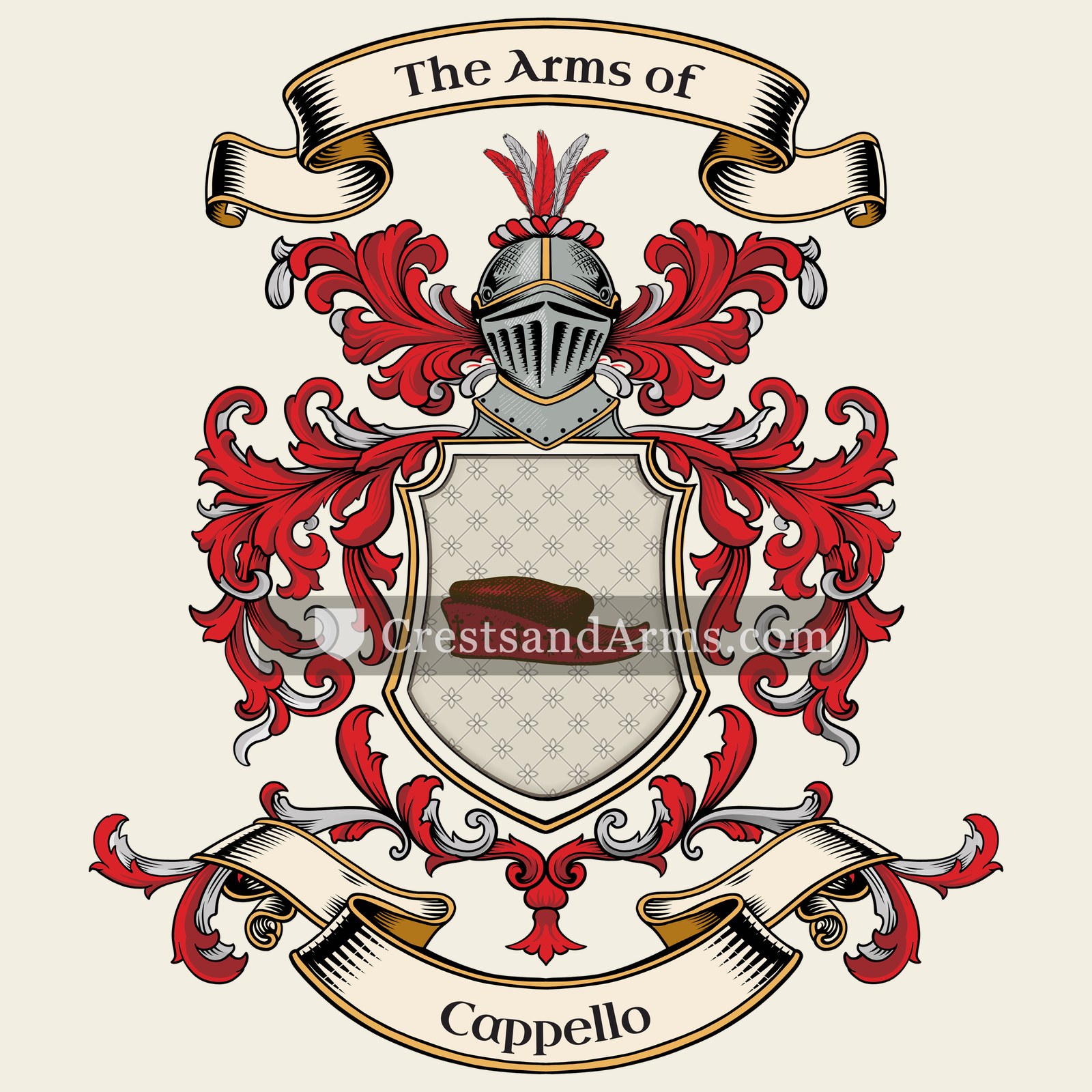
saltireResolution, and St Andrew's cross
hat or capDignity, and the honour of office
Colours
Silver (Argent)Means: Peace and sincerity
Blue (Azure)Means: Loyalty and truth
Historical info
Source
J. B. Rietstap, Armorial Général, Gouda: G. B. van Goor Zonen, 1884–87
Blazon (the actual original written record)
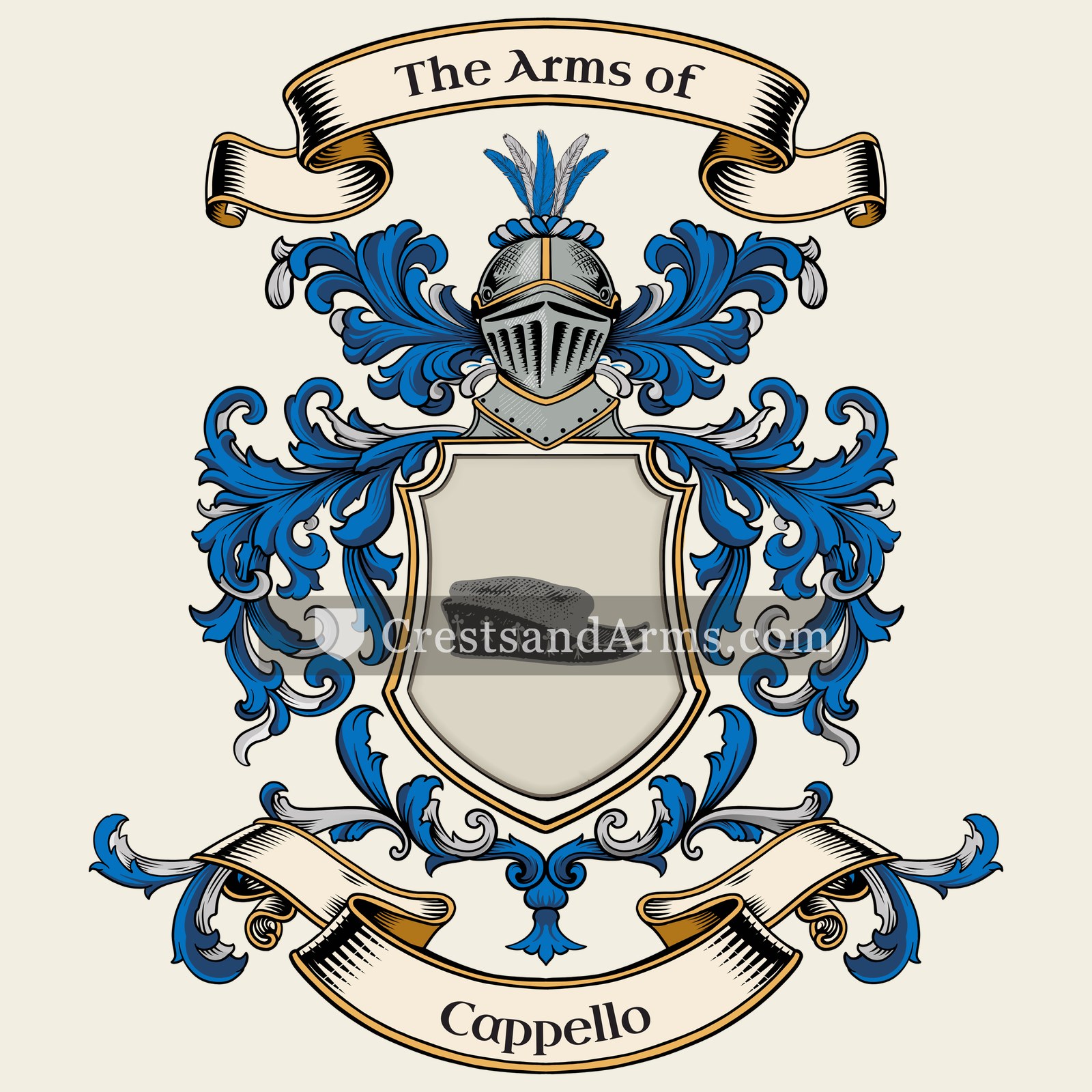
“Coupé d'arg. sur azur, au chapeau de l'un en l'autre, les cordons de gu., passés en saut., ch. sur la forme d'une fleur-de-lis d'or. C.: trois pl. d'aut., une d'arg. entre deux d'azur.”
VeniceVenice, c. 1775
Digital archive packCoat of arms PNG, gold border print PDF, vector SVG and the certificate of authenticity. Sent to your email in minutes.
Map of Italy showing where the Cappello arms are recorded
The Cappello arms were recorded in Venice, c. 1775.
Venice ran on trade, and its great families were merchants before they were anything else. The city kept a formal list of its noble houses, and a name on that list carried arms as a matter of record.
This is where the arms were entered in the register. Families often moved to other parts of the country, so the same name can turn up in more than one region.
The body that granted and recorded arms in Italy in this period.
Alvise Giovanni Mocenigo
Sovereign of the period
Alvise Giovanni Mocenigo
1763–1778
Reigning in Belgium when the Cappello arms are first recorded.
How Arms Worked in Italy
In the Italian states, coats of arms were often used by noble families to show their status and history. These symbols were passed down through the generations to all legitimate male descendants. Younger branches of a family usually kept the original design but sometimes added small changes to distinguish their specific line from the main branch.
Granting authority
Various local rulers and city governments controlled the use of coats of arms across the different Italian states.
How they got arms
Families often assumed their own arms or received them as official grants from local lords, popes, or city councils.
Where arms were recorded
Arms were recorded in local city archives or private family books rather than in one single national register.
The family's standing
Recorded among the armigerous families of Venice.
Origin & History of the Cappello Family in Italy
The surname Cappello is deeply rooted in the history of Northern Italy, where it emerged as a descriptive name derived from the Italian word for hat. During the medieval and early modern periods, such names often identified individuals by their profession, such as a hat maker, or by a distinctive style of headwear they frequently wore. By the time the family was firmly established in Venice in 1775, the name had transitioned from a simple occupational label into a recognized lineage within the city's complex social structure. Venice served as a major hub for trade and craftsmanship, and families like the Cappellos often integrated into the urban fabric by participating in the city's vibrant guilds and commercial networks. This transition from a common noun to a hereditary family name reflects the broader patterns of Italian social evolution, where surnames became essential for distinguishing households in growing metropolitan centers.
Related Branches & Arms
Root word
cappa
A Latin term referring to a hooded cloak or cape.
This name
CappelloAn occupational surname for a maker or seller of hats or headwear.
also spelled
Capelo
Documented Sources
J. B. Rietstap, Armorial Général, Gouda: G. B. van Goor Zonen, 1884–87
State Archives in Belgium (Rijksarchief te België), Parochieregisters van Brabant
De Smet, A., L'émigration italienne en Belgique, 1977
Digital archive packCoat of arms PNG, gold border print PDF, vector SVG and the certificate of authenticity. Sent to your email in minutes.


 saltireResolution, and St Andrew's cross
 hat or capDignity, and the honour of office
 saltireResolution, and St Andrew's cross
 hat or capDignity, and the honour of office