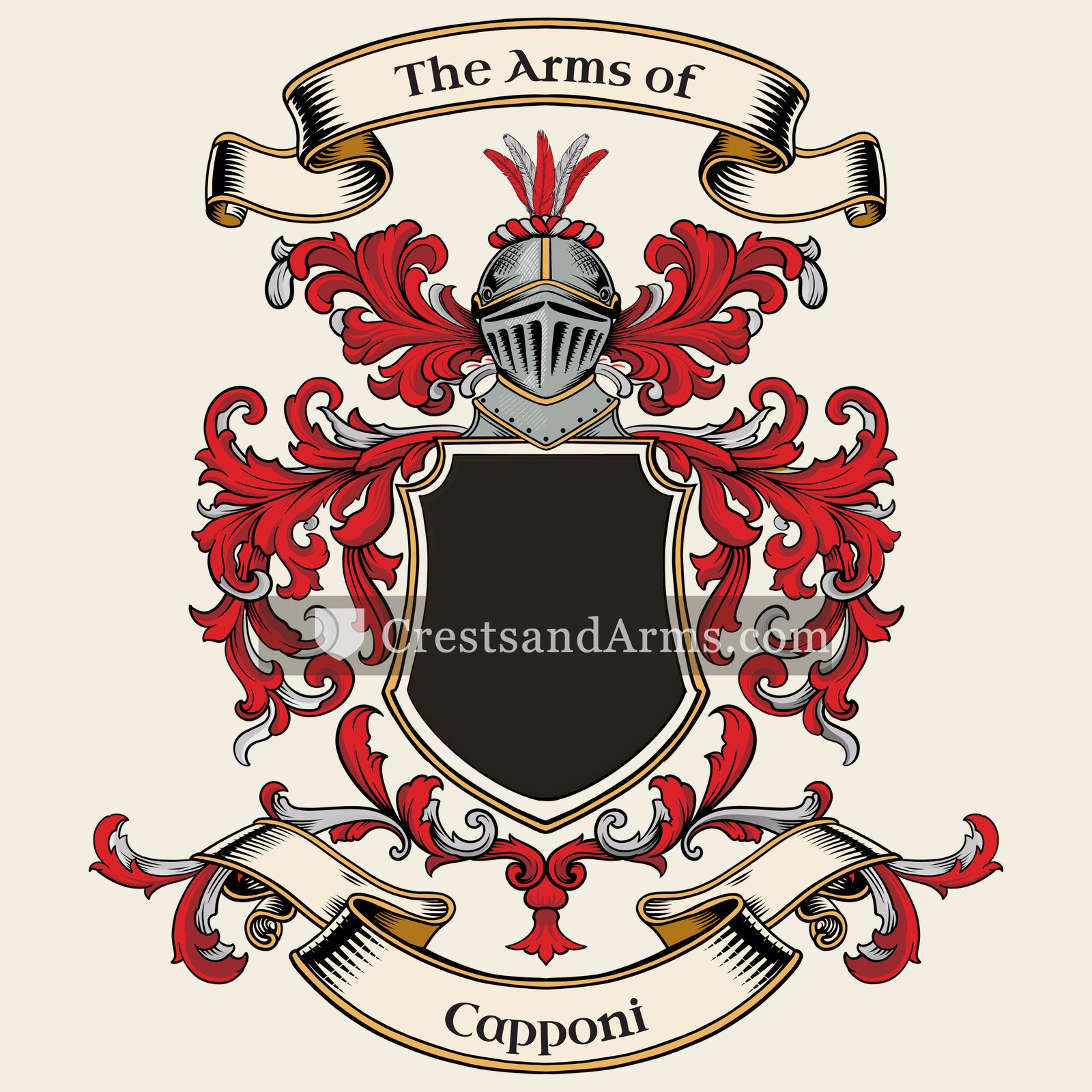
A record of documented arms, meaning and origin, researched for the Capponi family of France.
Reg. 2499 · French, A–C
Coat of Arms & Family Crest Details
Colours
Black (Sable)Means: Constancy
Silver (Argent)Means: Peace and sincerity
Historical info
Source
J. B. Rietstap, Armorial Général, Gouda: G. B. van Goor Zonen, 1884–87
Blazon (the actual original written record)
“Tranché de sa. sur arg. Cq. cour. C.: une tête de coq d'or, entre un vol à l'antique tranché de sa. sur arg. S.: deux griffons au nat., ou deux coqs, celui à dextre d'or et celui à sen. de sa. D.: POST TENEBRAS LUX.”
TuscanyTuscany, c. 1663
Digital archive packCoat of arms PNG, gold border print PDF, vector SVG and the certificate of authenticity. Sent to your email in minutes.
Map of France showing where the Capponi arms are recorded
The Capponi arms were recorded in Tuscany, c. 1663.
Tuscany's cities were run by merchant and banking families rather than landowners. Florence and Siena both kept formal records of their leading houses, and a house on those lists carried arms.
This is where the arms were entered in the register. Families often moved to other parts of the country, so the same name can turn up in more than one region.
The body that granted and recorded arms in France in this period.
Louis XIV of France
Sovereign of the period
Louis XIV of France
1643–1715
Reigning in France when the Capponi arms are first recorded.
How Arms Worked in France
In France, a coat of arms was a mark of honor that passed down through the male line to all legitimate descendants. Families often used the same shield without changes to show their shared heritage. If a branch wanted to stand out, they could add a small mark to their shield to show their specific place in the family tree.
Granting authority
The Juge d'armes de France acted as the official authority that regulated and verified coats of arms across the country.
How they got arms
Families typically inherited their arms from ancestors, though they could also receive them through royal grants or by proving their noble status.
Where arms were recorded
Coats of arms were officially recorded in the Armorial Général de France, which began its main collection in the year 1696.
The family's standing
Recorded among the armigerous families of Tuscany.
Origin & History of the Capponi Family in France
The Capponi family name is deeply rooted in the history of Tuscany, where the family established itself as a prominent force in regional life long before the seventeenth century. The name itself is believed to derive from the Italian word *cappone*, which refers to a capon or a castrated rooster. In medieval and Renaissance Italy, it was common for surnames to evolve from nicknames based on physical traits, occupations, or local animals. By the time the family was documented in Tuscany in 1663, they had already spent generations building influence through trade, banking, and political service within the city of Florence. Their rise to prominence was marked by a commitment to public administration and the arts, allowing them to remain a central part of the Tuscan social fabric for centuries. This legacy of civic engagement helped the family maintain their status and identity throughout the shifting political landscape of the Italian peninsula.
Capponi Meaning & Related Branches
Root word
Cappa
A Latin term referring to a hooded cloak or cape.
This name
CapponiDerived from a nickname for someone who wore a distinctive cloak or a maker of capes.
also spelled
Caponi
Cappony
Kaponi
Documented Sources
J. B. Rietstap, Armorial Général, Gouda: G. B. van Goor Zonen, 1884–87
Kent, F. W., Lorenzo de' Medici and the Art of Magnificence, 2004
Litta, Pompeo, Famiglie celebri italiane: Capponi di Firenze, 1819
Archivio di Stato di Firenze, Carte Strozziane, serie V
Digital archive packCoat of arms PNG, gold border print PDF, vector SVG and the certificate of authenticity. Sent to your email in minutes.