Map of Belgium showing where the Capron arms are recorded
The Capron arms were recorded in Tournaisis, c. 1737.
This is where the arms were entered in the register. Families often moved to other parts of the country, so the same name can turn up in more than one region.
The body that granted and recorded arms in Belgium in this period.
Charles VI, Holy Roman Emperor
Sovereign of the period
Charles VI, Holy Roman Emperor
1711–1740
Reigning in Belgium when the Capron arms are first recorded.
How Arms Worked in Belgium
In Belgium, a coat of arms is considered personal property that is passed down through the male line to legitimate descendants. Families often use the same shield design across generations to show their shared heritage. If a branch of the family wants to change the design, they must apply for an official update to their specific version of the arms.
Granting authority
The Conseil héraldique is the official body that regulates and approves all coats of arms in Belgium.
How they got arms
Families obtain their coats of arms through formal royal grants or by confirming their historical right to use existing designs.
Where arms were recorded
All approved coats of arms are officially recorded in the public registers of the Conseil héraldique since 1844.
The family's standing
Recorded among the armigerous families of Belgium.
Origin & History of the Capron Family in Belgium
The family name Capron has deep roots in the region of Tournaisis, a historic area in what is now modern-day Belgium. By the year 1737, records confirm that members of the family were already well-established within this territory. The name itself is thought to have originated from the Old French word capron, which historically referred to a type of strawberry or a specific style of head covering. Families living in the Tournaisis region during the eighteenth century often worked in agriculture or local trades, which helped them integrate into the social fabric of the rural landscape. As the family grew, they became a consistent part of the local community, contributing to the development of the region through their daily labor and local connections. Their presence in the early eighteenth century reflects a time of steady growth for many families in the Southern Netherlands, as they navigated the changing political and economic conditions of the era.
Coat of Arms & Family Crest Details
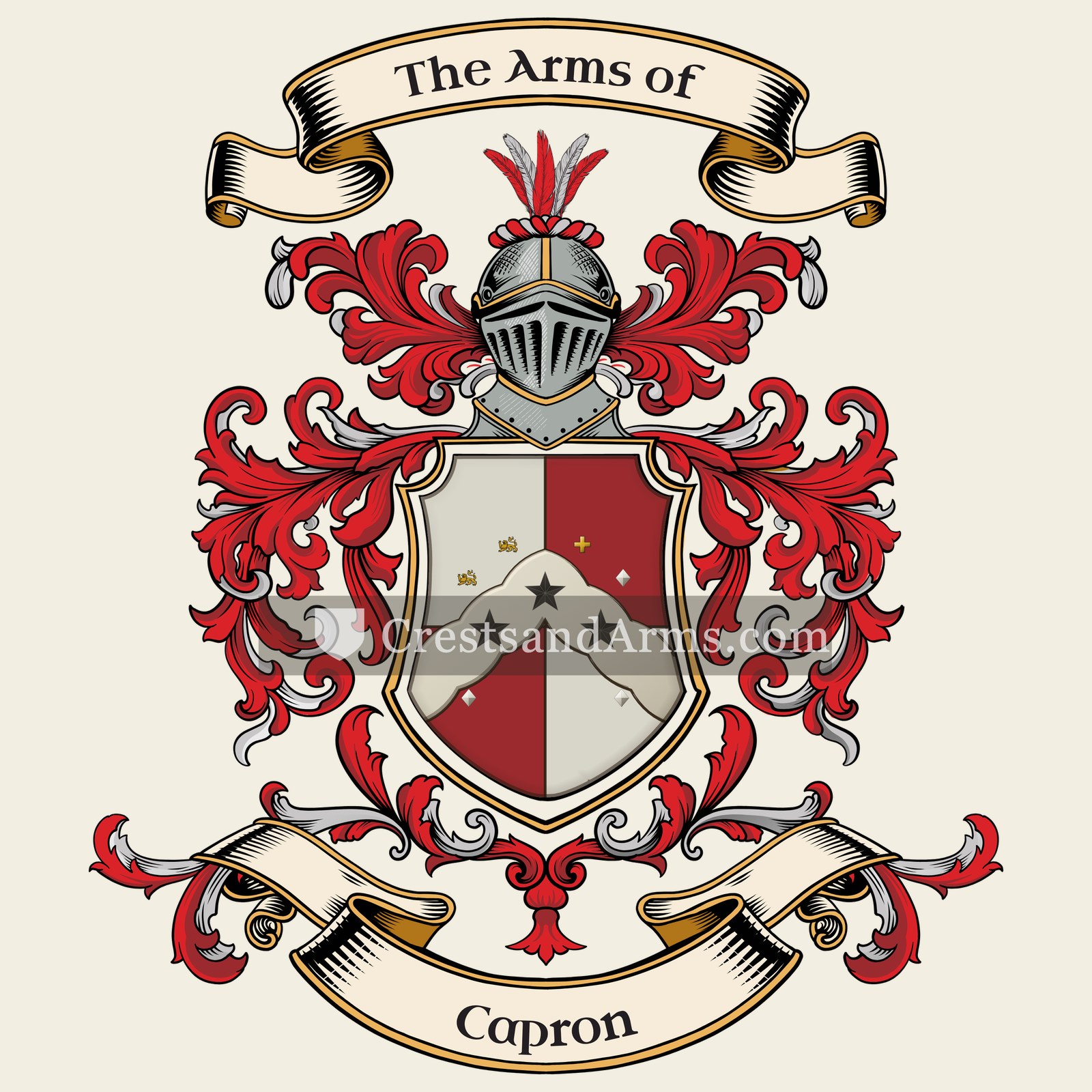
Symbols on this shield
chevronProtection, and faithful service completed
cross symbolChristian faith and service
ermineDignity and rank
lionCourage, strength and royalty
mulletThe third son, and a divine quality from above
lozengeHonour and nobility, and the arms of a woman
Colours
Red (Gules)Means: Military strength
Silver (Argent)Means: Peace and sincerity
ErmineMeans: Dignity
Gold (Or)Means: Generosity
Black (Sable)Means: Constancy
Historical info
Source
Sir Bernard Burke, The General Armory of England, Scotland, Ireland and Wales, London: Harrison & Sons, 1884
Blazon (the actual original written record)
“Quarterly, 1st and 4th, per chev. gu. and az. on a chev. engr. ar. betw. two lions combatant in chief erminois and a cross flory in base or, three mullets sa., for CAPRON; 2nd and 3rd, sa. on a chev. betw. three lozenges ar. each lozenge charged with an erm. spot, another chev. gu., CAPRON (ancient)”
NorthamptonStoke Doyle · Northampton, c. 1620
Digital archive packCoat of arms PNG, gold border print PDF, vector SVG and the certificate of authenticity. Sent to your email in minutes.
Map of England showing where the Capron arms are recorded
The Capron arms were recorded in Northampton, c. 1620.
Northamptonshire was grazing and hunting country in the middle of England, thick with manor houses. Its families were numerous and long-settled, and a settled landed family almost always ended up with arms.
This is where the arms were entered in the register. Families often moved to other parts of the country, so the same name can turn up in more than one region.
The body that granted and recorded arms in England in this period.
James VI and I
Sovereign of the period
James VI and I
1603–1625
Reigning in Belgium when the Capron arms are first recorded.
How Arms Worked in England
English heraldry allowed arms to be shared by all legitimate descendants of the original owner. These symbols were treated as personal property that moved through the generations to all children. While the eldest son kept the original design, other family members could use the same shield without needing to change it or register their own unique versions.
Granting authority
The College of Arms in London has regulated the use of coats of arms throughout England and Wales since 1484.
How they got arms
Families typically obtained their coats of arms through a formal grant from the Crown or by proving their ancient right to them.
Where arms were recorded
All official coats of arms are recorded in the registers kept at the College of Arms, which date back to the fifteenth century.
The family's standing
Recorded among the armigerous families of Northampton.
Origin & History of the Capron Family in England
The surname Capron has roots that stretch back to medieval England, where it likely functioned as a descriptive nickname or an occupational identifier. Etymologists often link the name to the Old French word "caperon," which referred to a specific type of hooded cloak or a cap worn during the Middle Ages. By the early 17th century, the family had established a notable presence in Northampton, a town with a long history of trade and craftsmanship. Records confirm that members of the Capron family were living in this region by 1620, placing them in a bustling hub of the English Midlands during a time of significant social and economic change. As the family settled into local life, they became part of the fabric of Northamptonshire, contributing to the community as the surname gradually passed down through generations.
Capron Meaning & Related Branches
Root word
cappa
A Latin term referring to a hooded cloak or cape.
This name
CapronAn occupational name for a maker or seller of hooded cloaks or capes.
also spelled
Capronn
Capronne
Capronus
Kapron
Caprun
Related arms
Cappronvariant spelling
Documented Sources
J. B. Rietstap, Armorial Général, Gouda: G. B. van Goor Zonen, 1884–87
Archives de l’État à Tournai, Registres paroissiaux de la province de Hainaut, 1737
Dauzat, Albert, Dictionnaire étymologique des noms et prénoms de France, 1951
Leys, O., De familienamen in België, 1970
Digital archive packCoat of arms PNG, gold border print PDF, vector SVG and the certificate of authenticity. Sent to your email in minutes.




 chevronProtection, and faithful service completed
 cross symbolChristian faith and service
 ermineDignity and rank
 lionCourage, strength and royalty
 mulletThe third son, and a divine quality from above
 lozengeHonour and nobility, and the arms of a woman