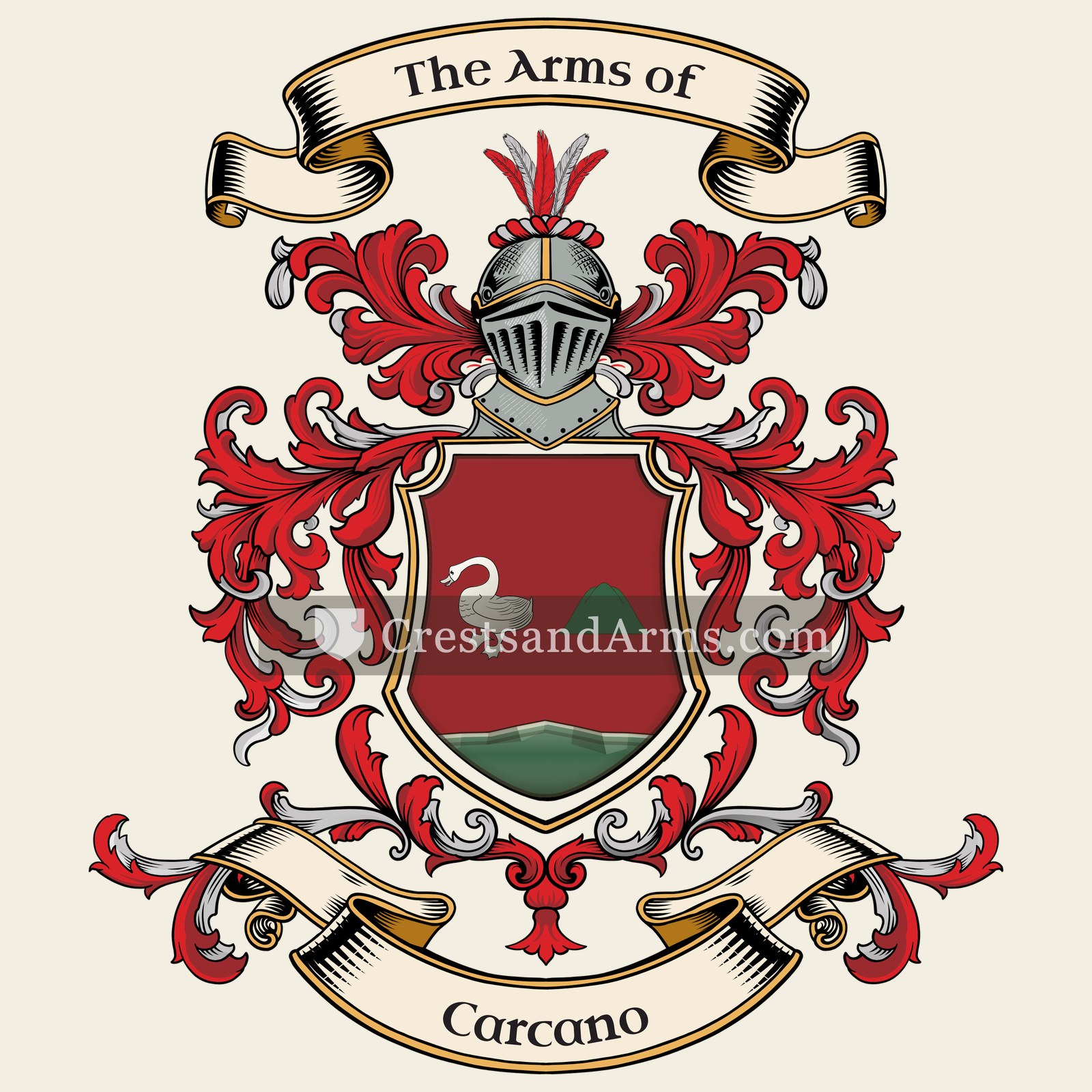
A record of documented arms, meaning and origin, researched for the Carcano family of Italy.
Reg. 4758 · Italian, A–C
Coat of Arms & Family Crest Details
Symbols on this shield
mountThe ground held, and steadfastness upon it
swanGrace, light and the poet's art
Colours
Red (Gules)Means: Military strength
Green (Vert)Means: Hope
Silver (Argent)Means: Peace and sincerity
Historical info
Source
J. B. Rietstap, Armorial Général, Gouda: G. B. van Goor Zonen, 1884–87
Blazon (the actual original written record)
“De gu. à un cygne d'arg., bq. et m. d'or, posé sur un listeł flottant d'arg. inscrit des mots AMOR ET LABOR en lettres de sa.; le tout soutenu d'une colline de trois coupeaux de sin.; le cygne surm. d'une hache d'arg., emm. d'or, posée en fasce, le tranchant en bas. C.: le cygne, iss., surm. de la hache. L. d'arg. et de gu.”
ItalyMilan, c. 1775
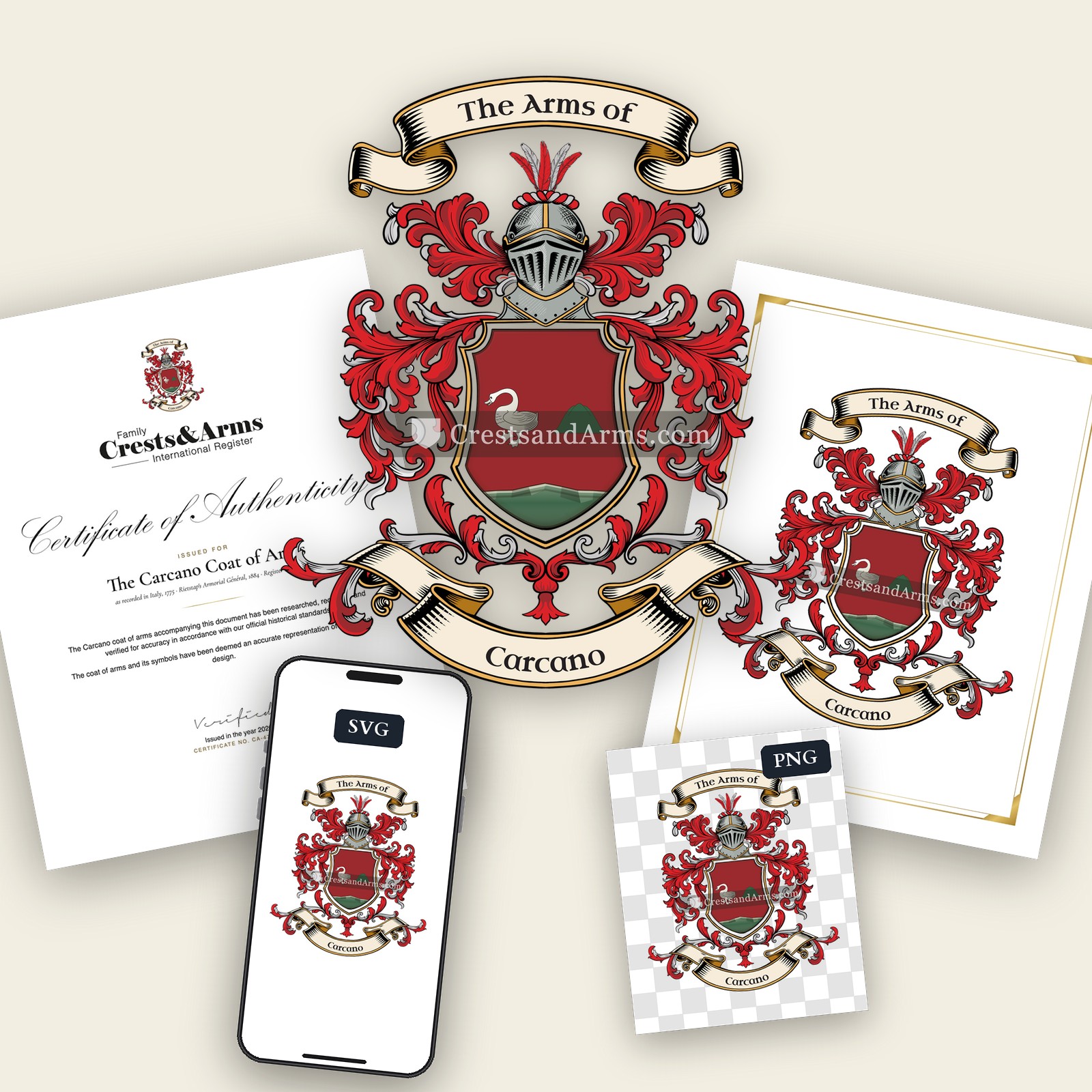
Digital archive packCoat of arms PNG, gold border print PDF, vector SVG and the certificate of authenticity. Sent to your email in minutes.
Map of Italy showing where the Carcano arms are recorded
The Carcano arms were recorded in Milan, c. 1775.
This is where the arms were entered in the register. Families often moved to other parts of the country, so the same name can turn up in more than one region.
The body that granted and recorded arms in Italy in this period.
Alvise Giovanni Mocenigo
Sovereign of the period
Alvise Giovanni Mocenigo
1763–1778
Reigning in Italy when the Carcano arms are first recorded.
How Arms Worked in Italy
In the Italian states, coats of arms were often used by noble families to show their status and history. These symbols were passed down through the generations to all legitimate male descendants. Younger branches of a family usually kept the original design but sometimes added small changes to distinguish their specific line from the main branch.
Granting authority
Various local rulers and city governments controlled the use of coats of arms across the different Italian states.
How they got arms
Families often assumed their own arms or received them as official grants from local lords, popes, or city councils.
Where arms were recorded
Arms were recorded in local city archives or private family books rather than in one single national register.
The family's standing
Recorded among the armigerous families of Italy.
Origin & History of the Carcano Family in Italy
The Carcano family name is deeply rooted in the history of Milan, where members of the lineage were well-established by the late eighteenth century. The name itself is believed to be topographic in origin, likely derived from the local geography or a specific place name within the Lombardy region. During the 1700s, the family was part of the social and economic fabric of Milan, a city that served as a major cultural hub under the influence of the Austrian Empire. As the family grew, they became integrated into the administrative and professional life of the city, reflecting the broader trends of urban development in Northern Italy. By the time records confirm their presence in 1775, the Carcano name was already associated with the civic identity of Milanese society, marking them as a family that contributed to the local community for generations.
Carcano Meaning & Related Branches
Root word
carcare
to clear land or to cultivate soil
This name
Carcanoa topographic name for someone who lived on or worked cleared agricultural land
also spelled
Carcanoe
Carcani
Carcanos
Related arms
Carcanivariant spelling
Documented Sources
J. B. Rietstap, Armorial Général, Gouda: G. B. van Goor Zonen, 1884–87
Bosisio, Alfredo, Storia di Milano, 1978
State Archives of Milan (Archivio di Stato di Milano), Stato Civile della Restaurazione
Digital archive packCoat of arms PNG, gold border print PDF, vector SVG and the certificate of authenticity. Sent to your email in minutes.


 mountThe ground held, and steadfastness upon it
 swanGrace, light and the poet's art
 mountThe ground held, and steadfastness upon it
 swanGrace, light and the poet's art