Map of Italy showing where the Carena arms are recorded
The Carena arms were recorded in Milan, c. 1775.
This is where the arms were entered in the register. Families often moved to other parts of the country, so the same name can turn up in more than one region.
The body that granted and recorded arms in Italy in this period.
Alvise Giovanni Mocenigo
Sovereign of the period
Alvise Giovanni Mocenigo
1763–1778
Reigning in Italy when the Carena arms are first recorded.
How Arms Worked in Italy
In the Italian states, coats of arms were often used by noble families to show their status and history. These symbols were passed down through the generations to all legitimate male descendants. Younger branches of a family usually kept the original design but sometimes added small changes to distinguish their specific line from the main branch.
Granting authority
Various local rulers and city governments controlled the use of coats of arms across the different Italian states.
How they got arms
Families often assumed their own arms or received them as official grants from local lords, popes, or city councils.
Where arms were recorded
Arms were recorded in local city archives or private family books rather than in one single national register.
The family's standing
Recorded among the armigerous families of Italy.
Origin & History of the Carena Family in Italy
The Carena family name is deeply rooted in the historical landscape of northern Italy, particularly within the bustling urban center of Milan. By the late eighteenth century, the family had established a notable presence in the city, appearing in municipal records as early as 1775. The name itself is thought to derive from the Italian word *carena*, which refers to the keel of a ship or the underside of a hull. This linguistic connection suggests that the earliest ancestors of the family may have been involved in maritime trades, boat building, or perhaps lived near major river ports where such terminology was common. As the family settled into the social fabric of Milan, they transitioned from these potential nautical origins into the professional and civic life of a growing industrial city. Their presence in 1775 places them in Milan during a period of significant administrative reform under Austrian rule, marking them as part of the established urban class that helped shape the city’s development during the Enlightenment.
Coat of Arms & Family Crest Details
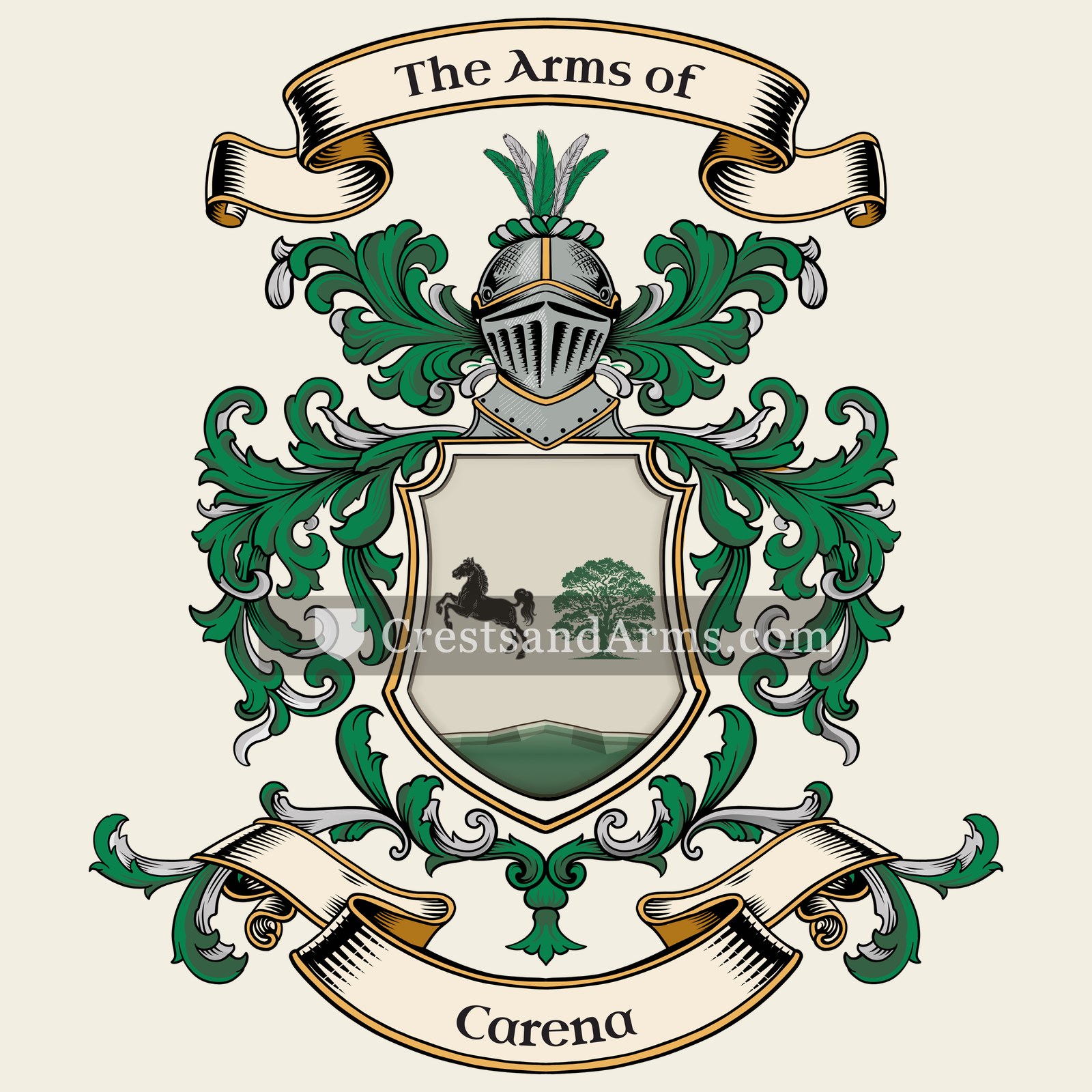
Symbols on this shield
mountThe ground held, and steadfastness upon it
horseReadiness to serve king and country
treeLife, endurance and deep roots
Colours
Silver (Argent)Means: Peace and sincerity
Green (Vert)Means: Hope
Black (Sable)Means: Constancy
Historical info
Source
J. B. Rietstap, Armorial Général, Gouda: G. B. van Goor Zonen, 1884–87
Blazon (the actual original written record)
“D'arg. à un cheval de sa., pass. devant un arbre de sin.; le tout soutenu d'une terrasse de sin. (Carenay.”
Spainc. 1722
Digital archive packCoat of arms PNG, gold border print PDF, vector SVG and the certificate of authenticity. Sent to your email in minutes.
Map of Spain showing where the Carena arms are recorded
The Carena arms were recorded in Spain, c. 1722.
Arms such as these were typically recorded in Castile.
Castile was the heart of Spain and the source of most of its noble families. Land won in the long wars against the Moors was granted out to fighting men, and a man granted land was granted arms along with it.
This is where the arms were entered in the register. Families often moved to other parts of the country, so the same name can turn up in more than one region.
The body that granted and recorded arms in Spain in this period.
Philip V of Spain
Sovereign of the period
Philip V of Spain
1714–1724
Reigning in Italy when the Carena arms are first recorded.
How Arms Worked in Spain
In Spain, a coat of arms was considered a form of property that belonged to the entire family line. These arms were passed down from a father to all his children equally. Younger branches of the family usually kept the original design without needing to add any special marks to distinguish their specific line.
Granting authority
The Cronista Rey de Armas was the official body that regulated and granted coats of arms throughout Spain.
How they got arms
Families often obtained their arms through royal grants or by proving their noble status to the official heraldic authority.
Where arms were recorded
Coats of arms were officially recorded in the registers of the Cronista Rey de Armas starting in 1496.
The family's standing
Recorded among the armigerous families of Spain.
Origin & History of the Carena Family in Spain
The history of the Carena family in Spain is rooted in the rugged landscapes of the Castile region, where the name was firmly established by the early eighteenth century. By 1722, records indicate that family members were active participants in the social and economic life of this central Spanish territory. During this era, Castile was the heart of the Spanish kingdom, and families like the Carenas often lived in small agricultural communities or growing provincial towns. The name likely evolved from local linguistic roots, reflecting the way people identified themselves by their trade, their specific village, or their family lineage. As the family settled into the Castilian countryside, they became part of the local population that helped shape the region through farming, commerce, and community service. These early ancestors lived during a time of transition for Spain, and their presence in the historical record serves as a window into the lives of ordinary families who built the foundation of their name in the Iberian Peninsula.
Carena Meaning & Related Branches
Root word
Carina
Derived from the Latin word for dear, beloved, or precious.
This name
CarenaAn Italian occupational or descriptive surname referring to a beloved person or a keel.
also spelled
Carene
Careni
Carenae
Documented Sources
J. B. Rietstap, Armorial Général, Gouda: G. B. van Goor Zonen, 1884–87
Archivio di Stato di Milano, Stato civile della Restaurazione, Milano
Olivieri, Dante, Dizionario dei cognomi italiani, 1953
De Felice, Emidio, Dizionario dei cognomi italiani, 1978
Digital archive packCoat of arms PNG, gold border print PDF, vector SVG and the certificate of authenticity. Sent to your email in minutes.


 starThe celestial goddess, and nobility
 starThe celestial goddess, and nobility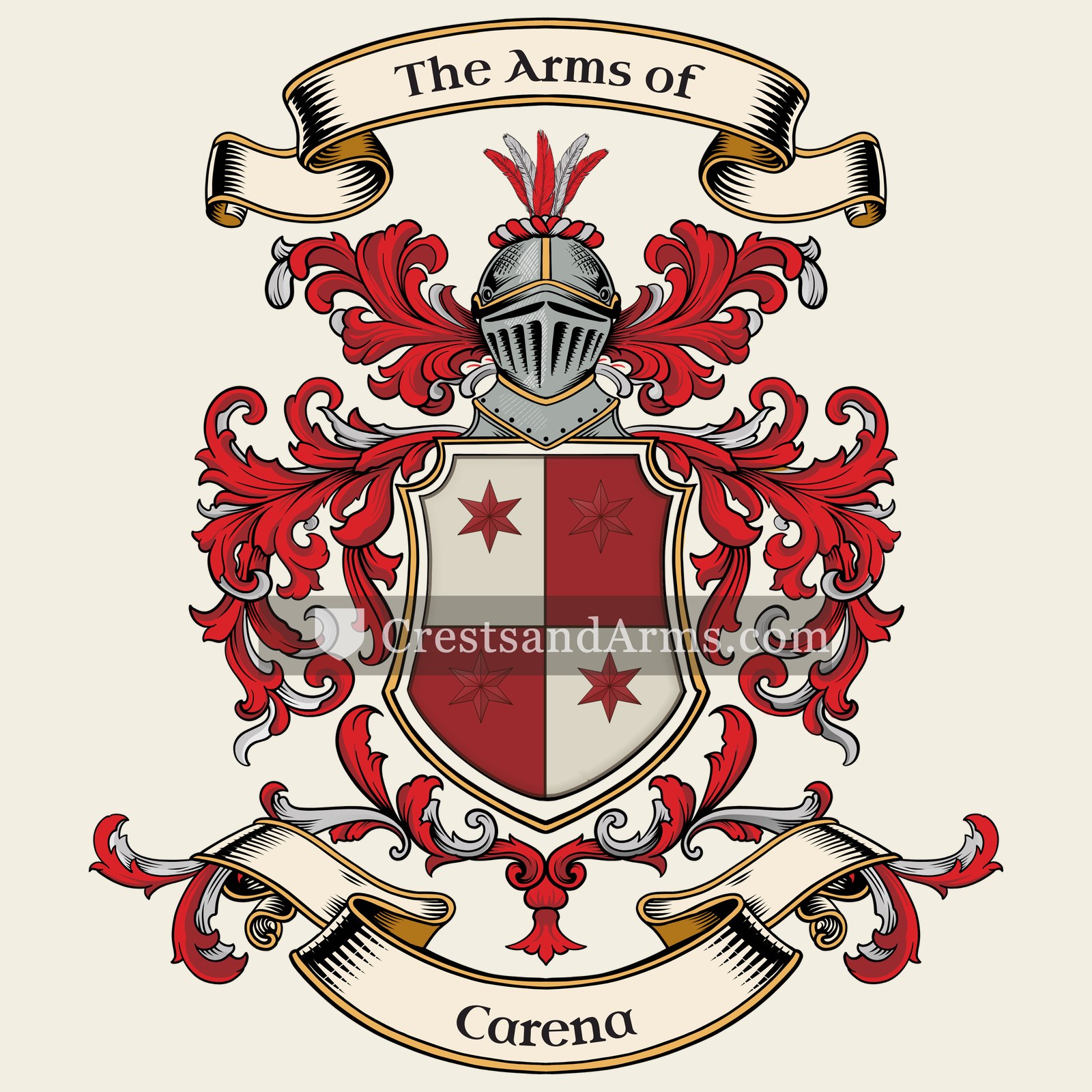


 mountThe ground held, and steadfastness upon it
 horseReadiness to serve king and country
 treeLife, endurance and deep roots